GreenFiber Attic Insulation in Hollywood: A Homeowner’s Guide
GreenFiber cellulose insulation delivers an honest R-value of about 3.2 to 3.8 per inch, which beats fiberglass loose-fill’s typical 2.2 to 2.7, meaning you get more thermal resistance per inch in shallow Hollywood attic bays. It’s made from 85% recycled paper content treated with borate fire retardants that earn it a Class 1 flame spread rating, so the newspapers in your ceiling won’t burn the way you’d expect. If you’d rather not climb into your attic this weekend, call us at (866) 605-6949 for a free estimate.
Most contractors in Los Angeles treat GreenFiber as interchangeable with pink fiberglass loose-fill. It isn’t. The density, the fire chemistry, the sound performance, and the way it settles in old Hollywood homes are all materially different. We install both, along with spray foam systems from Icynene and Demilec, so we don’t have a horse in this race. Here’s what we’ve learned putting GreenFiber into attics from Beachwood Canyon to Little Armenia.
What Exactly Is GreenFiber Cellulose Insulation?
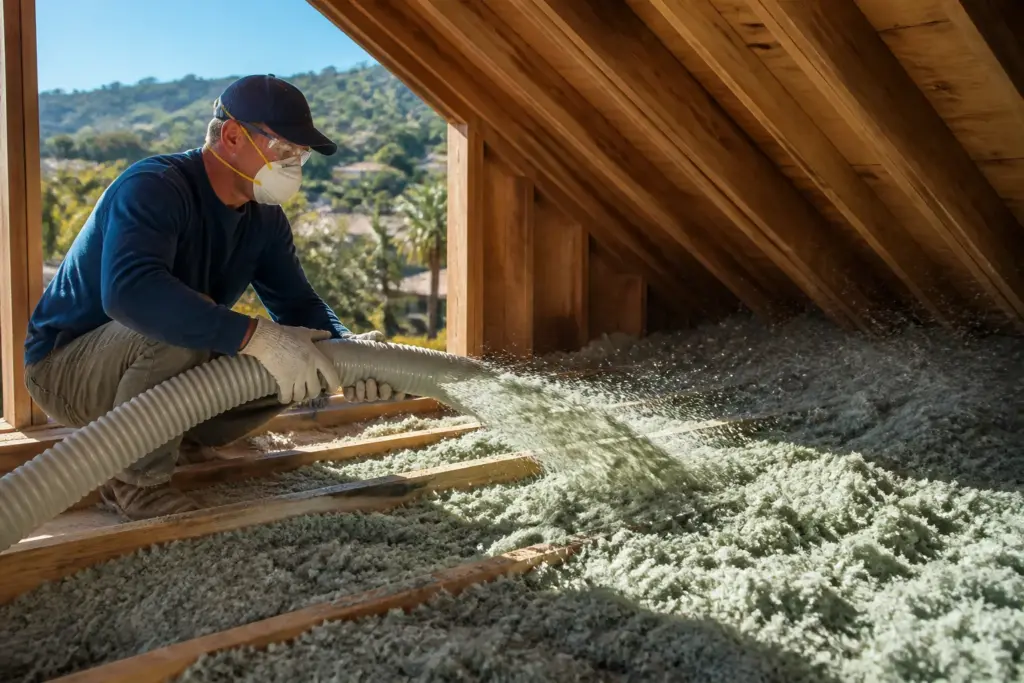
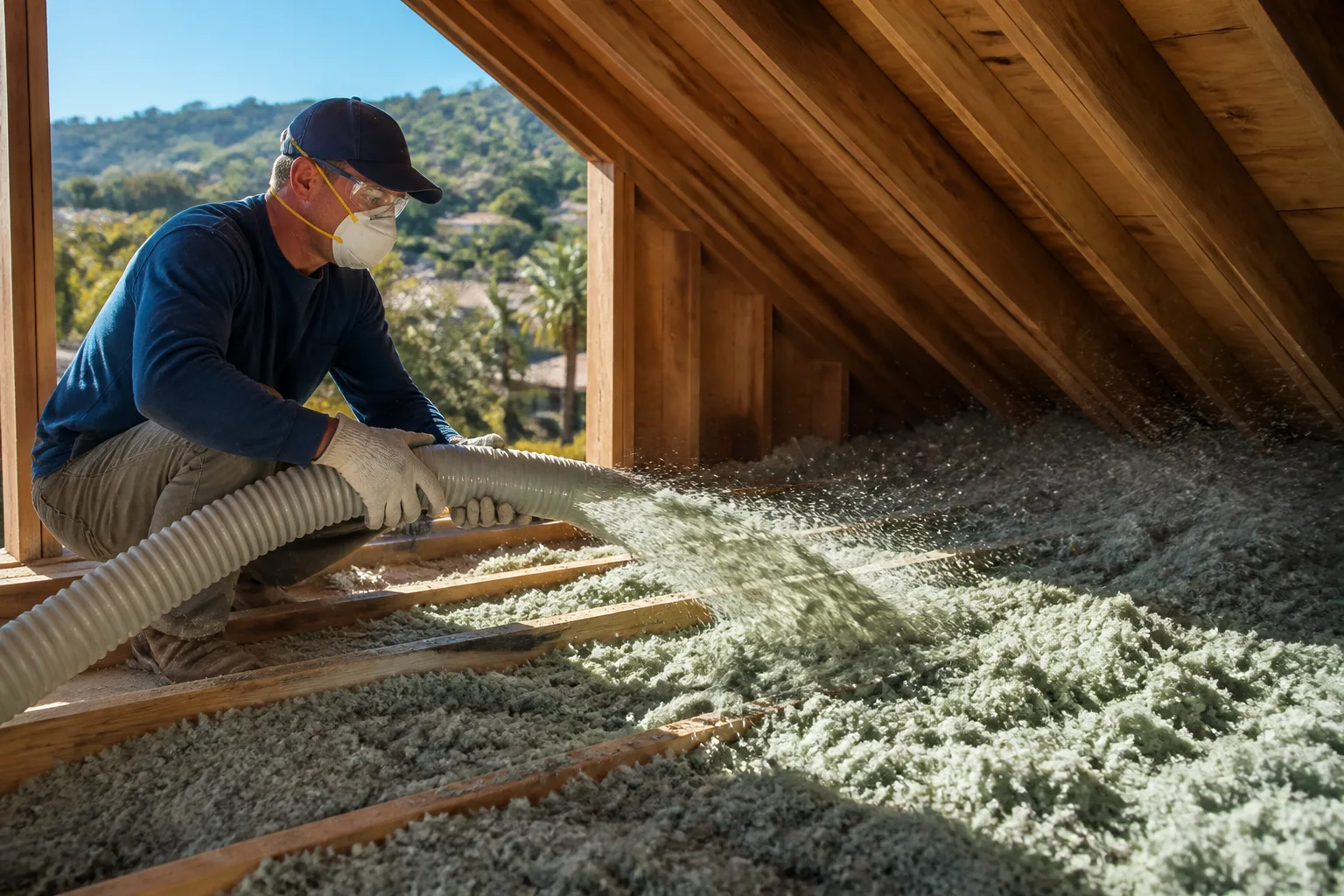
GreenFiber is a blown-in insulation made primarily from recycled newsprint and cardboard. The Hollywood Insulation Co home team regularly installs it in homes where the attic access is tight, the rafter bays are shallow, or the homeowner wants a material with a smaller carbon footprint than fiberglass or foam.
The manufacturing process grinds recycled paper into fine fibers, then applies a borate-based treatment during production. That treatment does two jobs. First, it makes the material resist flame, which is why GreenFiber carries a Class 1 flame spread rating. Second, it discourages mold growth and makes the material unappealing to rodents and insects, which matters in older Hollywood attics where critters find their way in through gable vents and unsealed soffits.
Here’s the part most competitor pages skip: the installed density of GreenFiber runs between 1.5 and 3.5 pounds per cubic foot depending on the application. Loose-fill attic application lands around 1.5 to 2 pounds. Fiberglass loose-fill typically sits closer to 0.5 to 1 pound per cubic foot. That density difference is why cellulose blocks airflow through the insulation itself, which is something fiberglass doesn’t do as effectively. Air that moves through insulation carries heat with it, so the denser the material, the better it resists convective heat loss. In a Hollywood bungalow with a vented attic and old single-pane windows, that difference shows up on your LADWP bill.
Fire Performance: Why Borate Treatment Actually Matters
If you’re reading that GreenFiber is “fire-treated” and wondering whether that’s marketing language, here’s the straight answer: the borate treatment is real chemistry, and it’s the reason cellulose insulation isn’t a fire hazard the way loose paper would be. Untreated cellulose burns readily. Borate-treated cellulose doesn’t support flame spread. In standardized ASTM E84 testing, which measures flame spread and smoke development, borate-treated cellulose earns Class 1 ratings, which is the strictest classification and the same category required for commercial building materials in many applications.
We’ve pulled GreenFiber out of attics in Hollywood homes built in the 1920s and 30s, and when we cut into the material, the treatment is still visibly intact after decades. It doesn’t wear off, and it doesn’t settle out of the material. The borates are applied as a dry powder that adheres to the paper fibers during manufacturing, and they stay put.
That said, talk to any fire marshal and they’ll tell you insulation is only one part of your home’s fire story. If you have old knob-and-tube wiring in your attic, no insulation product on the market makes that safe. Cellulose’s fire performance matters, but it doesn’t replace addressing electrical hazards. We flag that for every homeowner before we start blowing insulation over anything.
Where GreenFiber’s Density Advantage Shows Up in Hollywood
Hollywood’s housing stock is unusual. You’ve got 1920s Spanish bungalows on hillside lots, converted duplexes from the 40s, two-story remodels where someone finished a garage into a primary suite, and now attached ADUs going up in backyards across the flats and up into the foothills. Each scenario creates specific thermal and acoustic challenges, and GreenFiber’s density makes it particularly effective in a few of them.
Sound Attenuation Between Floors
In converted two-story homes, the biggest complaint we hear from Hollywood homeowners is footfall noise and voices bleeding through the floor. Cellulose insulation installed in the floor cavity between stories deadens sound transmission measurably better than low-density fiberglass batt or loose-fill. The same property applies to attached ADUs where a tenant lives directly above a garage or connected to a primary residence. Our Attic Insulation in Hollywood page covers the cavity insulation work in more depth, but for sound purposes, GreenFiber at a dense-pack application is one of the strongest options you can install without going to acoustic panels.
Homes Near Hollywood Boulevard Corridors
If you live within earshot of Hollywood Boulevard, Sunset, Santa Monica Boulevard, or the 101, you know traffic noise can be constant. Insulation isn’t going to eliminate sound coming through single-pane windows, and anyone who tells you otherwise is overselling. But dense-packed cellulose in exterior walls and attic floors does take the edge off much more effectively than fiberglass. Combined with Good windows and air sealing, it makes a meaningful difference.
Shallow Rafter Bays
Many older Hollywood attics have 2×6 or 2×8 ceiling joists, not the 2×10 and 2×12 framing common in newer construction. A 2×6 bay gives you five and a half inches of depth. With GreenFiber’s higher R-value per inch, you can hit R-19 in that bay. With low-density fiberglass, you’re looking at R-13 or less in the same space. For achieving current California Title 24 energy code targets in shallow framing, blown-in cellulose from GreenFiber is genuinely practical where fiberglass falls short.
Moisture and Hollywood’s Climate: The Real Story
The most common sales objection you’ll hear against cellulose is moisture absorption. It’s the thing fiberglass contractors bring up when they hear you’re considering GreenFiber, and we think you should understand the nuance because it’s usually overstated.
Yes, cellulose can absorb moisture. If your roof leaks directly onto the insulation, or if you have a bathroom fan venting into the attic instead of through the roof, GreenFiber will soak up the water and lose R-value. It can also hold moisture near wood framing, which invites rot and mold over time. Those are real risks.
But here’s the Hollywood-specific context: our interior climate is dry. The marine layer that sits over the Westside and occasionally pushes inland doesn’t produce the same sustained humidity that homes in Miami or Houston deal with. A properly vented attic in Hollywood, with intake at the soffits and exhaust at the ridge or gable, will dry out in a day or two after any minor condensation event. The borate treatment in GreenFiber also inhibits mold growth, so even if the material gets damp, the chemistry helps prevent the worst outcome.
The honest bottom line: if your attic is dry and properly vented, moisture isn’t a reason to avoid GreenFiber. If your attic is damp, the problem is the dampness, and you should fix it regardless of what insulation you install. We installed GreenFiber in a Beachwood Canyon attic a few weeks ago where the homeowner had been told by another contractor that cellulose would “rot her house.” We did a moisture reading, found the attic at 9% relative humidity, and went ahead with the install. Her bedroom temperature dropped four degrees on the first hot afternoon. We pulled one out of a garage over in Melrose Hill last week where the roof decking underneath was bone dry after fifteen years of the insulation being in place.
GreenFiber vs. Spray Foam vs. Fiberglass: The Honest Trade-Offs
We install all three because no single material is right for every Hollywood house. Here’s where GreenFiber wins, and where it doesn’t.
Where GreenFiber is the right call:
- Shallow rafter bays where you need maximum R-value per inch
- Attics where you want sound attenuation between floors
- Homes where the homeowner prioritizes recycled content and fewer petrochemicals
- Projects where budget matters more than air sealing performance
Where spray foam outperforms GreenFiber:
- Unvented cathedral ceilings, where air sealing and vapor control are critical
- Attics being converted to living space, where closed-cell foam from Icynene or Demilec creates a moisture and air barrier that cellulose cannot
- Applications where the structure has limited depth and needs the highest R-value possible per inch, since closed-cell foam delivers R-6.5 to R-7 per inch
Where fiberglass makes more sense:
- Attics with existing fiberglass that just needs a top-up, since adding fiberglass over fiberglass avoids texture mismatch
- Very dusty, high-airflow vented attics where cellulose can settle over time and lose its thickness (fiberglass settles too, but it’s lighter and easier to fluff back up)
- Homeowners who are dealing with existing pest issues, since fiberglass is less attractive to pests than cellulose despite the borate treatment
If you’re looking at Spray Foam Insulation in Hollywood, our team can walk you through whether open-cell or closed-cell fits your specific attic configuration. For most traditional vented attic floors in Hollywood homes, though, GreenFiber is often the best balance of thermal performance, cost, and sustainability.
Installed R-Value and What California’s Energy Code Requires
California’s Title 24 energy code requires attic insulation in climate zones like Hollywood’s to hit R-38 at the ceiling in most new construction and major remodels. Existing homes being re-insulated are generally expected to get as close to R-38 as the framing allows. GreenFiber installed at a settled depth of 10 to 12 inches achieves R-38, depending on the exact density. At R-3.7 per inch settled, you need about 10 inches. At R-3.2 per inch, you need closer to 12.
This is where proper installation matters more than the product itself. We’ve walked through plenty of Hollywood attics where someone blew in fiberglass a decade ago, and the material has settled so much that the effective R-value is down to R-19 or less in the middle of the attic. Cellulose settles too, but because it’s denser, it often reaches a stable settled thickness more predictably. Our installers account for settlement during the blow-in process, which is the kind of thing that separates a dedicated insulation contractor from a handyman with a rental blower from the big-box store.
What GreenFiber Costs in Hollywood (Rough Numbers)
We don’t publish a flat price list because every Hollywood attic has different depth, access, and existing material removal requirements. That said, here are the rough ranges we’ve seen in this market over the last year:
| Scope | Typical Range (Hollywood, CA) |
|---|---|
| Blow GreenFiber over existing insulation to R-38 (1,200 sq ft attic) | $1,400 – $2,200 |
| Remove old insulation and blow GreenFiber to R-38 (1,200 sq ft attic) | $2,800 – $4,200 |
| Dense-pack GreenFiber into exterior walls (per square foot of wall) | $2.00 – $3.50 per sq ft |
| Attic air sealing (foam sealing top plates, chases, penetrations) | $600 – $1,400 |
These are starting references, not quotes. Attic access, roof pitch, and existing insulation condition all move the number. If you want an exact price for your home, call (866) 605-6949 and we’ll schedule an on-site estimate at no cost.
The Bottom Line
GreenFiber cellulose isn’t just “the recycled option.” It delivers higher R-value per inch than fiberglass loose-fill, better sound attenuation in multi-story Hollywood homes, and a fire-retardant chemistry that’s genuinely robust. It’s not the best choice for unvented cathedral ceilings, where spray foam from Spray Foam Insulation in Hollywood is the stronger technical answer. And if you’re just topping up an attic that already has fiberglass, adding more fiberglass from Owens Corning or Johns Manville through our Blown In Insulation in Hollywood service may make more sense.
If you’re in Hollywood and want an honest assessment of what your attic needs, we’re happy to come look. Hollywood Insulation Co offers free estimates, and we’ll tell you if GreenFiber is the right product for your house or if something else fits better. Call (866) 605-6949 to schedule a visit.
Frequently Asked Questions
Yes. GreenFiber carries a Class 1 flame spread rating from its borate fire-retardant treatment, and the borates also discourage mold and pests in properly vented Hollywood attics. The material is used successfully in thousands of homes across Southern California each year.
GreenFiber delivers R-3.2 to R-3.8 per installed inch, depending on settled density. That’s meaningfully higher than the R-2.2 to R-2.7 typical of fiberglass loose-fill, which means you can reach R-38 in about 10 to 12 inches of settled depth. Call (866) 605-6949 if you want to know what your current attic is actually providing.
Cellulose settles more than fiberglass during the first few months after installation because it relies on gravity to reach a stable density. A competent installer accounts for this by blowing in additional material so the final settled depth matches the target R-value. If installed correctly, GreenFiber’s settled performance remains stable for decades.
For unvented roof assemblies, such as cathedral ceilings or attics being finished into living space, spray foam from Icynene or Demilec outperforms cellulose because it provides an integral air and moisture barrier. GreenFiber is better suited to vented attic floors where blown-in application is practical and cost-effective. We install both because no single method fits every situation Attic Insulation in Hollywood project. If you’re unsure which applies to your home, call (866) 605-6949 for a free assessment.
Written by the team at Hollywood Insulation Co, serving Hollywood since 2018.
Need Insulation Help?
Call Hollywood Insulation Co — licensed & insured, here with fast after-hours help in Hollywood.
(866) 605-6949