
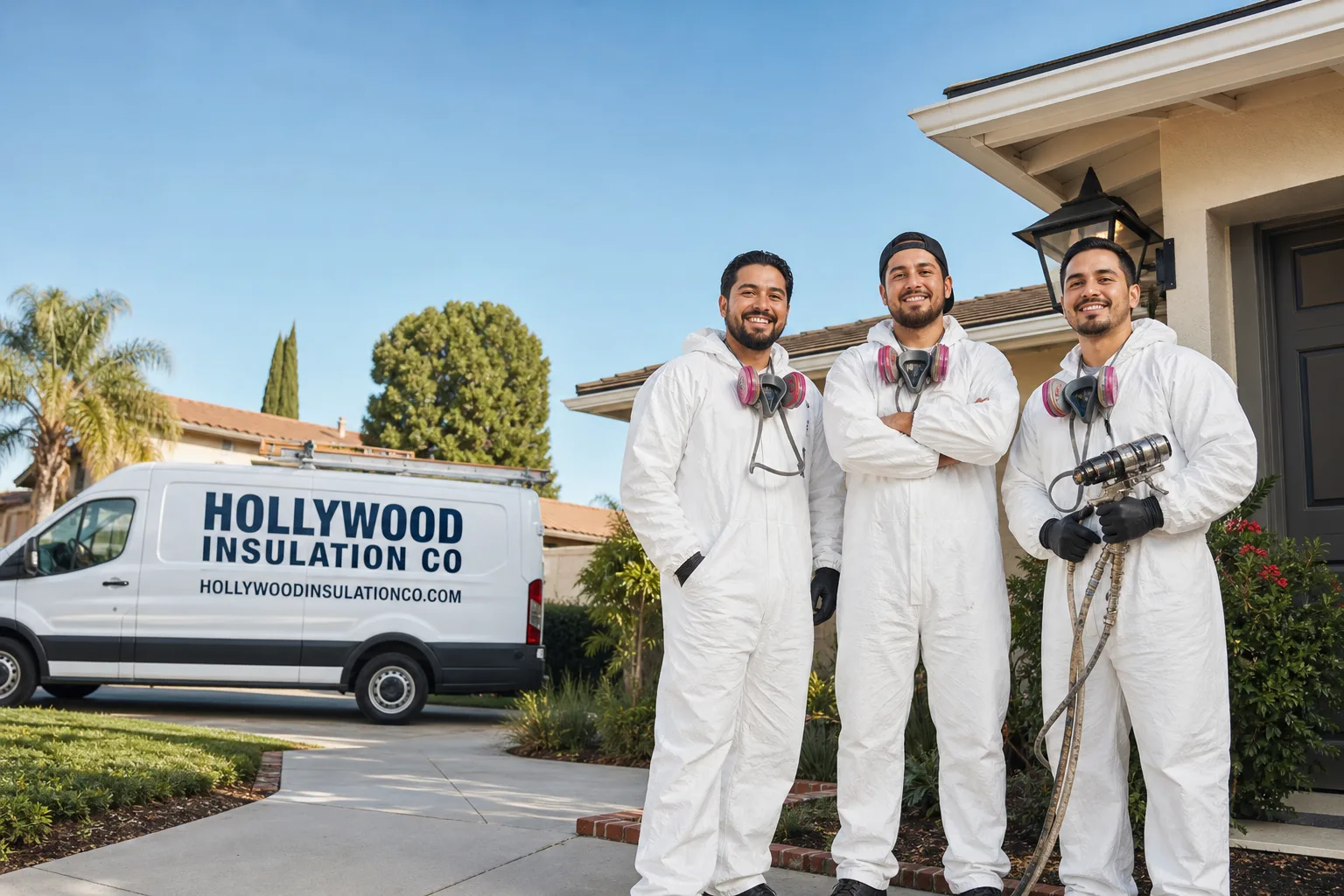
Fast, Reliable Attic Insulation Across Palm Desert
Attic insulation in Palm Desert is a cooling-load problem before it’s anything else. Homes here sit under concrete tile roofs in 110°F+ summer heat, and the attic becomes an oven that drives your air conditioner into overdrive. We install attic insulation, spray foam, and blown-in systems across Palm Desert, Indian Wells, Rancho Mirage, La Quinta, and Thousand Palms, and we start every job by finding where the heat is actually getting in. Noel Camacho leads our Palm Desert crews. Call (866) 605-6949 for a free estimate.
Why Hollywood Insulation Co Is Palm Desert’s Preferred Attic Insulation Company
We’re a dedicated insulation specialist, not a general contractor who happens to carry batts. That distinction matters in Palm Desert, where the failure mode is almost always heat gain through the roof deck and unsealed duct work in a 150°F attic. Our technicians diagnose thermal bypasses, R-value deficiencies, and radiant-barrier failures on Palm Desert homes every week. We know what a 1978 stucco-on-frame house near the Palm Desert Country Club needs, and we know what a 1994 Rancho Mirage-adjacent tract home needs, and they’re usually different. Homeowners here tell us the same thing: the AC runs all afternoon and the back bedrooms still feel warm. That’s an attic problem. We fix it.
Because we carry eight manufacturer brands, we don’t force one product on every Palm Desert house. We match the material to the roof type, the existing insulation, and how the home is built. For a concrete-tile roof with tight scuttle access, we might pull tiles at the ridge and work from the top. For a flat-section roof over a country-club-area rancher, we’ll take a different approach. That’s the work. Call (866) 605-6949 and we’ll send someone who knows Palm Desert attics specifically.
Attic Insulation Built for Palm Desert’s Heat
Most Palm Desert homes built between the 1970s and 1990s left the factory with R-11 or R-19 fiberglass in the attic. After three or four decades of 150°F heat cycling, that material is compressed, dusty, and delivering a fraction of its labeled R-value. We see original batts in country-club-area homes that measure R-6 to R-8 when tested. The fix is rarely just adding more on top. The failed material has to come out, the air leakage pathways have to be sealed, and then the new system goes in. Our Attic Insulation team handles the full sequence in Palm Desert, from removal through air sealing to final R-value verification.
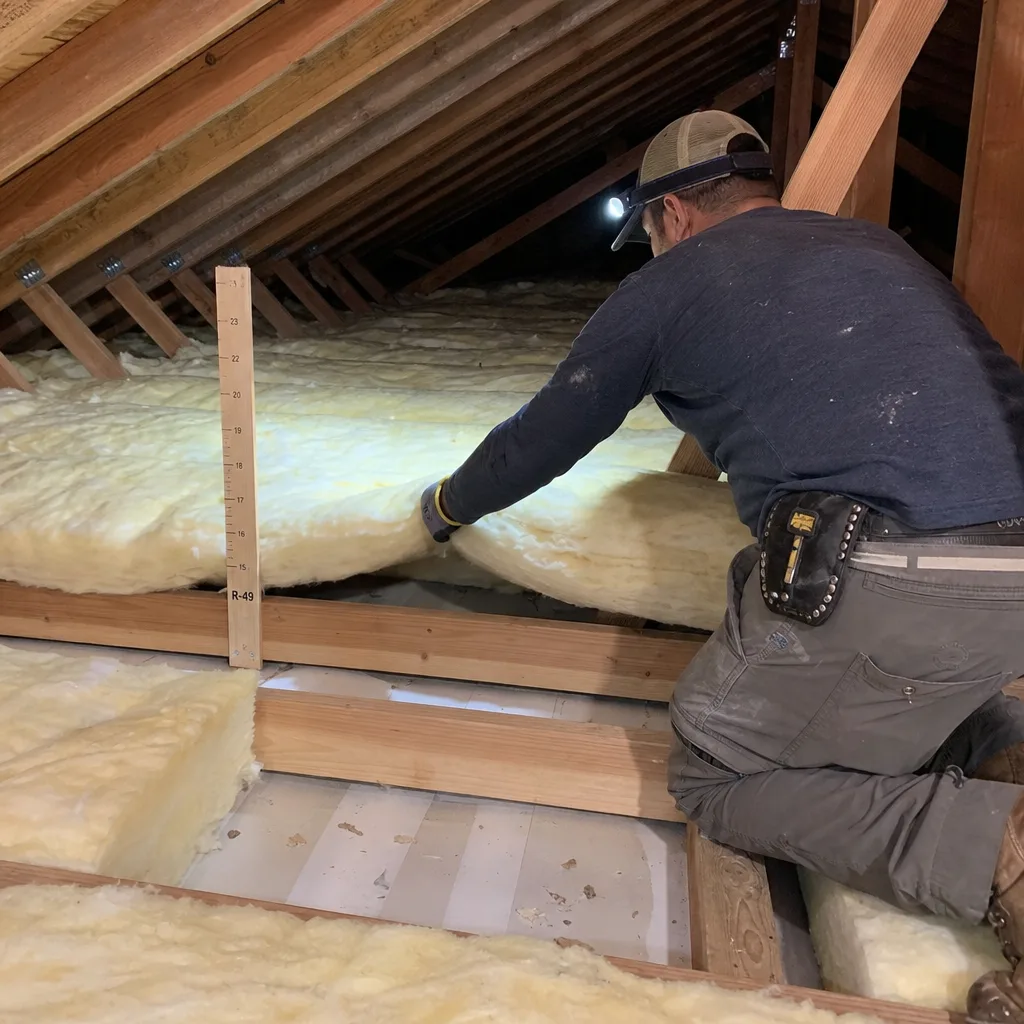
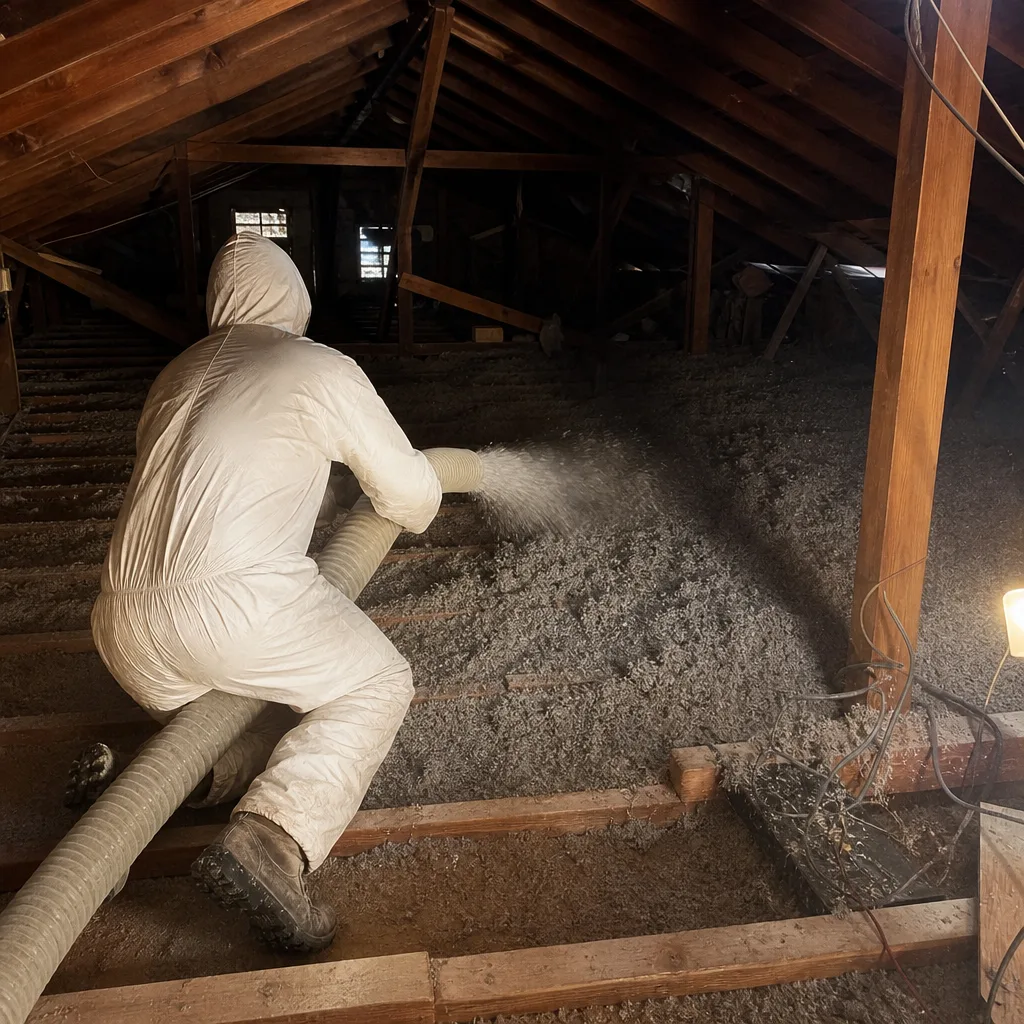
We install three methods under one roof: batt, blown-in, and spray foam. For Palm Desert’s dry heat and concrete tile roofs, we often recommend blown-in fiberglass to R-38 or R-49 with a radiant barrier, because that combination addresses radiant heat gain and convective losses at the same time. But some homes, especially those with HVAC equipment in the attic, benefit more from Icynene open-cell spray foam applied to the roofline. The right answer depends on the house. That’s the point.
Radiant Barrier in Palm Desert
Radiant barrier in Palm Desert is often the single highest-impact upgrade you can make to an older home, because it attacks the dominant heat transfer path: direct radiation from a 140°F-plus roof deck onto the insulation below. In Palm Desert’s country-club-area homes, foil radiant barriers stapled under rafters in the 1970s through 1990s have frequently sagged or torn from decades of 150°F+ heat cycling, which is why Reflectix repair in Palm Desert is something we assess during every attic inspection. We see foil hanging in sheets, detached at the staples, doing nothing. Before adding R-value, that failed foil has to come out, because it creates hot pockets and convective loops that undermine new insulation. A typical radiant barrier installation or replacement in Palm Desert runs $1,800 to $3,600 depending on attic size, access, and whether old foil removal is required.
Radiant Barrier Assessment
We start by checking what’s actually under the rafters. In Palm Desert homes built before about 2000, radiant barrier foil was common as a retrofit, and the quality of the installation varies wildly. Some foil is intact and still doing its job. Much of it isn’t. We’ll tell you the difference before we recommend spending money.
Radiant Barrier Installation and Replacement
When we install new radiant barrier in Palm Desert, we staple it to the underside of the rafters with the reflective side facing the roof deck, maintaining a consistent air gap. The gap is what makes it work. Without it, the foil just conducts heat. We also verify attic ventilation, because a radiant barrier in a poorly vented attic can trap heat and make the problem worse. Call (866) 605-6949 to find out whether your attic needs it.
Attic Cleaning Services in Palm Desert
Attic cleaning services in Palm Desert usually mean more than vacuuming out dust, because the dust here is compounded by decades of degradation from extreme heat. Old fiberglass breaks down. Rodents, birds, and pack rats find their way in through gaps around scuttle holes and roof penetrations, especially in older country-club-area homes with mature landscaping. We remove contaminated material, sanitize the space, and prep the attic for a clean insulation install. A full attic cleaning and contamination removal in Palm Desert typically runs $900 to $1,800 for an average 1,800-square-foot home, before new insulation goes in. The price moves up if there’s extensive rodent damage or if old radiant barrier foil has to be pulled down as part of the job.
Removal of Heat-Degraded Insulation
In a Palm Desert attic that hasn’t been touched since the 1980s, the insulation is often matted, compressed, and useless. We remove it completely before installing new material. Leaving degraded batts in place and blowing over them is a shortcut that compromises the new system.
Sealing Before Insulating
Air sealing is the unglamorous step that separates a good attic insulation job from a great one in Palm Desert. We seal scuttle openings, duct boots, air handler platforms, ceiling penetrations, and wire penetrations before insulating. In a 150°F attic, even small leaks pull conditioned air out of the house and force your AC to work harder. The air sealing step is included in our insulation quotes, not sold as a separate add-on.
What happens when you call
- 1
A real person answersNo phone trees — you reach a local pro.
- 2
You get an upfront price rangeHonest numbers before anyone is dispatched.
- 3
A background-checked tech heads outLicensed & insured, dispatched right away.
- 4
You approve before work beginsNothing starts until you say go.
Trusted Brands We Service in Palm Desert
We carry eight manufacturer brands so the recommendation is based on your Palm Desert home, not on whatever’s on the truck. For most blown-in applications in Palm Desert we specify Owens Corning fiberglass, which holds its loft and R-value through extreme heat cycles. For air sealing plus insulation in one step, we use Icynene and Demilec spray foam systems, both open-cell and closed-cell. For homeowners who want a recycled-content option, GreenFiber cellulose is available and performs well in standard vented attics. We keep Palm Desert-specific inventory staged locally, so common jobs don’t wait on a warehouse delivery. You won’t get a sales pitch for one brand. You’ll get a recommendation that fits the roof you have.
Common Attic Insulation Problems We See in Palm Desert Homes
- Compressed original batts in 1970s – 90s homes. R-11 and R-19 fiberglass installed in the Reagan and Bush years has been cooked by decades of 150°F attic temperatures. We routinely test it at R-6 to R-8 in Palm Desert country-club-area homes. It looks like insulation. It isn’t doing the job.
- Sagging or torn radiant-barrier foil. Under-rafter foil loses tension as staples fail and the material degrades from heat cycling. Torn foil creates hot pockets that undermine everything else in the attic. It has to come out before new insulation goes in.
- Unsealed duct boots and air handler platforms. In most 1980s Palm Desert homes, the HVAC air handler and ducts sit in the hottest part of the house. Unsealed boots leak cooled air into the attic before it reaches registers. We seal these as part of every insulation install in Palm Desert.
- Poor scuttle access. Many older Palm Desert homes have a small scuttle hole in a hallway closet as the only attic access. We work through tight scuttle access, but for concrete tile roofs we can also pull tiles at the ridge and work from the top. Both approaches are in our normal playbook here.
Pricing for Attic Insulation in Palm Desert, CA
A typical full attic insulation replacement in Palm Desert runs $3,200 to $6,500 for a 1,500 to 2,200-square-foot single-story home, including removal of old material, air sealing, and new blown-in insulation to R-38. A top-up over existing insulation that’s in decent shape runs $1,400 to $2,600. Radiant barrier installation runs $1,800 to $3,600 depending on attic size and whether failed foil removal is needed. Attic cleaning runs $900 to $1,800. What moves the price in Palm Desert specifically: concrete tile removal and replacement when we work from the top, failed foil removal, duct sealing scope, and the condition of the existing insulation. Every quote is free and itemized. Call (866) 605-6949 and we’ll give you real numbers for your house, not a range pulled from a website.
We Also Serve Cities Near Palm Desert
Our Palm Desert crews cover the full Coachella Valley corridor. We work in Palm Desert daily, and also serve Indian Wells, Rancho Mirage, La Quinta, and Thousand Palms with the same crew and the same equipment. If you’re a few minutes down the 111 in Indian Wells or over in Rancho Mirage, we can schedule you on the same routes. Call (866) 605-6949 to book.
Serving Palm Desert, CA — Our Local Coverage Area
We’re based in the Palm Desert area and know this community well. Use the map below to see our service coverage — if you’re nearby, we can almost certainly help.
FAQs About Attic Insulation in Palm Desert
Because Palm Desert’s summer attic temperatures routinely exceed 150°F, and your attic insulation is the only thing standing between that heat and your living space. In coastal California, insulation is mostly about keeping heat in. Here, it’s about keeping heat out. A poorly insulated Palm Desert attic forces your AC to run longer, shortens the life of the equipment, and leaves you with hot bedrooms even when the thermostat says 74.
Have it assessed, and don’t assume it’s working. Foil installed decades ago has often sagged, torn, or detached from the staples after thousands of 150°F heat cycles. Failed foil creates hot pockets that undermine new insulation. We include a radiant barrier assessment with every Palm Desert attic inspection. Call (866) 605-6949 and we’ll take a look.
Yes. Many Palm Desert homes have tight scuttle access and concrete tile roofs. We regularly pull tiles at the ridge and work insulation through the attic from the top. The tiles are removed carefully and reset when the job is done. This is standard practice for our Palm Desert crews.
We schedule that work for early morning when attic temperatures are lowest, and we work in short cycles with proper hydration and ventilation. Sealing duct boots and air handler platforms is part of our standard insulation scope in Palm Desert, not a separate charge. The work gets done correctly, even in summer, just on a schedule that respects the temps.
R-38 is the minimum we recommend for a vented attic in Palm Desert, and R-49 is worth considering for larger single-story homes where the attic footprint is huge. The R-value matters less than the total system: sealed ducts, working radiant barrier, proper ventilation, and clean installation. An R-49 attic with leaky ducts still drives high bills. Call (866) 605-6949 for a free evaluation of your house.
We work across all Palm Desert ZIP codes, including 92211, 92255, 92260, and 92261, and we know the housing stock in each one. If your attic hasn’t been touched since the home was built, it’s time. Call (866) 605-6949 for a free estimate today.
Written by Noel Camacho, Owner at Hollywood Insulation Co, serving Palm Desert and the Coachella Valley.