Fast, Reliable Attic Insulation Across Rolling Hills Estates
Attic insulation in Rolling Hills Estates isn’t a one-size-fits-all job. Homes here sit right on the Palos Verdes Peninsula, where the marine layer rolls in most mornings and hangs around until early afternoon. That means moisture control matters as much as R-value. Hollywood Insulation Co has spent years working in rolling hills estates attics, and we know exactly what coastal humidity does to batt insulation, roof sheathing, and ventilation systems. We respond fast to Rolling Hills Estates, typically same-day or next-day for assessments. Call (866) 605-6949 and we’ll get someone out to look at your attic.
Why Hollywood Insulation Co Is Rolling Hills Estates’s Preferred Attic Insulation Company
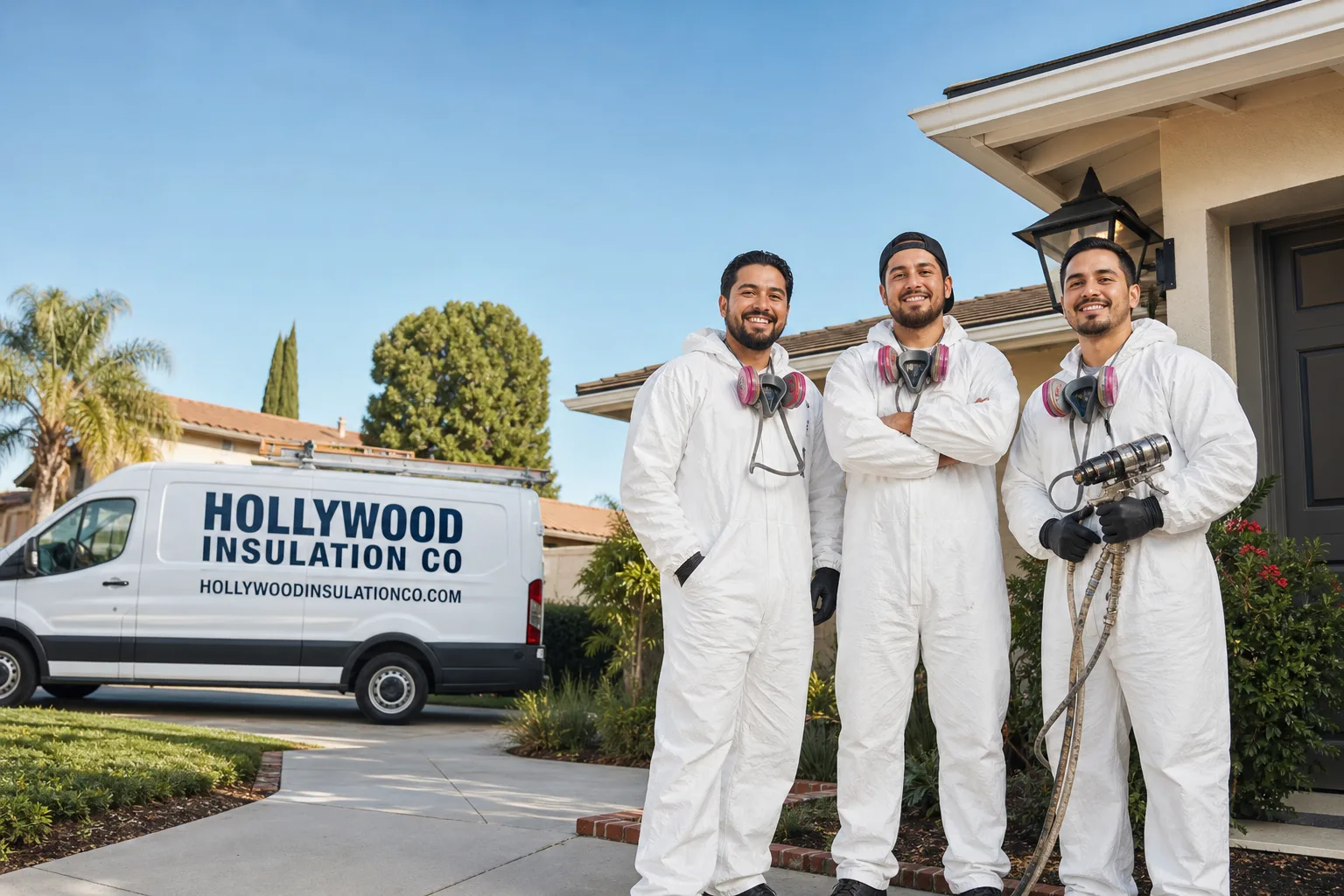
We’re insulation specialists. That’s the whole trade. Every technician on our team works in attics day in and day out, diagnosing thermal bypasses, air leakage, and R-value deficiencies. When a Rolling Hills Estates homeowner calls us, they’re not getting a general contractor who also happens to do insulation. They’re getting someone who knows why a 1960s hillside home on a canyon edge develops condensation on the underside of roof sheathing in June. That depth of local knowledge shows up in every project we complete across Rolling Hills Estates.
Our reputation in Rolling Hills Estates is built on honest material recommendations. We carry eight manufacturer brands across fiberglass, mineral wool, spray foam, and cellulose, so we’re never forcing one product onto a home that needs something different. Homeowners in the gated estates off Crest Road and the mid-century ranch neighborhoods around Monte Malaga have called us back for multiple projects, and word travels fast in a city this size. Response time to Rolling Hills Estates is something we take seriously. If you call before noon, we can usually get a technician to your property that afternoon.
Attic Ventilation in Rolling Hills Estates
Attic Ventilation in Rolling Hills Estates solves a problem that inland South Bay cities barely deal with: marine-layer condensation. When cool, damp air from the coast gets trapped in a poorly vented attic, it condenses on cold roof sheathing. Over time, that moisture soaks into batt insulation, rusts fasteners, and creates the conditions for mold in rafter bays. Proper ventilation keeps air moving so that moisture never gets a chance to settle. For Rolling Hills Estates homes, especially those on hillsides or canyon edges, ventilation is often the single most important upgrade you can make before adding more insulation.
Ridge and soffit vent retrofits
Most 1950s to 1970s Rolling Hills Estates homes were built with minimal venting. Adding ridge vents paired with properly sized soffit vents creates continuous airflow from bottom to top. We inspect existing vent screens too, because salt air corrodes them faster than people expect. A typical attic ventilation retrofit in Rolling Hills Estates runs $850 to $2,200 depending on roofline length and the number of existing vents.
Powered and solar attic fans
For canyon-edge homes where natural airflow is weak, a solar-powered attic fan can make a real difference. These units pull moist air out during the hottest part of the day. In Rolling Hills Estates, where the marine layer often lingers until early afternoon, a solar fan with a built-in humidistat works well. Expect to pay $900 to $1,800 installed.
Radiant Barrier in Rolling Hills Estates
Radiant Barrier in Rolling Hills Estates serves a different purpose than what you’d expect in a hot inland climate. Here, it’s less about blocking brutal summer heat and more about stabilizing attic temperatures and reducing condensation cycles. A radiant barrier stapled to the underside of roof rafters reflects radiant heat away from the attic floor. In Rolling Hills Estates, where cool coastal temps reduce cooling-driven insulation demand, a radiant barrier still helps by keeping the attic temperature more consistent. That consistency reduces the expansion and contraction that contributes to moisture problems in older roof assemblies. For hillside homes with vaulted ceilings and exposed rafters, a radiant barrier is often paired with ventilation upgrades. Radiant barrier installation in Rolling Hills Estates typically runs $1,200 to $2,800 depending on attic square footage and accessibility.
Foil-faced roof sheathing upgrade
If you’re re-roofing, we can coordinate with your roofer to install foil-faced sheathing instead of standard OSB. This bakes the radiant barrier into the roof deck itself. For Peninsula homes where re-roofing happens every 20 to 25 years due to salt air and wind exposure, it’s a smart timing play.
Attic floor radiant barrier for open-beam ceilings
Homes with open-beam ceilings and exposed rafters can’t take a standard rafter-mounted barrier. In those cases, we lay a radiant barrier across the attic floor above the insulation. It still cuts radiant heat gain into the living space, and it never touches the rafters. This approach works well in the custom hillside homes around Rolling Hills Estates.
Trusted Brands We Service in Rolling Hills Estates
We install Rockwool mineral wool, GreenFiber recycled cellulose, Icynene open-cell spray foam, and Demilec closed-cell spray foam across Rolling Hills Estates. Each material has a different strength. Rockwool handles moisture without losing R-value and adds real fire resistance. GreenFiber is the choice for homeowners who want recycled-content material. Icynene open-cell foam air-seals the attic while letting the assembly dry. Demilec closed-cell foam adds structural strength and a vapor barrier in one pass. For Rolling Hills Estates customers, that range matters. Coastal conditions punish the wrong material fast. We keep our most-used products stocked locally and can get uncommon products to your job within days, not weeks.
Common Attic Insulation Problems We See in Rolling Hills Estates Homes
- Damp, compressed batt insulation in vaulted ceilings. In Rolling Hills Estates’ hillside and canyon-edge homes, the marine layer drives moisture to condense on the underside of roof sheathing, so techs routinely find saturated batt insulation and mold-prone rafter bays, a condition that inland South Bay cities like Torrance and Gardena rarely see. Wet batts lose most of their R-value and need to be pulled out, not topped off.
- Settled 1950s-1970s fiberglass. Original insulation in mid-century ranch homes breaks down over decades. It settles unevenly, leaving gaps at eaves and around exposed beams. Marine-layer moisture accelerates the deterioration. We see this constantly in homes built before 1980 across Rolling Hills Estates.
- Thermal bridging at exposed rafters and beams. Vaulted, open-beam ceilings look great but create hard-to-insulate cavities. Wood rafters conduct heat and cold directly through the roof assembly. In damp coastal air, that thermal bridging pulls condensation right onto the wood. Fixing it requires careful cavity-filling and vapor management, not just more insulation.
- Rusted fasteners and corroded vent screens. Salt air from the Pacific works its way into attics, corroding the metal screens on gable vents and ridge vents. Once screens fail, pests get in and airflow drops. On hillside homes in Rolling Hills Estates, we replace these with corrosion-resistant materials during insulation work.
Pricing for Attic Insulation in Rolling Hills Estates, CA
Attic insulation pricing in Rolling Hills Estates depends on material, attic size, and whether old insulation needs removal first. A blown-in GreenFiber cellulose top-up over existing insulation in a standard 1,500-square-foot Rolling Hills Estates ranch typically runs $1,400 to $2,300. Full attic batt insulation replacement with Rockwool Comfortbatt in the same footprint lands between $3,200 and $5,500. Spray foam is the premium option: open-cell Icynene runs $3.50 to $5.00 per board foot installed, while closed-cell Demilec runs $5.00 to $7.50 per board foot. Attic ventilation retrofits run $850 to $2,200. Radiant barrier runs $1,200 to $2,800. Old insulation removal, when needed, adds $1.50 to $2.50 per square foot. Call (866) 605-6949 for a free estimate. We’ll give you exact numbers for your home, not a generic brochure price.
We Also Serve Cities Near Rolling Hills Estates
Our team works across the South Bay and the Palos Verdes Peninsula. Beyond Rolling Hills Estates, we regularly handle Attic Insulation projects in Manhattan Beach, Torrance, Lomita, and Palos Verdes Estates. If you’re nearby and dealing with a damp attic or poor insulation, give us a call. More about our work serving this area is on our Rolling Hills Estates page.
Key Takeaways for Rolling Hills Estates Homeowners
- Moisture control beats R-value here. The marine layer condenses on cold sheathing in hillside homes, and no amount of insulation fixes trapped moisture.
- Ventilation comes first. Before adding insulation, make sure air moves through the attic. Vented attics with corroded screens need attention.
- Material choice matters. Rockwool, GreenFiber, Icynene, and Demilec each handle coastal damp differently. We match the material to your home’s actual conditions.
- Old batts in mid-century Rolling Hills Estates homes are usually done. Settled, damp fiberglass from the 1960s is not something you top off.
Serving Rolling Hills Estates, CA — Our Local Coverage Area
We’re based in the Rolling Hills Estates area and know this community well. Use the map below to see our service coverage — if you’re nearby, we can almost certainly help.
FAQs About Attic Insulation in Rolling Hills Estates
Because the marine layer pushes damp air into attics nearly every morning, and that moisture condenses on cold roof sheathing. In Rolling Hills Estates, a hillside home with R-38 fiberglass and no vapor management will still develop damp batts and mold-prone rafter bays. We prioritize vapor-permeable assemblies, proper ventilation, and materials like Rockwool that hold their R-value when damp. Call (866) 605-6949 to talk through your attic’s specific conditions.
We treat those as custom jobs. On a mid-century ranch in the Monte Malaga neighborhood, we opened a vaulted ceiling and found the original R-7 fiberglass batts soaked from years of condensation on the cold sheathing. Our crew removed the wet batts, treated the mold-prone rafter bays, and installed Rockwool Comfortbatt with a continuous vapor-permeable air barrier, then added two low-profile vented skylights to improve cross-ventilation and keep the assembly dry. For hard-to-reach cavities, we use dense-pack cellulose or spray foam that conforms to irregular shapes. Call us for a site assessment; every hillside home here is different.
Look for damp spots on ceilings, musty odors in upstairs rooms, visible mold on rafters or sheathing, and insulation that looks flat or matted down. In Rolling Hills Estates, we also see rusted nail heads poking through roof sheathing and corroded vent screens as early warnings. If you can see condensation on the underside of the roof deck on a foggy morning, your assembly is not drying. Call (866) 605-6949 and we’ll inspect it.
Yes, but ventilation alone won’t stop corrosion. Salt air still gets into the attic regardless of airflow. What ventilation does is keep humidity lower, which slows the corrosion rate on fasteners, vent screens, and any exposed metal. We pair ventilation retrofits with corrosion-resistant materials, galvanized or coated fasteners, and stainless or aluminum vent screens. In Rolling Hills Estates, this is standard practice, not an upgrade. Call us for a ventilation inspection and we’ll show you what’s failing.
We lean on Rockwool Comfortbatt for its moisture resistance and fire rating, GreenFiber cellulose for its recycled content and dense-pack performance, and Icynene open-cell foam for air sealing that still lets the assembly dry. Demilec closed-cell foam is the right call when you need a vapor barrier and structural strength in one. Every recommendation is based on the specific home’s exposure, roofline, and existing assembly. For an exact recommendation for your Rolling Hills Estates home, call (866) 605-6949 for a free estimate.
If your Rolling Hills Estates attic is damp, under-insulated, or just not keeping your home comfortable, call Hollywood Insulation Co at (866) 605-6949. We’ll come out, inspect the attic, and tell you exactly what’s going on and what it costs to fix. No pressure, no generic solutions. Just an honest read on your home from an insulation specialist.
Written by Noel Camacho, Owner at Hollywood Insulation Co, serving Rolling Hills Estates and the Palos Verdes Peninsula.