
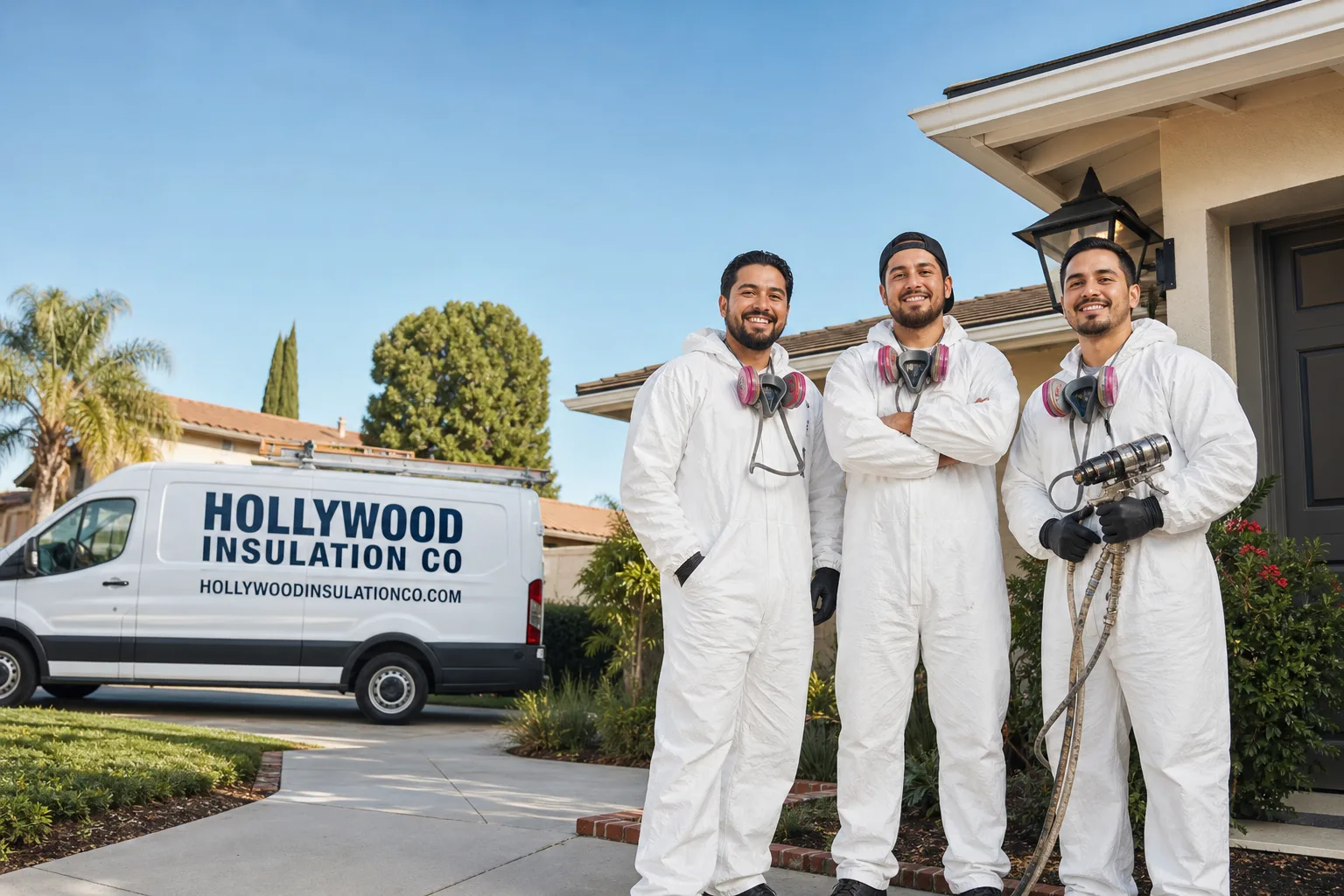
Spray Foam Insulation That Handles Avocado Heights Heat and Older Homes
Spray foam insulation in Avocado Heights solves the two biggest problems local homeowners face: summer heat that turns unconditioned spaces into ovens, and postwar construction that was never built with energy efficiency in mind. Most homes here date from the 1950s through the 1970s, with original 2×4 walls, minimal attic insulation, and detached structures that were never meant to be sealed. If you’re dealing with a hot second floor, a garage that cooks in the afternoon, or a tack room you’re trying to use as a guest space, closed-cell or open-cell foam can change how that space works. Call us at (866) 605-6949 for a free estimate, and we’ll come out to Avocado Heights and look at what you actually have.
Key takeaways:
- Hollywood Insulation Co specializes in spray foam for older Avocado Heights homes and detached structures, not just new construction.
- We install both open-cell and closed-cell systems from Icynene and Demilec, so the recommendation matches your building, not whatever’s on the truck.
- Most Avocado Heights spray foam jobs focus on garages, tack rooms, additions, and attic roof decks that trap heat or leak air.
- Closed-cell foam is the right call where fire resistance, moisture control, or structural rigidity matter – important in a valley with Santa Ana wind season.
- Our crews know the 91746 housing stock and the horse-lot lots around the San Gabriel Valley. We see the same retrofit problems week after week.
See how we approach spray foam work across the region on our Spray Foam Insulation page, or keep reading for what’s specific to serving Avocado Heights.
Why Avocado Heights Calls Hollywood Insulation Co for Spray Foam
The spray foam jobs we do in Avocado Heights rarely start the way a new-construction project does. Instead, they start with a homeowner who’s lived in a 1960s ranch for years, who’s tired of one bedroom that never cools down, or who added a window unit to a tack room and still can’t keep it under 90 degrees on a July afternoon. That’s where our crew comes in. We work in Avocado Heights regularly, from the streets off Valley Boulevard to the larger lots toward the eastern edge of 91746 where the horse properties thin out. Our technicians know these homes: wood-frame ranches, original 2×4 walls, vented attics, and outbuildings that predate any building energy code.
Led by Noel Camacho, our insulation crew is a specialist crew. We’re not a general contractor who happens to have a spray foam rig in the yard. Every tech who arrives in Avocado Heights spends their weeks diagnosing thermal bypasses, air leaks, and R-value gaps in existing buildings. That’s the whole job. And because we handle spray foam, blown-in, and batt insulation all under one roof, we can honestly tell you when spray foam isn’t the best fit for a given Avocado Heights structure, and show you the alternative. It happens. Not every 2×4 cavity on a horse-lot outbuilding needs closed-cell foam. But when it does, we install Icynene and Demilec systems properly.
Avocado Heights homeowners call us because we answer the phone, we show up when we say we will, and we quote the job based on what we find, not on a one-size-fits-all square-foot price. We’ve insulated detached garages that were 110 degrees inside, tack rooms that owners hoped to turn into guest quarters, and ranch houses where the attic had little more than a dusting of old fiberglass. That range of local experience matters. It means we already know what a 1950s roof deck looks like, how the framing runs, and where the air is actually getting in.
How Much Does Spray Foam Insulation Cost in Avocado Heights?
In Avocado Heights, a typical spray foam project runs anywhere from $1,800 to $6,500 depending on the structure and the foam type. Here’s the honest breakdown. A detached two-car garage with open-cell foam on the ceiling and walls usually lands between $2,200 and $3,800. A closed-cell job on the same garage, which adds more R-value per inch and acts as a vapor barrier, runs closer to $3,500 to $5,500. Roof deck spray foam on a 1,200-square-foot ranch attic sits in the $4,000 to $6,500 range. Tack rooms and smaller outbuildings on Avocado Heights horse lots are the most variable, because the framing and access differ so much: expect $1,800 to $4,000 depending on whether we’re foaming walls only or walls plus the underside of the roof. Rim joist spray foam on a 1950s ranch, a job that dramatically tightens the envelope, typically costs $900 to $2,000 for the full perimeter. The base cost factors are square footage, foam depth, whether we need to prep the existing framing, and access. Avocado Heights lots are spacious, but older outbuildings sometimes have low clearance, odd framing, or old electrical that requires care before we spray.
Noel Camacho and the crew quote every Avocado Heights job on-site. Call (866) 605-6949 and we’ll come out, inspect the actual structure, and give you a number that won’t change unless the scope does. Estimates are free, and we won’t recommend foam where foam isn’t the right answer.
Garage Spray Foam Insulation in Avocado Heights
Garage Spray Foam Insulation in Avocado Heights is one of the most common jobs we do, because so many homes here have detached garages that were built as storage and now serve as workshops, home gyms, or even partial living space. The first thing we check is whether the garage was framed to be conditioned. Most weren’t. On a 1960s ranch lot, a detached garage has bare stud walls, a vented attic, and maybe one electrical circuit. If you’re running a portable AC in there and it’s still 95 degrees by noon, the structure has no thermal barrier. Foam changes that. We spray the wall cavities and, where the owner wants true sealed performance, the underside of the roof deck. That creates a conditioned envelope that actually holds the cool air your window unit is producing.
For a standard two-car detached garage in Avocado Heights, open-cell spray foam on the walls and ceiling runs about $2,200 to $3,800. Closed-cell on the same footprint runs $3,500 to $5,500, and it’s the better choice if you’re storing anything sensitive to moisture or if the garage shares a wall with living space. We work with both Icynene and Demilec systems, so the foam brand gets matched to the application, not pulled off a truck because it’s the only thing we carry.
Detached Garages on Horse Lots
Horse-lot garages in Avocado Heights are often built as lean-tos or simple wood structures with no insulation at all and no real intention of ever being conditioned. When an owner wants to use one as a workshop or storage for tack, the first question is whether sealing the structure makes sense. In many cases, it does, but only if we address venting at the same time. Sealing a garage without managing moisture can trap damp air against old framing.
Attached Garages With Shared Walls
Attached garages are a different animal. The shared wall between the garage and the living space is usually the biggest air leak in the home, and Avocado Heights ranch houses are no exception. We often recommend closed-cell foam on that shared wall and the garage ceiling, which cuts both heat transfer and air movement into the conditioned part of the house. It’s a targeted job that makes a noticeable difference in how the adjacent rooms feel in summer.
Closed Cell Spray Foam Insulation in Avocado Heights
Closed Cell Spray Foam Insulation in Avocado Heights is the workhorse for local retrofit jobs because it packs roughly R-6.5 to R-7 per inch, adds structural rigidity to older wood framing, and acts as a vapor and air barrier all at once. On a 2×4 wall in a 1960s ranch, closed cell gets you to about R-26 in the same cavity where fiberglass batts might manage R-11 and still leak air around the edges. That’s the difference between a bedroom that finally cools down and one that stays eight degrees hotter than the rest of the house. For Avocado Heights, there’s another layer: our inland valley location means August days in the high 90s and occasional Santa Ana wind events. Closed cell foam holds its shape, doesn’t sag, and doesn’t become a fire accelerant the way some older foam products did. For homeowners who watch the wildfire risk maps every fall, that’s a real consideration.
Closed-cell projects in Avocado Heights typically run $3,500 to $6,500 depending on the structure. We install closed-cell systems from Icynene and Demilec, two of the most specified spray polyurethane foam brands in North America, and our techs are trained on both. The right depth depends on the surface: 2×4 wall cavities get two to three inches, roof decks get more, and rim joists get enough to seal the band board completely.
When Closed Cell Makes Sense
Installing closed cell is the right call when you’re dealing with moisture exposure, unvented roof assemblies, or walls that need every bit of R-value the cavity will hold. In Avocado Heights, we recommend it for tack rooms and outbuildings that are getting wall and roof deck coverage, because those structures typically have no vapor control at all. The closed-cell layer stops warm valley air from condensing inside the wall cavity, which is exactly the failure mode that rots old 2×4 framing over time.
Roof Decks and Rim Joists
A vented attic roof deck in a mid-century Avocado Heights ranch pushes heat downward into the living space all afternoon. Spraying the underside of the roof deck with closed-cell foam turns the attic into semi-conditioned space, which cuts the temperature differential dramatically. Rim joist work is the other high-impact closed-cell job on these homes: the band board around the perimeter of the house is often completely uninsulated, and sealing it stops a huge amount of air movement. Rim joist spray foam on a typical Avocado Heights ranch runs $900 to $2,000, and it’s one of the fastest paybacks we see in this trade.
Spray Foam Problems We See Again and Again in Avocado Heights
- Spot-foaming one room in a 1950s ranch while leaving the rest of the 2×4 wall bays empty. The foam helps the one room, but unsealed framing bays still short-circuit the whole envelope, and the homeowner doesn’t understand why the adjacent hallway is still hot. We map the entire assembly before we spray anything.
- Detached tack rooms and garages foamed like living space without addressing venting or moisture. Foam without ventilation management can trap damp air against the wood framing, and in Avocado Heights’s older outbuildings, that means rot risk down the line. We check this on every horse-lot job.
- Vented mid-century attics with the roof deck sprayed but the gable and soffit vents left open. If you seal the roof deck but leave the vents pulling in 100-degree San Gabriel Valley air, you’ve defeated the air seal and spent a lot of money to do it. The venting has to be addressed as part of the foam job.
- Foam depth that doesn’t match the application. A two-inch open-cell pass on a roof deck is not the same as a closed-cell application on an unvented assembly, and on Avocado Heights homes with original 2×4 framing, the wrong depth means the space never performs the way it should. We spec the depth per surface, not per project.
Trusted Brands We Install in Avocado Heights
We carry spray foam systems from Icynene and Demilec, two of the most specified open-cell and closed-cell spray polyurethane foam brands in North America. That matters for Avocado Heights homeowners because it means the foam isn’t a generic product our crew picked up on sale. Icynene open-cell is a proven air-sealing foam for wall cavities and vented spaces. Demilec closed-cell brings high R-value per inch plus moisture control for unvented attics, roof decks, and outbuildings. We also stock fiberglass from Owens Corning and cellulose from GreenFiber for the jobs where spray foam isn’t the right tool. Carrying all of these under one roof means the recommendation for your Avocado Heights home is based on your building, not on whatever happens to be on the truck. Call (866) 605-6949 and we’ll tell you straight which material fits.
The Horse-Lot Retrofit Reality in Avocado Heights
Here’s the thing generic spray foam pages never tell you: in Avocado Heights, a huge share of our foam calls are not for the main house. They’re for detached garages, tack rooms, and converted outbuildings on horse-keeping lots that were never built to be conditioned in the first place. These structures have bare 2×4 walls, no cavity insulation, and a roof assembly that was never meant to hold a thermal barrier. The job starts with deciding whether the building should be sealed at all. Some tack rooms are better served with a simple roof deck treatment. Others need full wall and ceiling coverage. The wrong call leaves the owner with a foamed structure that still doesn’t hold cool air, or worse, one that traps moisture against old wood. We’ve done enough of these in 91746 to know which way each building tilts before we even open a can of foam.
On a ranch-style property off one of Avocado Heights’s horse-lot streets, our crew was called out because a detached tack room doubling as a guest space hit 100°F by early afternoon despite a window unit running nonstop. The structure had bare 2×4 walls with no cavity insulation and a vented attic ceiling, so we applied closed-cell spray foam to the wall cavities and the underside of the roof deck, sealing the assembly and turning an unconditioned outbuilding into a usable cooled space. That’s the kind of retrofit reality that doesn’t show up on a new-construction insulation quote.
Avocado Heights Climate, Wildfire Risk, and the Right Foam Choice
The inland San Gabriel Valley climate is the reason spray foam makes so much sense here. Summer temps in Avocado Heights regularly hit the 90s and push past 100, and the biggest insulation payoff on an older ranch is keeping attic heat out and reducing cooling load. That’s a roof deck conversation. But the Santa Ana wind season adds another variable. When the winds blow hard from the northeast, embers travel, and homeowners in Avocado Heights start thinking about fire-resistant assemblies. Closed-cell spray foam performs better than open-cell in that context, and it’s the system we steer toward on roof decks and outbuildings where fire and wind exposure are real concerns. It’s not a fireproofing product, but it’s a dense, rigid layer that doesn’t sag or melt away the way older foam products did. For homeowners who follow the wildfire risk maps every fall, material selection is part of the conversation, and we have the brand portfolio to have that conversation honestly: Icynene and Demilec closed-cell systems, each with their own fire performance characteristics.
We Also Serve Cities Near Avocado Heights
Our crews work throughout this part of the San Gabriel Valley, so if you’re in West Puente Valley, La Puente, Valinda, or El Monte, we can schedule your spray foam job the same week. The housing stock is similar across these communities: mid-century ranches, wood-frame construction, and lots of detached structures. If you’re near Avocado Heights but just outside the 91746 boundary, call (866) 605-6949 and we’ll confirm coverage for your address.
Serving Avocado Heights, CA — Our Local Coverage Area
We’re based in the Avocado Heights area and know this community well. Use the map below to see our service coverage — if you’re nearby, we can almost certainly help.
FAQs About Spray Foam Insulation in Avocado Heights
Yes, that’s one of the most common jobs we do in Avocado Heights. The work starts with an inspection of the framing, the roof assembly, and the existing vents. On most tack rooms and detached garages, we apply closed-cell spray foam to the wall cavities and the underside of the roof deck, which seals the structure and lets your window unit or portable AC actually keep up. Expect $1,800 to $4,000 for a tack room and $2,200 to $5,500 for a garage depending on foam type. Call (866) 605-6949 and we’ll come out and tell you exactly what your structure needs.
In most Avocado Heights ranch houses, yes. Original 2×4 wall cavities have room for about three inches of closed-cell foam, which gets you to roughly R-20 to R-21 and seals the air leaks that fiberglass never touches. That’s a dramatic change for a bedroom that’s been hot since the day the house was built. We also recommend checking the attic and rim joists at the same time, because a 1950s ranch usually has all three problems at once. Call (866) 605-6949 for a full inspection and an honest read on what’s worth doing.
Yes, if we spray the roof deck and leave the gable and soffit vents open, hot San Gabriel Valley air will still get pulled into the attic, and you’ll defeat the seal. On a vented attic, we have to address the venting as part of the foam job. In many cases, that means closing the existing vents and converting the attic to an unvented, conditioned space. We spec this per house, not per project. Call (866) 605-6949 and we’ll walk you through what your attic actually needs.
Yes. Closed-cell spray foam is the denser, more rigid material, and it’s the system we recommend on roof decks, outbuildings, and any surface where fire and ember exposure are a concern during Santa Ana season. It doesn’t sag or melt away the way older foam products did. We’ll talk through the fire performance characteristics of the specific Icynene and Demilec products we install. Call (866) 605-6949 and we’ll help you choose a material that matches both your energy goals and your fire-risk tolerance.
Yes. Spray foam insulation doesn’t convert a tack room or garage into legally habitable space, and we can insulate the structure without triggering a change-of-use requirement. That’s a common request on Avocado Heights horse lots, where owners want a workshop or guest room that’s comfortable without going through the county permitting process for a formal conversion. The foam job is a thermal and air-sealing improvement to the existing structure, not a change in its legal use. Call (866) 605-6949 and we’ll talk through what’s possible on your lot.
Written by Noel Camacho, Owner at Hollywood Insulation Co, serving Avocado Heights and the San Gabriel Valley.