
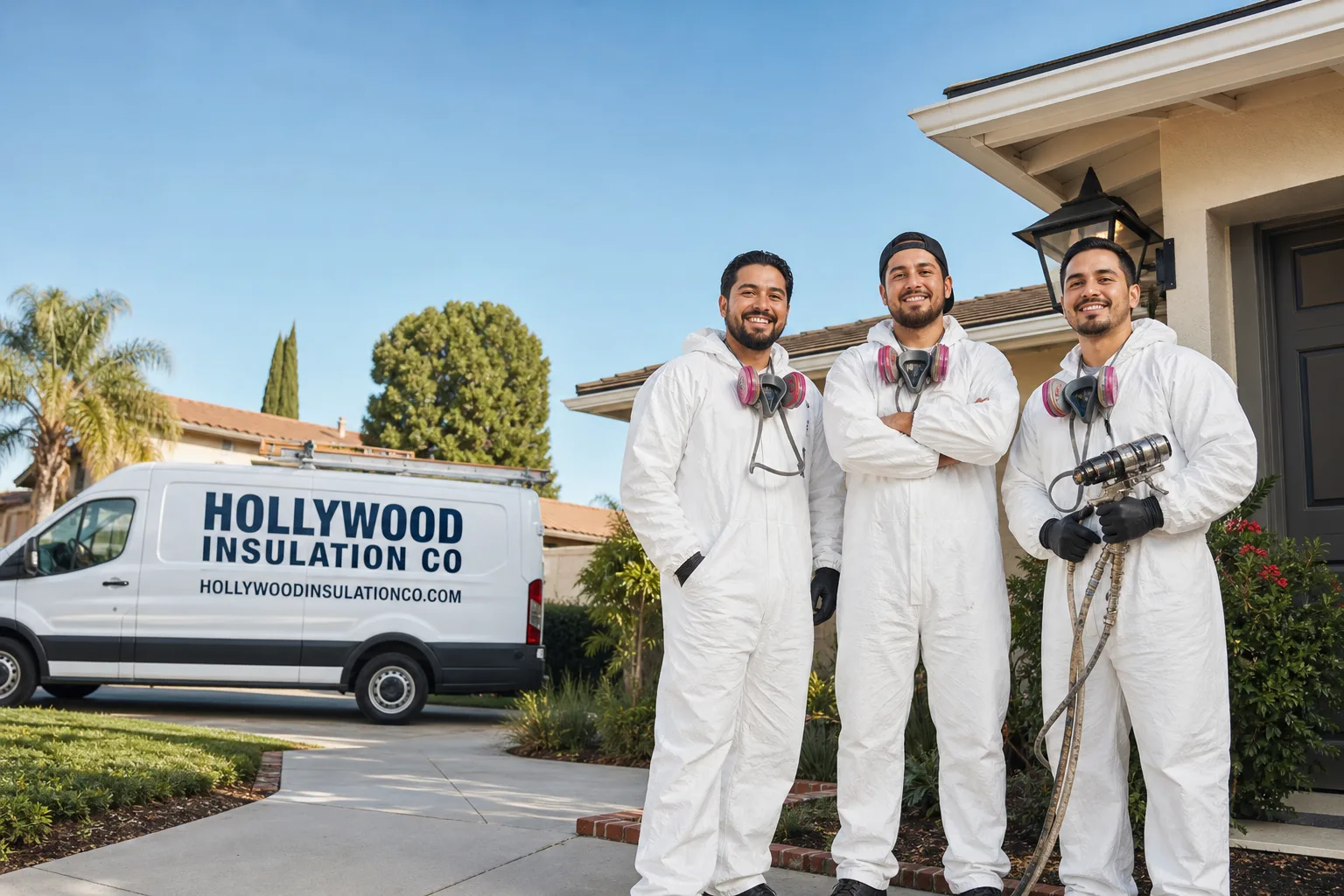
Fast, Reliable Spray Foam Insulation Across Covina
Spray foam insulation in Covina runs $1.80 to $4.20 per board foot for open-cell and $2.50 to $6.50 for closed-cell, with most garage or crawl space projects in the 91722, 91723, and 91724 zip codes landing between $2,400 and $7,800 depending on square footage and prep work. We get crews to Covina neighborhoods like Charter Oak, Covina Hills, and the downtown corridor near Citrus Avenue within one business day for estimates, and most jobs are scheduled within the week. Call (866) 605-6949 and we’ll walk you through what your specific house actually needs.
Covina’s post-war stucco ranch homes sit in the hot, dry eastern San Gabriel Valley at the base of the San Gabriel Mountains. The sun here doesn’t just warm attics; it bakes them. South- and west-facing roof slopes absorb triple-digit summer heat for hours, which is why our work in Covina leans so heavily on attic air sealing, rim joist treatment, and garage wall foam rather than the cold-weather wall insulation that drives jobs in coastal or foothill communities. We know these houses because we’ve worked inside hundreds of them, from the 1940s tracts off Badillo Street to the newer builds north of the 210. The thermal problems are consistent. The fixes are specific.
Why Hollywood Insulation Co Is Covina’s Preferred Spray Foam Insulation Company
We are an insulation specialist, not a general contractor who happens to carry a foam rig. Every technician on a Covina job spends their entire workweek on one trade: diagnosing air leakage, thermal bypasses, and R-value deficiencies inside building cavities. That focus matters when you’re dealing with a 1950s ranch off Sunflower Avenue that still has its original thin batts sagging inside west-facing garage walls. A generalist sees a wall. We see the stucco-side sheathing heat-cycling the framing behind it.
Covina homeowners regularly tell us the same things: bedrooms above the garage run ten degrees hotter in July, the attic feels like a furnace by noon, and the cooling bill climbs every summer. Noel Camacho, who leads our team, has built our Covina-specific process around those exact complaints. We start by testing what’s already there, because in these older tract homes the original insulation is often compressed, degraded, or missing entire sections. Then we match the fix to the failure. Only then do we spray.
We carry eight manufacturer brands, including Icynene and Demilec spray foam systems, Rockwool mineral wool, and GreenFiber cellulose. That breadth means we recommend what the house needs, not what happens to be on the truck that day. If a Covina crawl space needs closed-cell rim joist foam and the attic needs open-cell, we do both. No forced fits.
Crawl Space Spray Foam Insulation in Covina
Crawl Space Spray Foam Insulation in Covina typically costs $1,900 to $4,600 for rim joist treatment and partial wall coverage on a standard 1,200 to 1,800 square foot ranch, and it addresses a problem nearly every post-war stucco home in 91722, 91723, and 91724 shares: ground moisture wicking into the subfloor through unsealed rim joists. Covina’s dry summers lower crawl space humidity for months, but the winter and irrigation season push moisture upward, which is exactly when foam adhesion matters most. We foam the rim joists first to cut the moisture path, then address any wall or floor insulation needs.
Rim Joist Sealing Before Anything Else
Older Covina crawl spaces with open dirt floors and perimeter vents let moisture rise constantly. If spray foam is applied over joists that are already damp, it won’t bond correctly. We inspect the rim joist band first, dry the surface where needed, and spray closed-cell foam directly against the band joist to create both an air seal and a moisture barrier. That single step often fixes cold floors in winter and musty-smelling bedrooms above the crawl space.
Subfloor Protection in Mid-Century Homes
Many Covina ranch homes built in the 1940s and 1950s have minimal subfloor insulation and no vapor barrier. After rim joist sealing, we assess whether the subfloor itself needs a closed-cell blanket to stop heat transfer from the crawl space into living areas. On a recent job on a 1950s single-story ranch off Cypress Street near Covina Park, our lead tech found the crawl space rim joists were wicking ground moisture into the subfloor. We applied a foam blanket to the rim joists, which stopped the dampness transfer and stabilized the floor temperatures above.
Garage Spray Foam Insulation in Covina
Garage Spray Foam Insulation in Covina runs $2,200 to $6,100 depending on whether we’re treating walls, the ceiling below a bonus room, or the full garage envelope. In Covina’s sun-baked stucco ranches, the garage isn’t just an unconditioned storage space; it’s a thermal driver that pulls heat into the house through shared walls and ceilings. The west- and south-facing garage walls on Covina homes absorb solar gain for hours each summer afternoon, and when the garage is insulated, the adjacent living rooms stay measurably cooler.
Wall Cavity Foam for West and South Exposure
Covina’s post-war stucco ranch homes in 91722, 91723, and 91724 often have garages that face west or south. The same sun that bakes the roof deck also heat-cycles garage framing and girts, making garage spray foam a structural-stabilization job here rather than just a comfort upgrade. Closed-cell foam sprayed against the stucco-side sheathing locks the framing in place, fills the heat gaps, and stops the thermal cycling that eventually loosens the original batt insulation.
Garage Ceiling Treatment Under Living Space
When a bedroom sits above a Covina garage, the ceiling cavity is a major thermal bypass. Most builders in the 1950s through 1970s left these ceiling cavities with fiberglass batts that settle and leave exposed joist space. We spray open-cell foam directly into the ceiling cavity to fill every gap and create a continuous air seal between the garage and the conditioned space above. Homeowners tell us the difference is immediate: the bedroom floor no longer feels warm in the afternoon, and the AC doesn’t run as long.
Trusted Brands We Service in Covina
We install both Icynene and Demilec spray foam systems, two of the most specified spray polyurethane foam brands in North America, and we carry Rockwool mineral wool and GreenFiber cellulose when the job calls for fire-resistant or recycled-content materials. Our Covina crews stock the full foam system components locally, which means faster turnaround on warranty work and quicker scheduling. We don’t sell one brand’s solution; we run eight manufacturer lines because Covina’s ranch-era homes need different materials for garages, attics, and crawl spaces. When you call (866) 605-6949, the recommendation is based on what your house needs.
Common Spray Foam Insulation Problems We See in Covina Homes
- Sagged and detached fiberglass in garage walls. Repeated triple-digit heat cycles in west- and south-facing Covina garage walls cause original fiberglass batts to sag and pull away from the stucco-side sheathing, leaving bare gaps that pump heat into the house. We remove the failed batts, air-seal the framing, and spray closed-cell foam against the sheathing instead.
- Foam applied over degraded original attic insulation. Some Covina homeowners or prior contractors spray foam directly over thin, compressed original attic insulation, which traps heat rather than blocking it. The fix is removing or correcting the old layer first, then applying foam or radiant barrier in the proper sequence for sun-baked south and west roof slopes.
- Poorly vented attics baking the foam and framing. Covina attics can hit 140 degrees in July, and without proper ventilation the foam and adjacent framing cook. We assess venting before every attic foam job and correct airflow paths when needed.
- Moisture undermining rim joist adhesion. In older crawl spaces under 1940s and 1950s Covina ranches, rim joists often wick ground moisture that prevents foam from bonding. We dry and prep the band joist before spraying closed-cell foam to ensure adhesion that lasts.
Pricing for Spray Foam Insulation in Covina, CA
Here’s what Covina homeowners should expect to pay based on the work involved. Open-cell spray foam runs $1.80 to $4.20 per board foot. Closed-cell foam, which adds moisture blocking and structural strength, runs $2.50 to $6.50 per board foot. A typical garage wall and ceiling treatment in a Covina ranch falls between $2,200 and $6,100. Crawl space rim joist sealing usually lands between $1,900 and $4,600. Full attic air sealing plus foam layers on a 1,200 square foot home ranges from $3,000 to $7,800. The biggest cost factors are surface prep, access difficulty, and whether old insulation needs removal first. Estimates are free, and the price we quote is the price you’ll see on the invoice. Call (866) 605-6949 to schedule a walkthrough.
We Also Serve Cities Near Covina
Our crews handle Spray Foam Insulation work throughout the eastern San Gabriel Valley. Beyond Covina, we regularly schedule jobs in Irwindale, Azusa, Citrus, and West Covina. If you’re just outside Covina’s 91722, 91723, or 91724 zip codes, call us and we’ll confirm coverage for your street.
Serving Covina, CA — Our Local Coverage Area
We’re based in the Covina area and know this community well. Use the map below to see our service coverage — if you’re nearby, we can almost certainly help.
FAQs About Spray Foam Insulation in Covina
Yes, and it’s one of the highest-value upgrades for Covina’s west- and south-facing garage walls, since the foam blocks solar gain that otherwise radiates through shared walls into living space. A closed-cell application against the stucco-side sheathing in a Covina garage typically runs $2,200 to $6,100. Call (866) 605-6949 for a site-specific quote.
Your 1960s Covina ranch likely has the original thin or compressed attic insulation and less attic ventilation than newer construction, which allows the afternoon sun on your south roof slope to superheat the attic. In Covina’s dry inland climate, the fix is usually removing the degraded layer and adding foam air sealing plus a radiant barrier or high-R upgrade. Call us for an attic inspection and we’ll show you exactly what’s up there.
Yes, but only if the rim joists and ground moisture are addressed first. In Covina’s older crawl spaces, we dry and seal the rim joist band before applying closed-cell foam, which blocks moisture migration while still allowing the space to breathe through existing vents. The order matters. Get it wrong and the foam fails. We do this every week under Covina ranches.
Spray foam in the walls and ceiling won’t affect your garage door opener or tracks, since those components mount to the door frame and the ceiling is treated above, not on, the track hardware. In fact, a cooler garage reduces thermal expansion on the metal door, which may extend the life of springs and rollers. The work is contained to the cavities, not the door system.
We install Icynene and Demilec spray foam systems in Covina, covering both open-cell and closed-cell applications, and we also carry Rockwool mineral wool and GreenFiber cellulose when the project calls for fire-resistant or recycled-content alternatives. Which system we recommend depends on your specific house, not on what’s convenient. Call (866) 605-6949 and we’ll explain the difference for your exact application.
Call Hollywood Insulation Co for Spray Foam Insulation in Covina
If your Covina home has a hot garage, a musty crawl space, or an attic that feels like an oven by noon, we can diagnose the thermal problem and fix it with the right material. We’re insulation specialists. That’s all we do. Call (866) 605-6949 for a free estimate, and we’ll schedule a walkthrough at your Covina home this week.
Written by Noel Camacho, Owner at Hollywood Insulation Co, serving Covina and the eastern San Gabriel Valley.