
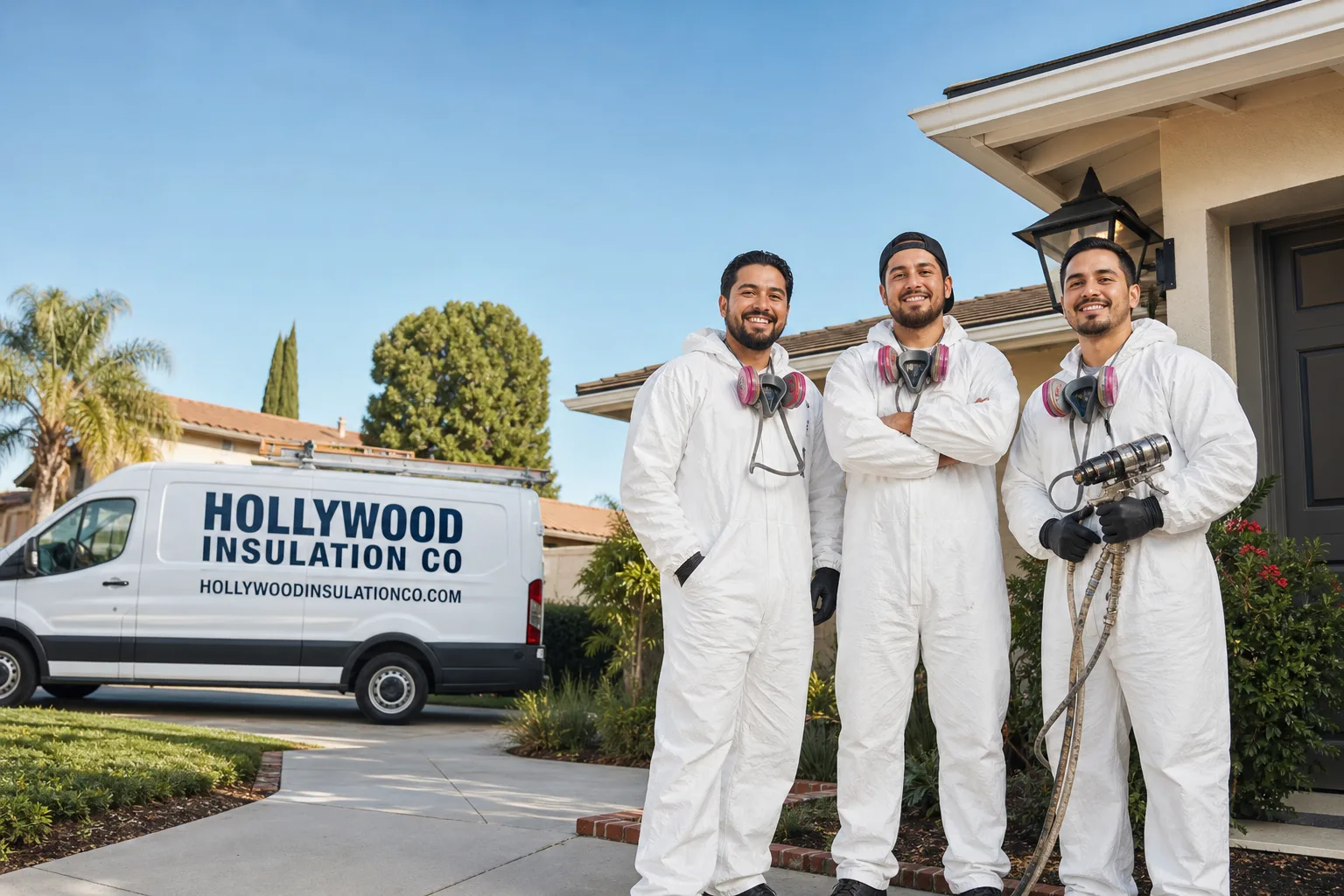
Fast, Reliable Spray Foam Insulation Across Huntington Park
Spray foam insulation in Huntington Park usually costs between $1,800 and $9,500 depending on the area being treated, with most attic retrofits landing in the $2,400 to $4,800 range. We run crews into 90255 weekly, so we know the difference between a Walnut Park fourplex and a 1920s bungalow off Pacific Boulevard. If you’re fighting a second floor that bakes in summer or walls that radiate heat by noon, call (866) 605-6949. We’ll send someone who actually understands old stucco construction, not someone who reads a manual in your driveway.
Why Hollywood Insulation Co Is Huntington Park’s Preferred Spray Foam Insulation Company
Huntington Park homes aren’t built like the rest of LA. The housing stock here runs 1910s through 1950s: stucco-clad bungalows, small Spanish-style homes, and low-rise apartment buildings on lots so tight that neighbors can practically hand you a coffee through the window. That changes how insulation work gets done. Our crews have spent enough time in 90255 to know that attics here often top out at three feet, that side yards run narrow, and that original wiring is frequently still live in the walls. We plan for that before we show up.
Noel Camacho, who runs Hollywood Insulation Co, built our Huntington Park reputation on those constrained jobs. The ones other companies quote sight-unseen, then walk away from when they realize they can’t stand up in the attic. We carry Icynene and Demilec spray foam systems precisely because they let us handle both open-attic sprays and closed-cavity injections on the same property. That matters when half your attic is walkable and the other half is a shed-roof addition with twelve inches of clearance.
Our response time to Huntington Park runs same-day or next-morning in most cases, because the drive from our Hollywood base is short and our scheduling is built around the 90255 corridor. You won’t wait a week for an estimate.
Spray Foam Insulation Contractors in Huntington Park
Spray foam insulation contractors in Huntington Park have to solve a problem most LA contractors never see: how to insulate a wall cavity or attic space you can’t physically enter. On these pre-1960 bungalows, the job is rarely an open-attic spray. It’s a hole-injection retrofit through stucco, through side-yard access points, or through existing vents into closed cavities. A full wall retrofit on a small bungalow in Huntington Park typically runs $3,800 to $7,500. An open-attic roof deck spray runs $2,400 to $5,200 depending on square footage and foam type.
Closed-Cavity Injection Work
Most Huntington Park walls are uninsulated frame under stucco. The practical way to fix that without tearing off siding is drilling injection holes and pumping foam into the stud bays. We use Demilec closed-cell for these jobs when moisture control matters, and Icynene open-cell when the priority is air sealing on a budget. The process is dusty, but it’s the difference between a house that holds cool air and one that leaks it through every wall.
Rim Joist and Garage Ceiling Sealing
Older Huntington Park homes leak air where floor framing meets foundation and where attached garages meet living space. Sealing a rim joist with closed-cell foam usually runs $900 to $2,100 for a typical bungalow footprint. Garage ceiling spray foam, especially on converted garages that bake under flat roofs, runs $1,800 to $3,600 and pays for itself in the first two summers if the garage shares a wall with bedrooms.
Spray Foam Attic Insulation in Huntington Park
Spray foam attic insulation in Huntington Park is usually installed on the underside of the roof deck, not on the attic floor. That’s because most of these pre-war homes have no usable attic floor to speak of, and because the real problem is radiant heat pushing down through the roof on a hot Pacific Boulevard afternoon. Roof deck spray foam in a single-story bungalow here runs $2,800 to $5,400 for open-cell and $4,200 to $7,800 for closed-cell. The price difference comes down to R-value needs and whether we’re addressing moisture control too.
Shallow-Attic and Kneewall Retrofits
Many Huntington Park attics top out at two or three feet. We’ve worked on bungalows where the only access was a 14-inch scuttle in a hallway ceiling. In those cases we inject foam through holes cut into gable ends or through the roof plane itself. Kneewalls in older Spanish-style homes are prime candidates because they’re rarely insulated at all, and they’re directly exposed to western sun. Foaming a kneewall cavity usually costs $1,200 to $2,800 per wall section.
Post-Installation Thermal Checks
After a spray foam job in Huntington Park, we walk the house with an infrared camera to check for missed bays, gaps around old framing, and thermal bridging at the stucco. On a recent 1920s bungalow off Pacific Boulevard, our crew couldn’t walk the attic because of a knee-high ceiling and a shed-roof rear addition with almost no clearance. We injected two-pound closed-cell Icynene through narrow access holes drilled from the side yard into the kneewall and wall cavities, working around original knob-and-tube wiring that couldn’t be foamed over. The rear bedrooms stopped baking in late-afternoon sun, and the shallow attic stopped radiating heat into the living space.
Trusted Brands We Service in Huntington Park
We stock and install Icynene and Demilec spray foam systems because they cover different jobs well. Icynene open-cell handles air sealing and sound control in walls where moisture isn’t a concern. Demilec closed-cell gives us the R-value and vapor impermeability needed for rim joists, tight roof decks, and stucco wall cavities that see condensation risk. We also carry GreenFiber and Owens Corning products for the attics and walls where blown-in actually makes more sense than spray foam. If a Huntington Park home has a walkable attic with no moisture issues, we’ll tell you blown-in is cheaper and smarter than spraying the roof deck. Having eight manufacturer brands across the portfolio means the recommendation fits your house, not our truck inventory.
Common Spray Foam Insulation Problems We See in Huntington Park Homes
- Foam against live knob-and-tube wiring: Pre-1960 Huntington Park walls often still have original wiring. Spraying closed-cell foam directly over active knob-and-tube traps heat against the insulation and violates electrical code. The wiring has to be rerouted or at minimum isolated before we spray.
- Assuming a walkable attic: A surprising number of bids come in assuming standard attic access, then the crew arrives and finds a three-foot ceiling and a shed-roof addition. That’s where hole-injection through side-yard access points becomes the job, not an exception.
- Wrong-side vapor barriers in stucco cavities: Closed-cell foam sprayed on the wrong side of an uninsulated stucco wall can trap moisture in the frame. On Huntington Park’s stucco bungalows, we map the wall assembly before choosing open-cell versus closed-cell.
- Overfilled kneewall cavities: Shallow kneewalls packed against low-slope shed roofs can’t take unlimited expansion. Overfilling pushes framing and cracks ceiling plaster below. We run conservative lift rates on these tight Huntington Park cavities.
Pricing for Spray Foam Insulation in Huntington Park, CA
Expect to pay $1,800 to $9,500 for spray foam insulation in Huntington Park, with the spread driven by surface area, access difficulty, and foam type. Open-cell attic roof deck work on a small bungalow runs $2,800 to $5,400. Closed-cell runs $4,200 to $7,800 for the same square footage. Wall injection retrofits run $3,800 to $7,500 for a full single-story home, and smaller jobs like rim joist sealing land between $900 and $2,100. Homes with knob-and-tube wiring that hasn’t been addressed will cost more, because the wiring has to be dealt with before we spray. Call (866) 605-6949 for a free estimate on your specific Huntington Park property. We’ll give you real numbers, in writing, before any work starts.
We Also Serve Cities Near Huntington Park
Our crews work the full corridor around Huntington Park, including Walnut Park, Bell, Cudahy, and Maywood. These neighborhoods share the same pre-war stucco housing stock and tight-lot constraints, so the same crew knowledge applies. If you’re in any of these areas, you’re within our regular service route. For a full breakdown of materials and methods, see our Spray Foam Insulation service page or the Huntington Park area guide.
Serving Huntington Park, CA — Our Local Coverage Area
We’re based in the Huntington Park area and know this community well. Use the map below to see our service coverage — if you’re nearby, we can almost certainly help.
FAQs About Spray Foam Insulation in Huntington Park
Yes. We don’t need to walk your attic to insulate it. In Huntington Park’s 1910s-1950s bungalows, we inject foam through access holes drilled into gable ends, side-yard walls, or the roof plane itself. The foam expands into the cavity and reaches what a person can’t. This is our standard approach on these tight attics, not a workaround. Call (866) 605-6949 and we’ll assess your specific attic geometry.
We don’t spray over live knob-and-tube, period. Foam traps heat around the conductors, which creates a fire hazard and violates electrical code. We identify wiring before any spray, then work with a licensed electrician to reroute or decommission those circuits. Once wiring is addressed, we proceed with the insulation. It adds cost, but it’s the only code-compliant way to foam these older Huntington Park walls.
Closed-cell is usually the right choice for uninsulated stucco walls in Huntington Park. It adds structural rigidity to old stucco, blocks moisture migration, and delivers about double the R-value per inch of open-cell. The exception is when wall cavities have existing vapor-retarding layers or the framing is too fragile for the expansion pressure. We assess each wall assembly before recommending one system over the other.
Yes. Huntington Park’s problem is summer heat, especially in the Pacific Boulevard corridor where the urban heat-island effect pushes attic temperatures past 140 degrees. Open-cell or closed-cell on the roof deck blocks that radiant heat from ever reaching the living space. Homeowners typically report the biggest difference in second-floor bedrooms and rooms under flat or shed-roof additions. That’s where cooling load drops fastest after the foam goes in.
We spray both Icynene and Demilec on these older Huntington Park homes, chosen by job. Icynene open-cell handles air sealing and sound control in interior walls and ceilings. Demilec closed-cell handles stucco wall cavities, rim joists, and underside-of-roof-deck applications where moisture control and maximum R-value per inch both matter. Having both systems lets us match the foam to your house, not the other way around. Call (866) 605-6949 for a free estimate and a material recommendation based on your home’s actual construction.
Written by Noel Camacho, Owner at Hollywood Insulation Co, serving Huntington Park.