
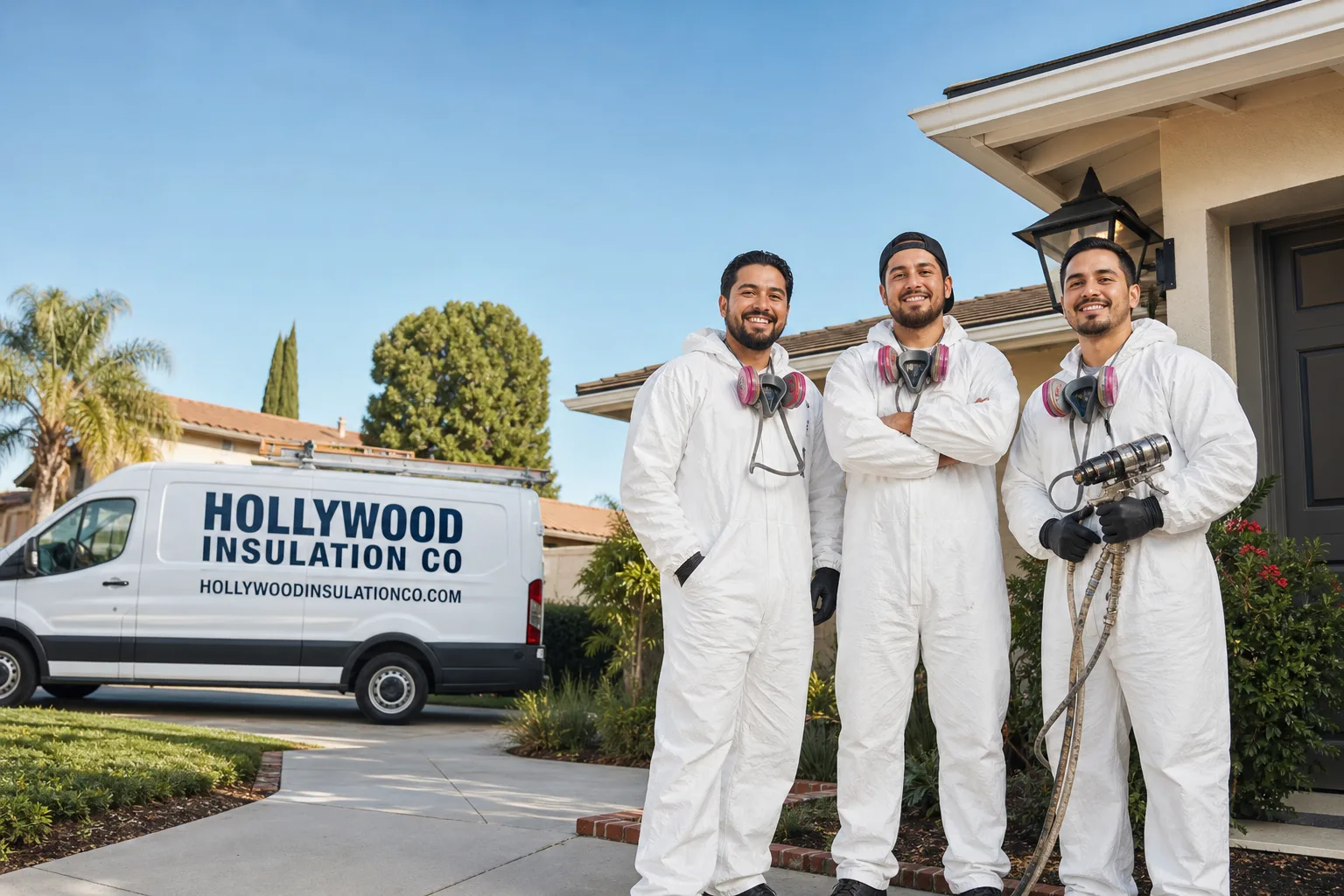
Fast, Reliable Spray Foam Insulation Across March Air Force Base
Spray foam insulation in March Air Force Base typically costs $2.50 to $6.75 per board foot installed, with a full garage ceiling and shared wall retrofit on a base-era tract home running roughly $2,800 to $6,400. Our crews respond to 92551 calls within one business day for estimates, and most garage-focused spray foam jobs wrap in a single visit. We know these homes. The uniform military-era tracts off Riverside Drive and around the base perimeter were built to 1950s-70s efficiency standards, which means the attic and garage assemblies are doing almost nothing to stop Inland Empire heat. If you’re in March Air Force Base and your back bedrooms bake every summer afternoon, call (866) 605-6949. We’ll diagnose the actual thermal boundary before anyone sprays a single square foot.
Why Hollywood Insulation Co Is March Air Force Base’s Preferred Spray Foam Insulation Company
We’re a dedicated insulation specialist, not a general contractor who occasionally sells foam. Every technician on our March Air Force Base jobs works exclusively in insulation day in and day out, which means we see the failure patterns in 92551’s housing stock that other crews miss. Homeowners near the base repeatedly tell us the same story: someone insulated the attic years ago, the bills barely moved, and the bedrooms still spike past 80°F by 3:00 p.m. That’s not an insulation problem. That’s a thermal bypass problem, and it’s the exact condition our Spray Foam Insulation team diagnoses on nearly every military-era tract home here.
Noel Camacho leads our insulation work, and his approach is straightforward: identify where the heat actually enters, then match the right foam system to that assembly. We carry Icynene and Demilec spray foam systems, both open-cell and closed-cell, alongside fiberglass, mineral wool, and cellulose options. That portfolio matters in March Air Force Base because no single product fixes a low-pitch attic, an attached garage shared wall, and wood-frame exterior walls equally well, which is why we also offer Reflectix repair in March Air Force Base for certain retrofit scenarios. We choose the material for the structure, not for the truck inventory.
Response time to March Air Force Base neighborhoods is consistently same-week for estimates, often next-day. We service the full 92551 zip code, from the tracts near the main gate off Van Buren Boulevard down toward Cactus Avenue and the newer development near the western edge. Local knowledge means we already know your roof pitch, your stud spacing, and your likely insulation condition before we walk the door.
Written by Noel Camacho, Owner at Hollywood Insulation Co, serving March Air Force Base and the Inland Empire.
Garage Spray Foam Insulation in March Air Force Base
Garage Spray Foam Insulation in March Air Force Base is the highest-return retrofit we perform on base-era tract homes, and it almost always starts with one problem: the attached garage shares a wall and a ceiling with your living space, and that wall was never insulated properly. The original builder-grade batt behind the drywall is thin, settled, and unsealed. When the Inland Empire sun pounds the garage roof all afternoon, that cavity turns into a heat reservoir that soaks straight into adjacent bedrooms. Spray foam seals the air gaps and adds continuous R-value to the garage ceiling and common wall in one pass, which no batt or blown-in product can match in this specific assembly.
Shared wall and ceiling sequencing
We foam the garage ceiling and the shared wall before touching anything else. If you insulate the attic above the house but skip the garage common wall, you leave the largest heat path between the 100°F summer attic and your living space completely open. Almost every March Air Force Base home we inspect has this exact condition.
Real numbers for 92551 garages
A standard two-car attached garage in a mid-century March Air Force Base tract home runs $1,900 to $3,400 for closed-cell foam across the ceiling and shared wall. Open-cell jobs run lower, $1,400 to $2,600, though we generally recommend closed-cell in garage applications here due to the extreme attic temperatures and the structural rigidity it adds to wood-frame assemblies.
Closed Cell Spray Foam Insulation in March Air Force Base
Closed Cell Spray Foam Insulation in March Air Force Base is the workhorse for this housing stock because it addresses three conditions simultaneously: air sealing, moisture control, and R-value per inch. On a 2×4 wood-frame military-era tract home, closed-cell foam delivers roughly R-7 per inch, which is nearly double what open-cell provides in the same cavity. It also acts as a vapor retarder once applied at 1.5 inches or more, which matters in 92551 because these homes were usually built with no vapor strategy at all. Inland Empire walls get hot, and spraying an open-cell product into a hot cavity with no vapor control can trap moisture against the sheathing. Closed-cell solves the problem rather than hiding it.
Why we specify Demilec closed-cell here
We install both Demilec and Icynene systems, and for closed-cell retrofit work on low-pitch March Air Force Base roofs, Demilec’s high-lift formula holds well on the underside of roof decks where other foams sag in extreme attic heat. Attics in 92551 routinely exceed 140°F by mid-afternoon in July and August, so the foam system you choose has to maintain its cell structure under sustained thermal load.
What homeowners pay
Closed-cell spray foam in March Air Force Base runs $4.00 to $6.75 per board foot depending on cavity depth and access. A full attic roof deck encapsulation on a 1,200-square-foot base-era home lands between $6,500 and $11,000. The smaller garage-and-shared-wall job is far more affordable and captures most of the comfort gain on these specific homes.
Trusted Brands We Service in March Air Force Base
We install Icynene open-cell and closed-cell systems alongside Demilec closed-cell products, and we also carry CertainTeed fiberglass and GreenFiber recycled cellulose for hybrid applications where foam alone isn’t the right call. Carrying multiple manufacturers means we’re not tied to one product line, and your March Air Force Base home gets the system that fits the actual assembly. For 92551 customers specifically, we keep open-cell and closed-cell stock available locally, which cuts lead time on garage and attic retrofits to days rather than weeks. That matters when your bedrooms are already hot and summer is not waiting.
Spray Foam Insulation in March Air Force Base customers also benefit from our hybrid approach: closed-cell foam at the thermal boundary, then cellulose or batt where additional R-value is cost-effective. No single product is right for every cavity, and we’ll tell you exactly where foam earns its cost and where it doesn’t.
Common Spray Foam Insulation Problems We See in March Air Force Base Homes
- Original builder-grade batt over an unsealed attic plane. The low-pitch roofs on 1950s-70s Military-family tract homes rarely got proper air sealing. Foam gets layered over an existing thermal bypass, and the attic heat still finds the conditioned space through gaps at top plates, chases, and can lights.
- Garage ceiling foamed but the shared wall ignored. We see this on homes where a previous contractor sprayed the flat garage ceiling but never touched the wall between the garage and the living room. That wall cavity, open to the same attic heat, keeps conducting 100°F-plus air into adjacent bedrooms all afternoon.
- No vapor strategy in wood-frame walls. Base-era March Air Force Base homes typically have no vapor barrier. Spraying an open-cell product into a hot Inland Empire wall cavity without addressing the vapor profile can trap moisture against the sheathing, especially on the west-facing walls that take full afternoon sun off the Santa Ana winds.
- Thin, settled original insulation in the low-pitch attic. The builder-grade batt installed when these homes were built has compressed to R-19 or less in many 92551 attics. That’s below code minimum by today’s standards, and in a climate where summer attic temperatures hit 140°F regularly, it’s functionally almost nothing.
Pricing for Spray Foam Insulation in March Air Force Base, CA
A full garage ceiling and shared wall closed-cell retrofit in March Air Force Base runs $2,800 to $6,400 for most base-era two-car garages, with smaller single-car jobs starting near $1,900. Whole-attic roof deck encapsulation lands between $6,500 and $11,000 on a 1,200-square-foot home. Rim joist spray foam in a crawlspace runs $700 to $1,400, and targeted wall cavity injection on interior walls costs $1,200 to $2,800 depending on access. What moves your number most is cavity depth, roof pitch, and whether we need to remove existing degraded batt before spraying. Every estimate is free, and we give you a written line-item price before any work begins. Call (866) 605-6949 for a same-week estimate in 92551.
We Also Serve Cities Near March Air Force Base
Our crews cover the entire western Riverside County corridor around March Air Force Base, including Moreno Valley, Woodcrest, Perris, and Good Hope. Same scheduling applies across all nearby service areas, and our material stock lives close enough that lead times don’t stretch when you’re outside the base perimeter but still in the same Inland Empire heat envelope.
Serving March Air Force Base, CA — Our Local Coverage Area
We’re based in the March Air Force Base area and know this community well. Use the map below to see our service coverage — if you’re nearby, we can almost certainly help.
FAQs About Spray Foam Insulation in March Air Force Base
Because your garage’s shared wall and ceiling were never insulated or air-sealed, and the attic above the house isn’t the only heat source. The garage roof bakes under Inland Empire sun all afternoon, heating the air in the garage cavity, which then conducts through the uninsulated common wall into your conditioned bedrooms. Insulating the house attic does nothing for that path. We foam the garage ceiling and shared wall as the first move on nearly every 92551 retrofit, and that’s typically where the comfort gain shows up. Call (866) 605-6949 for an assessment.
No, and we won’t do it. The original batt in these homes is thin, settled, and sitting over an unsealed attic plane. Spraying foam over it creates a new layer that does not address the thermal bypass underneath and can trap heat and moisture against the old material. We remove the failed batt, air-seal the plane properly, then apply the foam system matched to the cavity. It costs more upfront than a cover-over, and it’s the only sequence that actually changes how the house performs.
Closed-cell, in most March Air Force Base applications. These 2×4 wood-frame walls have no vapor strategy, and closed-cell foam at 1.5 inches or more functions as a vapor retarder while delivering roughly R-7 per inch. Open-cell has its place in interior sound control and some attic applications, but for the garage common walls, rim joists, and roof decks that dominate 92551 retrofits, closed-cell handles the heat and moisture profile of the Inland Empire better. We’ll show you the assembly and explain the choice before we quote it.
No. We foam the ceiling and shared wall, not the door assembly itself. The door tracks, opener, and spring remain fully accessible and untouched. If your builder-grade door sits against a fiberglass-insulated side wall, we can foam behind it without disturbing the track hardware. The only change you’ll notice is that the garage holds less afternoon heat, which means the opener and any battery backup in the unit operate in a lower ambient temperature, which extends their service life.
Check your attic in late afternoon during summer. If the space is above 130°F, your insulation plane is failing, regardless of what’s up there. Check the wall between your garage and the nearest bedroom at 4:00 p.m. If it’s warm to the touch, the shared wall has no meaningful insulation. Check your July and August energy bills against the square footage. If you’re paying more than $0.28 per square foot per month for cooling alone, you’re losing the fight. Any one of those conditions signals a retrofit, and we’ll confirm it on site. Estimates are free, call (866) 605-6949.