
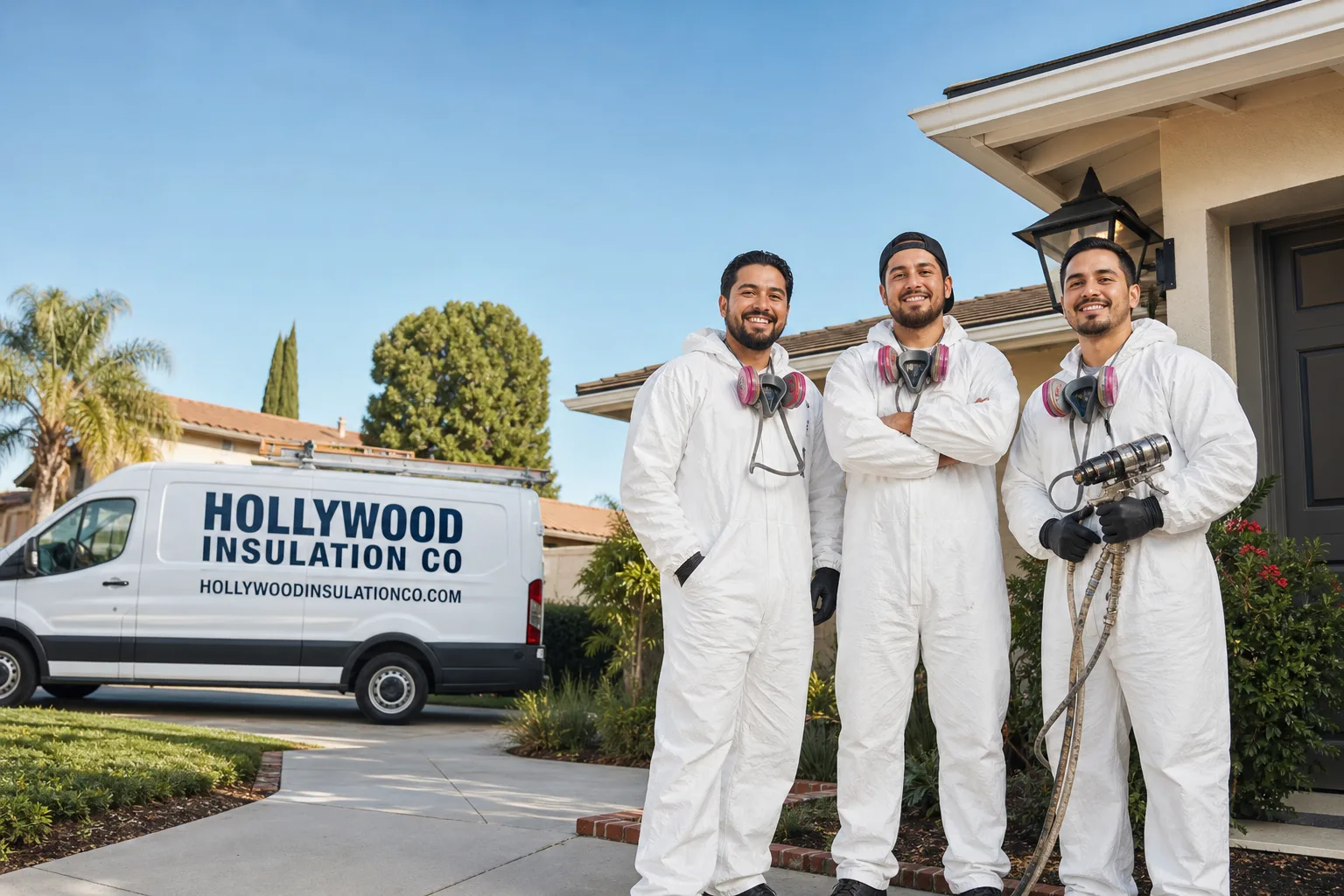
Fast, Reliable Spray Foam Insulation Across North Hollywood
Spray foam insulation in North Hollywood typically costs $2.50 to $5.50 per board foot installed, with most attic retrofits landing between $3,800 and $8,400 depending on depth and foam type. We run crews into North Hollywood daily from our Hollywood base, so same-week scheduling is standard and emergency estimates for heat-baked attics can usually happen within 48 hours. If your upstairs rooms are hitting 90°F by noon and your AC never shuts off, call (866) 605-6949 and we’ll tell you straight whether spray foam, a radiant barrier, or both actually make sense for your house.
North Hollywood isn’t like the coastal side of the hills. The Valley heat loads here are brutal, and most of the housing stock was built before anyone thought about insulation. That combination means the standard advice you’ll read online often doesn’t apply. We know this because we’ve opened up hundreds of attics between the NoHo Arts District, the blocks south of Magnolia, and the tract homes around 91601 and 91615. The failures are predictable. The fixes are too.
Why Hollywood Insulation Co Is North Hollywood’s Preferred Spray Foam Insulation Company
We’re a dedicated insulation specialist, not a general contractor carrying foam on the side. Every technician on our team works in this one trade, which matters when the job is a 1940s attic with knob-and-tube wiring and a roof deck that’s hot enough to curl shingles. North Hollywood homeowners call us because we diagnose thermal bypasses and air leakage before we recommend a material. Sometimes that material is open-cell foam. Sometimes closed-cell. Sometimes the real answer is a radiant barrier with foam on the rim joists, and we’ll tell you that before we sell you a thicker application you don’t need.
Our insulation portfolio spans eight manufacturer brands across fiberglass, mineral wool, spray foam, and cellulose. For spray foam specifically, we install both Icynene and Demilec systems, which means we can spec open-cell for interior air sealing and closed-cell for structural strength and moisture control without pushing one product line. In North Hollywood’s unvented, low-pitch attics, having both options matters more than anywhere else in Los Angeles. The wrong foam choice here doesn’t just underperform. It can trap moisture against old shingles and rot the deck from the inside.
Response time to North Hollywood is typically 24 to 48 hours for estimates. We stock foam kits, radiant barriers, and ventilation components locally, so we’re not waiting on a distributor when a Valley heat wave has your upstairs at 95°F. Noel Camacho runs our crews and has walked enough pre-1950 North Hollywood attics to know the failure patterns by street. That’s the kind of local knowledge that keeps a retrofit from becoming a re-do.
Spray Foam Insulation Contractors in North Hollywood
Spray Foam Insulation Contractors in North Hollywood deal with a housing stock that most national franchises don’t understand: 1920s stucco bungalows, 1940s dingbats, and 1960s tract homes, many of them with original single-pane windows and attics that have never been insulated. The job here isn’t just applying foam. It’s evaluating whether the roof deck can handle a sealed, unvented assembly, whether old wiring needs isolation, and what kind of radiant protection the attic actually needs.
For a typical North Hollywood bungalow, closed-cell foam on the roof deck runs $4.00 to $5.50 per board foot. Open-cell falls in the $2.25 to $3.25 range. Rim joist sealing, which closes the air gap where the foundation meets the framing, usually lands between $900 and $1,800 for a full perimeter on a single-story home.
Closed-Cell Roof Deck Applications
Closed-cell foam does two jobs at once: it insulates and it air-seals. On North Hollywood’s low-pitch, unvented roofs, we spray it directly to the underside of the roof deck to turn the attic into conditioned space. This is the method we recommend most often for pre-1960 homes where adding eave vents isn’t practical and the deck needs all the heat rejection it can get.
Rim Joist and Band Joist Sealing
Older North Hollywood homes leak air at the rim joist, where the floor framing sits on the foundation. That gap lets 100°F exterior air pour into the wall cavities. Closed-cell foam applied to the rim joist stops that infiltration and adds enough R-value to matter. We do this on nearly every older-home insulation project we take on in the Valley.
Spray Foam Attic Insulation in North Hollywood
Spray Foam Attic Insulation in North Hollywood is the single highest-impact upgrade for summer comfort, but only when it’s paired with the right radiant strategy. In a pre-1950 bungalow, the roof deck often reaches 150°F or more before noon in summer. Foam slows conductive heat transfer, but it doesn’t reflect radiant heat. Without a radiant barrier, an unvented attic can still bake at 140°F even with foam in place, because the heat is radiating from the deck surface into the foam’s face.
That’s the information gap most North Hollywood homeowners never hear. The fix that actually works is closed-cell foam sprayed to the deck, a radiant barrier on the deck’s underside or on the top of the roof, and upgraded ventilation where the roof pitch allows it. On the 1946 stucco bungalow near the NoHo Arts District, we found an attic with zero insulation and a roof deck so hot the asphalt shingles were curling. We sprayed 2 inches of Icynene closed-cell foam directly to the underside of the deck, then added a radiant barrier and a ridge vent. Peak attic temperature dropped from 155°F to 118°F. The homeowner said the second-floor bedroom finally cooled down by 3 PM.
Radiant Barrier and Foam Combined
The Valley sun hits North Hollywood roofs for 13-plus hours a day in July. Foam insulates, but a radiant barrier reflects. Together they cut attic temperatures by 30 to 40°F, which is the difference between an upstairs that’s usable and one that’s abandoned from June through September. We spec this combination on most pre-1970 attics we touch.
Open-Cell vs. Closed-Cell for Older Decks
Open-cell foam is cheaper and does excellent air sealing, but it’s vapor-permeable. On a 1920s or 1940s roof deck that’s already 80 years old, that can cause condensation against the sheathing in winter. Closed-cell foam adds a vapor retarder, structural strength, and higher R-value per inch. For unvented North Hollywood attics, closed-cell is usually the safer call, and we’ll explain the tradeoffs before you spend a dollar.
Trusted Brands We Service in North Hollywood
We work with Spray Foam Insulation systems from Icynene and Demilec because they’re two of the most specified spray polyurethane foam brands in North America, and both give us the open-cell and closed-cell options this market needs. For North Hollywood customers who want a non-foam alternative, we also install Rockwool mineral wool and GreenFiber recycled cellulose, both of which add fire resistance and sound control to older Valley construction. The point is breadth: eight brands, three installation methods, and no pressure to buy whatever’s already on the truck. Call (866) 605-6949 and we’ll spec the material that’s actually right for your roof, your wiring, and your summer.
Common Spray Foam Insulation Problems We See in North Hollywood Homes
- Foam applied directly over old knob-and-tube wiring. In pre-1950 North Hollywood attics, original knob-and-tube circuits are common. Foam sprayed over live, unisolated wiring creates a fire hazard that Los Angeles inspectors flag immediately. The wiring must be assessed and isolated before we touch the deck.
- Closed-cell foam sprayed too thick on unvented low-pitch roofs. When the deck can’t dry to the interior, trapped moisture degrades the sheathing and rots shingles from underneath. On North Hollywood’s flat and low-pitch roofs, thickness and curing rate have to be calculated against the roof’s drying potential.
- Open-cell foam without a radiant barrier in hot attics. Open-cell insulates but doesn’t reflect. In a 150°F Valley attic, it leaves the space baking at 140°F or higher because radiant heat passes right through. Homeowners who paid for open-cell alone and still can’t sleep upstairs usually call us in July.
- Ignoring rim joists and wall top plates. Many older North Hollywood homes leak more air through the rim joist than through the attic floor. Foaming the deck without sealing the rim joist leaves a major thermal bypass open, and the bill doesn’t shrink enough to justify the lost performance.
Pricing for Spray Foam Insulation in North Hollywood, CA
For a typical North Hollywood bungalow, open-cell spray foam runs $2.25 to $3.25 per board foot. Closed-cell runs $4.00 to $5.50. An attic retrofit on a 1,200-square-foot house usually lands between $3,800 and $8,400 total, with closed-cell on the roof deck at the upper end of that range. Rim joist sealing adds $900 to $1,800. Radiant barrier with foam runs $1.50 to $2.50 per square foot of attic floor. These are North Hollywood market numbers, not national averages. Estimates are free, and we’ll give you a written line-item quote before any work starts. Call (866) 605-6949 to schedule one.
We Also Serve Cities Near North Hollywood
Beyond Spray Foam Insulation in North Hollywood, we run crews into Studio City, Universal City, Burbank, and Valley Glen. The heat loads and older housing stock in those areas create many of the same attic and roof deck problems we fix every week in North Hollywood. If you’re outside the immediate area, call us anyway. We’ll tell you honestly whether we can reach you this week.
Serving North Hollywood, CA — Our Local Coverage Area
We’re based in the North Hollywood area and know this community well. Use the map below to see our service coverage — if you’re nearby, we can almost certainly help.
FAQs About Spray Foam Insulation in North Hollywood
No. Old insulation that’s crumbled to dust has to be removed before spray foam can bond properly to the deck or the joists. The dust layer prevents adhesion, and leaving it in place creates a thermal weak point under the new foam. We’ll assess the attic first, then tell you whether removal is a simple vacuum job or whether old wiring and debris add time. Call (866) 605-6949 for a free inspection.
Usually not. Spray foam slows conductive heat gain, but in a North Hollywood attic with a 150°F roof deck, radiant heat is the bigger problem. Foam without a radiant barrier typically leaves the attic at 140°F or hotter in the afternoon. The fix that works is closed-cell foam on the deck plus a radiant barrier and ventilation. That combination drops peak attic temperatures 30 to 40°F, which is the change your upstairs actually needs.
Open-cell foam is less expensive, expands more, and does excellent air sealing, but it’s vapor-permeable and has a lower R-value per inch. Closed-cell foam costs more, adds structural strength, acts as a vapor retarder, and delivers roughly double the R-value per inch. For 1960s tract homes with flat or low-pitch roofs in the Valley heat, closed-cell is usually the better spec. We install both and will explain which one fits your roof and budget before you decide.
Sometimes, but any spray foam installation in a multi-family building has to meet Los Angeles fire code for the assembly as a whole. That may require an ignition barrier or a thermal barrier depending on the attic type and whether it’s occupied space. We can’t promise a workaround before we see the attic. What we can do is assess the assembly, identify what the code requires, and give you a straight answer about whether the project is worth doing. Call (866) 605-6949 for that assessment.
Flat and low-pitch roofs on 1920s stucco bungalows are the hardest cases for spray foam because the deck can’t dry to the exterior and the roof cavity is tight. We typically spec a thin closed-cell application with a radiant barrier and mechanical ventilation, then verify the deck’s moisture balance before adding more R-value. The goal isn’t maximum foam thickness. It’s a roof that doesn’t rot and an attic that actually cools down. We’ve done this on many blocks south of Magnolia, and the results hold up through summer heat waves.
Written by Noel Camacho, Owner at Hollywood Insulation Co, serving North Hollywood and the San Fernando Valley.