
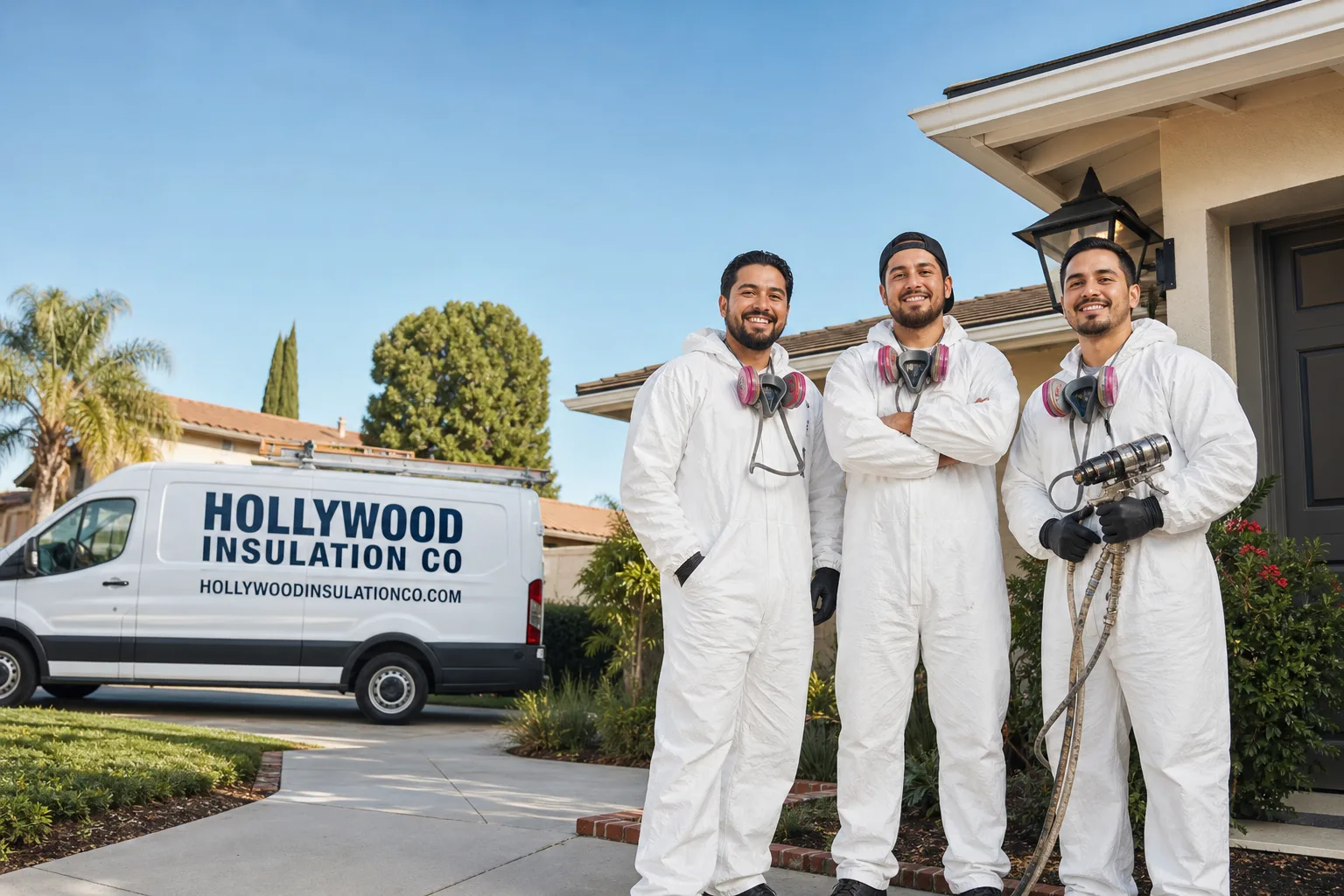
Fast, Reliable Spray Foam Insulation Across Quail Valley
Spray foam insulation in Quail Valley is most often the right call when an attached garage turns into an oven and the living space next to it never quite cools down. We run crews into the 92587 zip code weekly, and we know exactly what late-20th-century stucco tract homes here do in July: attics and garages spike past 120°F, builder-grade insulation settles, and heat pushes through shared walls all afternoon. Hollywood Insulation Co installs open-cell and closed-cell foam systems from Icynene and Demilec, sized for how Quail Valley’s dry inland heat actually loads a house. Call (866) 605-6949 for a free estimate and we’ll schedule the work around the heat, not during it.
How Much Does Spray Foam Insulation Cost in Quail Valley?
In Quail Valley, closed-cell spray foam runs roughly $2.75 to $4.25 per board foot installed, with most attached-garage and attic-lid jobs landing between $3,200 and $7,800 depending on square footage, access, and whether we’re also sealing the door frame and soffit gaps. Open-cell foam, which suits interior walls and sound control, typically falls between $1.75 and $2.60 per board foot. Rim joist work off a garage or bonus room usually lands between $900 and $2,400 for a typical Quail Valley home. These are real numbers for this market, not national averages. Call (866) 605-6949 for an exact quote; estimates are free.
Why Quail Valley’s Heat Changes What Spray Foam Has to Do
Quail Valley sits on the hot, dry inland edge of Riverside County, where summer attic temperatures routinely blow past 130°F and attached garages bake at 120°F-plus for four or five months straight. That is not a coastal moisture problem. This is a radiant-heat-rejection problem. The 1980s to 2000s stucco tract homes that dominate Quail Valley were built with tile or composition roofs and builder-minimum attic insulation. Thirty or forty years later, that insulation has settled and heat-degraded. A spray foam job here is not about winter cold retention; it’s about keeping July heat out of the attic, out of the garage, and out of the rooms that share walls with both. When we install closed-cell foam on the underside of a Quail Valley roof deck, we’re creating a thermal and air barrier that blocks the solar load before it ever reaches the living space. That is a different job than what a coastal crew would spec.
Why Hollywood Insulation Co Is Quail Valley’s Preferred Spray Foam Insulation Company
We’re a dedicated insulation specialist, not a general contractor with a foam rig on the side. That focus matters in Quail Valley, where heat-driven oxidation quietly wrecks garage hardware and under-insulated attics punish homeowners with brutal cooling bills. Led by Noel Camacho, our crews install three methods under one roof: attic insulation, Spray Foam Insulation, and blown-in, so a Quail Valley home gets the method that actually fits the failure mode, not whatever is easiest to sell.
We carry eight manufacturer brands spanning fiberglass, mineral wool, spray foam, and cellulose. For Quail Valley’s heat, we lean on Demilec closed-cell for roof decks and garage lids, and Icynene open-cell where air sealing and sound control are the priority. Homeowners off Canyon Hill Drive, Goetz Road, and around Quail Valley Middle School have had us out for everything from garage overheating to whole-attic air sealing. We know the lots, the roof pitches, and the access problems. We also know to schedule attic work for early morning, because a 140°F attic at 3 p.m. is not a safe or effective place to spray anything.
Garage Spray Foam Insulation in Quail Valley
Garage Spray Foam Insulation in Quail Valley is about more than comfort; it’s about stopping the heat-driven oxidation cycle that kills bare-steel springs, hinges, and opener chains. An attached garage here routinely hits 118°F to 125°F on July afternoons. That heat dries out factory lubricant, accelerates corrosion on torsion springs, and forces the opener motor to work against a heat-stiffened chain. What the job involves here specifically: spraying closed-cell foam on the shared wall between garage and living space, sealing the ceiling deck, and closing the door-frame and soffit gaps that let radiant heat pour back in. A typical Quail Valley garage spray foam job runs $1,800 to $4,400.
Shared Wall and Ceiling Deck Sealing
The wall between an attached garage and a primary bedroom or kitchen is the primary heat path. We spray closed-cell foam on that surface and seal the top plate to stop the thermal bridge before it reaches the conditioned space.
Door Frame and Soffit Gap Closure
Spraying foam without sealing the garage door frame and soffit vents leaves channels for hot air to enter and reheat the space. We close those first, then spray. Skipping that step cuts the value of the whole job.
Closed Cell Spray Foam Insulation in Quail Valley
Closed Cell Spray Foam Insulation in Quail Valley serves two roles: it blocks radiant heat and it stiffens the building envelope in a climate where dry air and extreme temperature swings punish structural joints. The most common application on Quail Valley homes is the underside of the roof deck in attached garages and attic lids over living space. Closed-cell foam carries an R-value near 6.5 to 7 per inch, but the real win here is that it stops air movement. In a tract home built in the 1990s, the ceiling is full of unsealed penetrations. Air migrates. Heat migrates with it. Closed-cell foam puts a stop to that. Most Quail Valley closed-cell garage and roof deck jobs land between $3,800 and $7,800.
Roof Deck Application for Radiant Heat Blocking
This is heat rejection at the source. The sun loads the roof, the roof radiates into the attic, and the attic superheats the ceiling. Closed-cell foam on the underside of the deck stops that transfer before the attic becomes a bake box.
Garage Ceiling and Rim Joist Sealing
Rim joists at the garage perimeter are a notorious leak point. Closed-cell foam seals rim cavities, stops air intrusion from the hot exterior wall assembly, and cuts the temperature swing that cooks garage hardware.
Field Notes: What We Found Off Canyon Hill Drive
On a 1990s stucco tract home off Canyon Hill Drive in Quail Valley, our crew measured the attached garage at 118°F on a July afternoon. The original builder-grade torsion springs were black with heat oxidation, and the opener chain was stiff with dried factory lubricant baked to the links. We sprayed 2 inches of Demilec closed-cell foam on the shared wall and the ceiling deck, sealed the door-frame gaps, and tightened the soffit runs. The homeowner called the following week to say the garage was holding near 88°F through the afternoon peak. The springs and chain were no longer cooking between cycles. That is what this work actually does in Quail Valley.
Trusted Brands We Service in Quail Valley
We install and maintain spray foam systems from Icynene and Demilec, plus blown-in and batt options from GreenFiber, Owens Corning, and others we keep in rotation. For Quail Valley’s heat, Demilec closed-cell and Icynene open-cell do the heavy lifting. Since we stock the full material lineup, we’re not steering a Quail Valley homeowner toward whatever is on the truck this week. The recommendation follows the thermal problem, not the other way around. Turnaround is fast because we schedule Quail Valley jobs as a local service area, not an out-of-town afterthought.
Common Spray Foam Insulation Problems We See in Quail Valley Homes
- Heat-oxidized garage hardware. Bare-steel torsion springs and hinges in attached garages oxidize and lose tension faster in Quail Valley’s 120°F-plus summer heat. The fix is often as much about cooling the garage with foam as it is about replacing the hardware.
- Settled, heat-degraded builder insulation. Thirty-year-old fiberglass in 1980s to 2000s tract homes has settled and lost loft. Radiant load then punches through and drives living-space temps past 130°F. Adding foam at the roof deck stops the load at the source.
- Under-ventilated, hard-to-reach attic runs. Long attic runs over attached garages often lack proper baffles and ventilation. Spraying foam without sealing the door frame and soffit gaps leaves thermal bridges that reheat the space within an hour.
- Partial air sealing jobs. We see homes where someone sprayed the ceiling but skipped the rim joists and top plates. The foam helps, but the garage still leaks heat through the gaps. Complete sealing is the only way to break the cycle here.
Pricing for Spray Foam Insulation in Quail Valley, CA
A typical closed-cell garage and roof deck job in Quail Valley runs $3,800 to $7,800. Open-cell interior wall applications land between $1,800 and $4,200. Rim joist sealing for a standard attached garage usually falls between $900 and $2,400. What moves the number: square footage, roof pitch, access difficulty, and whether we’re also sealing door-frame and soffit gaps before spraying. The heat here punishes half-measures, so we quote the full job, not a low number that leaves the thermal bridges open. Call (866) 605-6949 for a free, specific estimate for your home.
We Also Serve Cities Near Quail Valley
Hollywood Insulation Co provides Spray Foam Insulation in Quail Valley and runs crews into the surrounding Riverside County communities of Sun City, Canyon Lake, Meadowbrook, and Romoland. Same scheduling, same material lineup, same early-morning attic protocol.
Serving Quail Valley, CA — Our Local Coverage Area
We’re based in the Quail Valley area and know this community well. Use the map below to see our service coverage — if you’re nearby, we can almost certainly help.
FAQs About Spray Foam Insulation in Quail Valley
Yes, it does, but only if the job is sealed correctly. A properly foamed garage in Quail Valley stays 20 to 30 degrees cooler through the afternoon peak, which slows the oxidation that kills bare-steel springs and keeps opener chains from baking out their lubricant. If the door frame and soffit gaps are left open, the protection drops off sharply. Call (866) 605-6949 for an honest assessment.
Blown-in fiberglass slows conductive heat, but it does not stop air movement, and Quail Valley’s heat rides air movement hard through the ceiling plane and rim joists. Closed-cell foam blocks both heat conduction and air infiltration in one shot. It also adds structural stiffness, which matters on older tract homes in an earthquake-prone region.
Attached garages in Quail Valley commonly hit 118°F to 125°F on July afternoons, with some roof-facing walls pushing past 130°F. That heat dries out factory chain lubricant within a season or two, leaving the chain stiff and grinding. The opener motor then works harder, runs hotter, and fails earlier. Spray foam on the ceiling and shared wall cuts that heat load directly.
For the most part, yes. Quail Valley’s low humidity means vapor drive and mold risk are much less pressing than they are at the coast. The priority here is radiant heat rejection and air sealing. Closed-cell foam still gives you a vapor barrier by nature, but moisture is not the main enemy in this climate; heat is.
Early morning, no question. Attics and garages here are still manageable before 10 a.m., but by 2 p.m. the surface temperatures on the roof deck are too hot for safe, effective foam application. We schedule Quail Valley jobs as early starts. Call (866) 605-6949 and we’ll get you on the morning board.
Contact Hollywood Insulation Co for Spray Foam Insulation in Quail Valley
If your Quail Valley garage is cooking your hardware and your living space never cools off, call (866) 605-6949. We’ll show up early, measure the actual heat load, and quote a foam job sized for this climate and this house. Free estimates, straight answers, and a crew that understands Quail Valley’s heat better than any out-of-town outfit could.
Written by Noel Camacho, Owner at Hollywood Insulation Co, serving Quail Valley with spray foam, attic, and blown-in insulation expertise.