
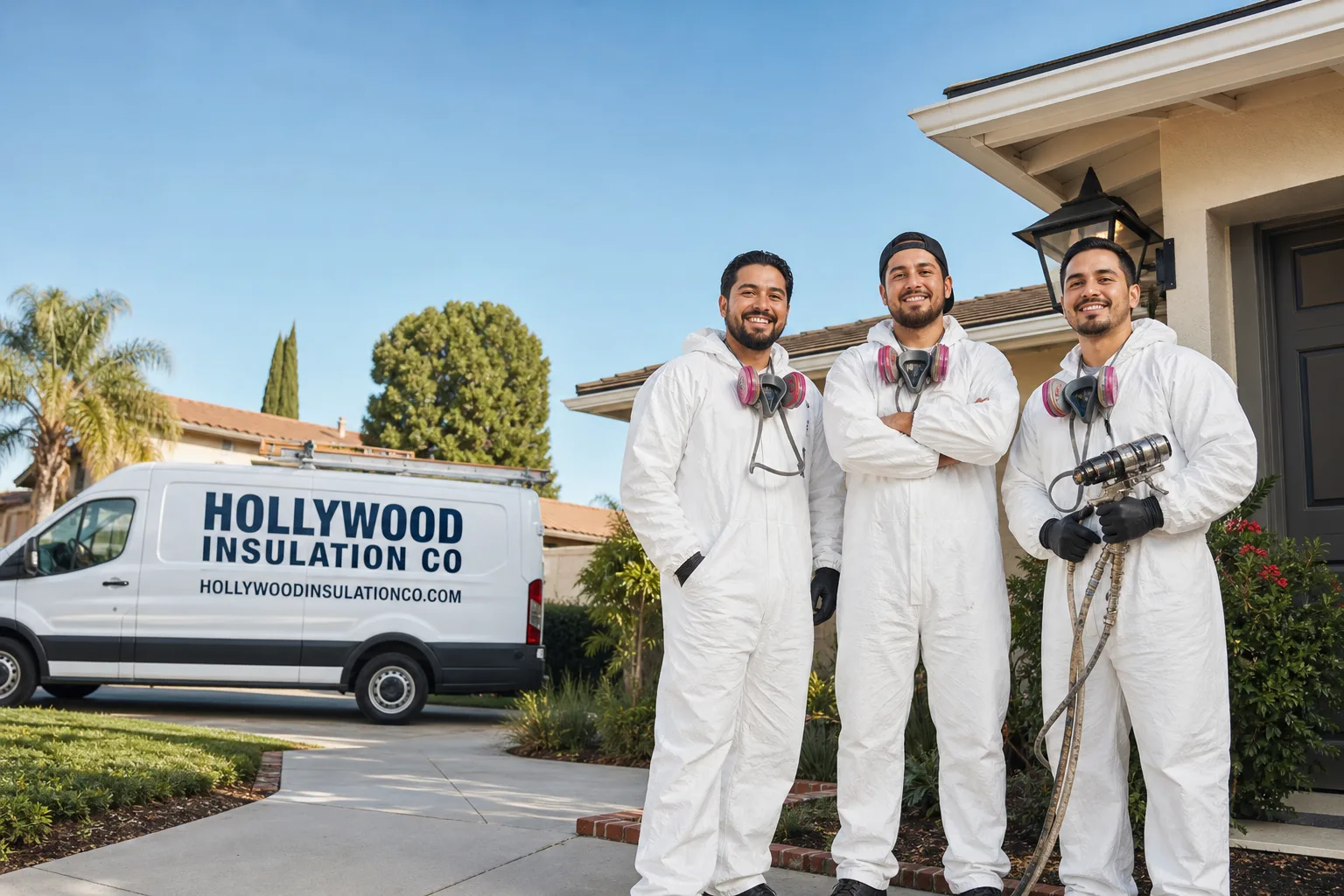
Fast, Reliable Spray Foam Insulation Across Silver Lakes
Spray foam insulation in Silver Lakes typically runs $2,800 to $7,400 for a full attic application, with most projects completed in one to two days. If you’re in the 92342 zip code and your home still has its original 1990s fiberglass batts, you’re losing thermal performance every afternoon the sun hits that tile roof. We know Silver Lakes homes because we work on them every week. Our crew can usually reach your street within 24 to 48 hours for an estimate. Call (866) 605-6949 and we’ll walk the attic with you.
Why Hollywood Insulation Co Is Silver Lakes’s Preferred Spray Foam Insulation Company
Silver Lakes homeowners call us because we’re an insulation specialist, not a general contractor who also installs insulation on the side. Every technician on our crew works in this one trade, and the problems we solve in Silver Lakes are specific: shallow 1990s attic framing, wind-packed dust in the batts, and tile roofs that push attic temperatures past 140°F by early afternoon. We’ve diagnosed hundreds of these homes around the golf course, the lakes, and the newer phases off Ranchero Road.
Noel Camacho leads our crews with a simple rule: match the material to the actual thermal problem, not to whatever’s on the truck. We carry both Icynene and Demilec spray foam systems, so we can recommend open-cell for interior air sealing or closed-cell for roof decks and rim joists without bias. Homeowners in Silver Lakes consistently mention two things after we finish: the rooms on the west side of the house finally hold temperature, and the dust that used to settle on ceiling fans has stopped. That’s the difference between insulation that takes up space and insulation that actually seals the envelope.
Spray Foam Attic Insulation in Silver Lakes
Spray Foam Attic Insulation in Silver Lakes means treating the attic as a conditioned space, not just piling more material on the floor. In homes built between 1988 and the early 2000s, the original R-13 or R-19 batts were laid between shallow 2×6 ceiling joists. After 25 to 35 years of Mojave wind pushing dust through the soffit vents, those batts have settled and compressed, often to half their rated depth or less. The fix is not adding a second layer of fiberglass. The fix is removing the failed material, air-sealing the top plates and penetrations, and applying spray foam where it can stop both the heat transfer and the dust infiltration at the source.
Roof Deck Application
Applying foam to the underside of the roof deck turns the attic into a sealed, semi-conditioned buffer zone. On a 1992 stucco-and-tile home near the Silver Lakes golf course, our crew found the original R-13 batts crushed to barely an inch under a layer of wind-deposited desert dust, with attic temps hitting 145°F by noon. We removed the failed batts, sealed the top plates and soffit gaps, and applied 6 inches of Icynene spray foam to the roof deck, cutting the afternoon attic temperature by over 40 degrees and stopping the dust infiltration that had been choking the original insulation.
Attic Floor Air Sealing
For homeowners who prefer to keep the attic vented, we can apply a targeted layer of closed-cell foam across the attic floor, sealing every wire penetration, can light, and top plate before adding fresh blown-in insulation. This approach works well in Silver Lakes because it directly addresses the convective loops that form when 140°F attic air gets pulled into the living space through unsealed gaps. It also stops the dust cycle: no open cavities, no dust settling through the ceiling.
Spray Foam Wall Insulation in Silver Lakes
Spray Foam Wall Insulation in Silver Lakes is the right call when you’re already opening walls for a remodel, or when you’re tired of the west-facing bedrooms running ten degrees warmer than the rest of the house. Most Silver Lakes homes were built with R-13 fiberglass batts in 2×4 exterior walls, a specification that barely met code in 1995 and falls well short of what the high desert demands. Closed-cell spray foam installed in those same cavities delivers roughly twice the effective R-value per inch, plus it stops the air movement that fiberglass never could.
Injection and Retrofit Options
If the drywall is staying up, we can inject slow-rise open-cell foam through small access holes from the interior or exterior. This is typically done room by room, and the holes are patched and textured to match the existing finish. It’s not as thermally complete as a full open-wall application, but it’s the practical way to address specific hot rooms without a full gut.
New Construction and Additions
For Silver Lakes homeowners building an addition or a casita near the lakes, closed-cell spray foam in the walls makes sense from day one. We install both open-cell and closed-cell systems from Icynene and Demilec, and we’ll spec the assembly based on what the room is actually for: a conditioned workshop needs different performance than a guest bedroom.
Trusted Brands We Service in Silver Lakes
We install spray foam systems from two of the most specified brands in North America: Icynene and Demilec. For Silver Lakes homeowners who need something different, we also carry Rockwool mineral wool and CertainTeed fiberglass in our standard lineup. Eight manufacturer brands across four insulation categories means we’re choosing the material for your home’s actual needs, not selling you the only product on the truck. For Silver Lakes specifically, we keep open-cell foam, closed-cell foam, and sealant inventory staged for fast turnaround, so a typical attic job doesn’t wait on a parts delivery.
Common Spray Foam Insulation Problems We See in Silver Lakes Homes
- Wind-driven dust compaction. Desert dust sifts through soffit vents year-round and settles into the fiberglass batts. After a decade or two, the batts compress to half their rated depth, and the R-value drops with it.
- Shallow 1990s attic framing. The original 2×6 ceiling joists simply don’t have the depth to hold enough fiberglass to fight a 140°F attic. Spray foam’s higher R-value per inch solves the geometry problem.
- Convective loops through top plates. The joint where interior walls meet the attic floor is rarely sealed in tract homes from this era. Hot attic air gets pulled into the wall cavities and radiates into rooms all afternoon.
- Tile roofs acting as heat sinks. The concrete tile on most Silver Lakes homes absorbs Mojave sun all day and keeps radiating heat into the attic long after sunset. Without spray foam underlayment, even fresh batts get overwhelmed.
For more on how spray foam works across different applications, see our Spray Foam Insulation overview.
Pricing for Spray Foam Insulation in Silver Lakes, CA
An open-cell spray foam attic in Silver Lakes typically runs $3,400 to $6,800 depending on roof complexity and square footage. Closed-cell roof deck applications run higher, generally $5,200 to $9,500, because the material cost is steeper and the prep work is more involved. A single wall cavity injection for one problem room usually lands between $900 and $2,200. What moves the number: whether we’re pulling out old batts, how much air-sealing the attic needs, and how accessible the framing is. Every Silver Lakes quote is free, and we give you the number before any work starts. Call (866) 605-6949 for an exact price on your home.
We Also Serve Cities Near Silver Lakes
Our crews run routes through the High Desert weekly, so we’re already in Silver Lakes and the surrounding communities. You’ll find us working in Adelanto, Victorville, Mountain View Acres, and Spring Valley Lake on any given week. If you’re in one of those areas and your attic is doing what Silver Lakes attics do, call us and we’ll schedule the same crew that handles Silver Lakes projects.
Serving Silver Lakes, CA — Our Local Coverage Area
We’re based in the Silver Lakes area and know this community well. Use the map below to see our service coverage — if you’re nearby, we can almost certainly help.
FAQs About Spray Foam Insulation in Silver Lakes
Yes. Spray foam applied to the roof deck or attic floor physically seals the openings where windblown dust enters, which no amount of fiberglass can do. Once the soffit gaps, top plates, and penetrations are sealed with foam, the dust stays outside where it belongs. Call (866) 605-6949 and we’ll inspect where your dust is actually coming in.
Yes. We inject slow-rise open-cell foam through small access holes in the drywall or stucco, then patch and texture to match. It’s not as complete as an open-wall application, but it delivers real improvement in the rooms that need it most. We’ll give you an honest read on whether injection or full replacement is worth it for your specific walls.
Spray foam wins on two fronts: R-value per inch and air sealing. Closed-cell foam delivers roughly R-6.5 per inch compared to R-3.2 for fiberglass, so the same shallow 2×6 cavity holds roughly double the thermal resistance. And fiberglass batts do nothing to stop air movement, which is the bigger problem in a dusty, wind-driven climate like Silver Lakes.
It depends on where the foam goes. A roof-deck application means the attic becomes a sealed, unvented space, and ventilation shifts to the conditioned house envelope rather than the attic itself. An attic-floor application leaves the attic vented as before, but air-sealing stops the dust and hot-air transfer at the source. We’ll spec the right configuration for your roof and your goals.
Most Silver Lakes homeowners see 20 to 35 percent reductions in cooling costs after a proper attic air-seal and spray foam application, which on High Desert electric bills often translates to $600 to $1,200 per year. At that rate, the typical attic project pays for itself in five to eight years. The comfort improvement, especially in west-facing rooms, is immediate. Call (866) 605-6949 for a free estimate and we’ll run the numbers on your actual home.
Written by Noel Camacho, Owner at Hollywood Insulation Co, serving Silver Lakes and the High Desert.