
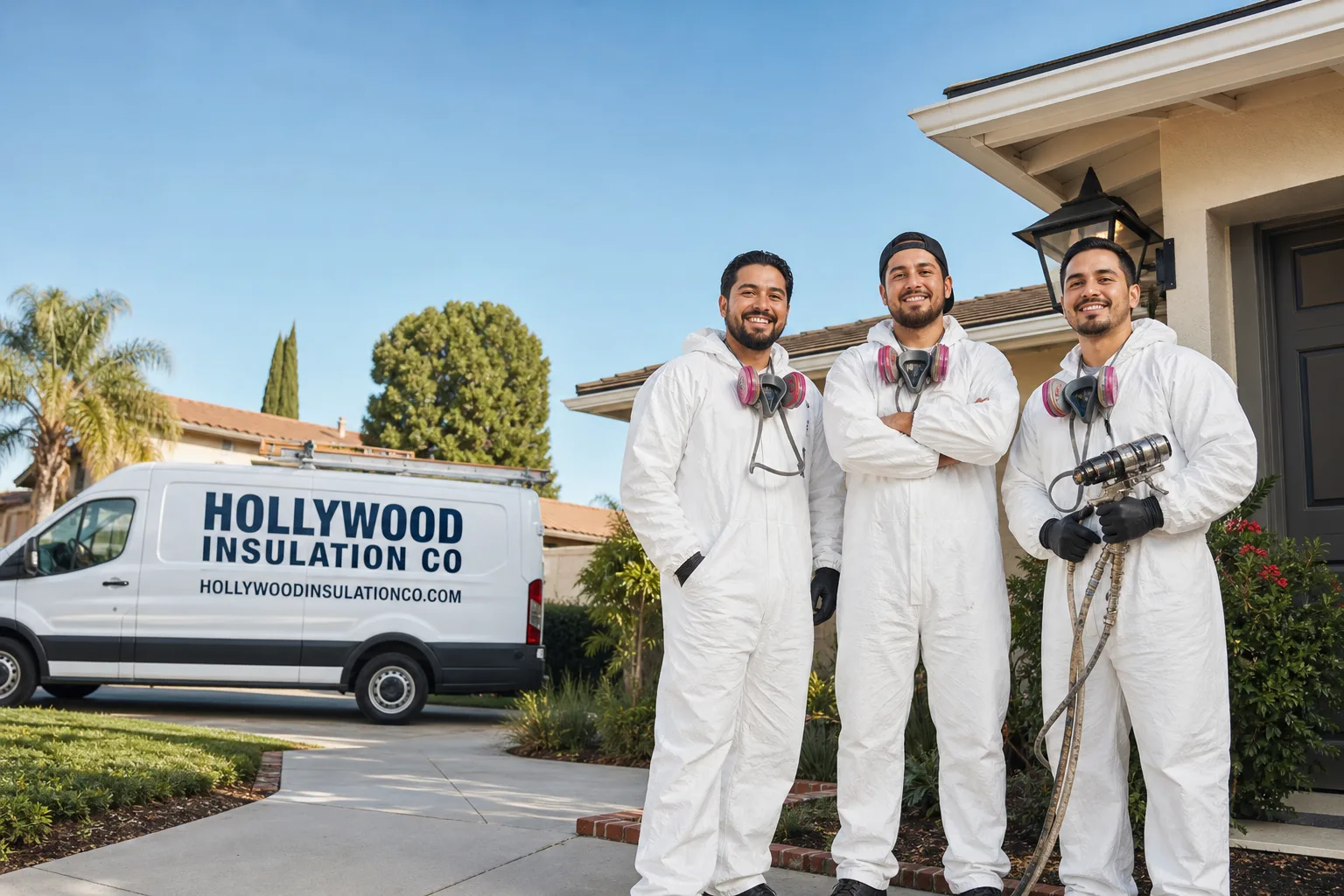
Fast, Reliable Spray Foam Insulation Across Sunland
Spray foam insulation in Sunland typically runs $2,400 – $6,800 for a full attic application on a single-story home, with most jobs completed in one to two days. The real question for most Sunland homeowners is whether their existing insulation has already failed under the valley-edge heat, and whether spray foam is the right fix. We work throughout 91040 and 91041, and we know exactly what the older ranch homes and foothill rebuilds in this area need because we have opened hundreds of attics here. Call (866) 605-6949 to schedule a free estimate.
Why Hollywood Insulation Co Is Sunland’s Preferred Spray Foam Insulation Company
We are insulation specialists, not a general contractor with an insulation division. Every technician on our Sunland jobs lives in this trade, and that shows when we encounter the unusual conditions common here: ash-contaminated attics from post-Sayre Fire rebuilds, low-pitch roof decks on foothill custom homes, and original fiberglass batts that have been baking under Sunland sun for 60-plus years. That familiarity means we do not have to guess at what works. We have already specified spray foam for dozens of homes in Sunland, so our recommendations carry the weight of field experience, not theory.
Our Spray Foam Insulation team carries both Icynene and Demilec systems, covering open-cell and closed-cell applications. That matters for Sunland because the foam spec changes depending on whether you are air-sealing a vented 1950s attic or encapsulating a tight, unvented cavity over a flat roof addition. We stock the material, we know the cure times in triple-digit heat, and we schedule jobs around Sunland’s hottest afternoon hours to keep the foam within its proper application window. When you call, you get a straight answer from someone who has done this exact job in your zip code.
Spray Foam Attic Insulation in Sunland
Spray Foam Attic Insulation in Sunland is the most effective way to stop the afternoon heat gain that makes inland-valley summers punishing, and it usually costs between $3,000 and $6,800 depending on roof area and access. Many Sunland homes built in the 1950s and 60s have original fiberglass batts that sag away from the roof deck, creating convection channels that let hot air radiate straight into bedrooms and living space. The fix is not another layer of fiberglass; it is sealing the attic at the roofline with spray foam so the heat never gets inside.
Sealing the Roof Deck Against Sunland Heat
On a 1958 ranch off Sunland Boulevard in 91040, our crew found original fiberglass batts sagging away from the roof deck, with heat staining on the west-facing sheathing. We removed the failing batts and applied Icynene spray foam to the underside of the deck, sealing the attic at the roofline and stopping the afternoon heat gain that had been baking the bedrooms. That is the typical failure mode in Sunland’s flat-valley tract homes: insulation installed before spray foam existed, now doing almost nothing.
Attic Encapsulation in Foothill Rebuilds
Hillside homes along the Angeles National Forest edge have a different problem. After the 2008 Sayre Fire, many rebuilds reused existing attic insulation, which now carries ash and smoke residue that traps odor and reduces R-value. Removing contaminated batts is labor-intensive, but spraying over them without addressing the contamination locks odor into the envelope. We spec the foam around the condition of the existing insulation, and that changes the scope from a simple spray to a full removal-and-encapsulation job.
Spray Foam Wall Insulation in Sunland
Spray Foam Wall Insulation in Sunland runs $2.40 – $3.80 per square foot of wall area, with full exterior-wall retrofit jobs on a single-story ranch landing between $4,500 and $12,000. Most Sunland homes were framed before wall insulation was standard practice in the San Fernando Valley, which means the wall cavities are either empty or stuffed with deteriorated batts that leave gaps around outlets, window frames, and rim joists. Spray foam fills those voids and creates an air seal that fiberglass never achieved in these older frames.
Retrofitting Empty Wall Cavities in 91040 Ranches
Many of the mid-century single-story homes between Sunland Boulevard and Woodward Avenue still have no wall insulation at all. That means the wall behaves like a thermal sieve, and before air conditioning existed, nobody noticed. Now it is the difference between a house that holds cool air and one that leaks it by 2:00 PM. We inject open-cell Icynene foam into the stud bays, and the air-sealing effect is immediate.
Fire-Resistant Wall Assemblies Near the Forest Edge
For homes closer to the Angeles National Forest boundary, we recommend closed-cell Demilec foam for its density, moisture resistance, and reduced airflow through the wall assembly during Santa Ana wind events. Ember intrusion is a real concern in these neighborhoods, and a tighter wall slows the movement of hot air through the cavity. That is a Sierra Madre foothill issue, not something you worry about in North Hollywood, and it changes the wall spec here.
Trusted Brands We Service in Sunland
We install Icynene both open- and closed-cell systems, and Demilec closed-cell foam for high-density applications. We also carry GreenFiber recycled cellulose and Owens Corning fiberglass for clients who want a non-foam option after seeing the full picture. Having all of these under one roof means we are not tied to promoting one material. Eight trusted brands, one honest recommendation, and that recommendation gets tailored to your Sunland home, not to whatever is already on the truck. That includes Reflectix service in Sunland when it fits the project.
Common Spray Foam Insulation Problems We See in Sunland Homes
- Sagging original fiberglass batts: In 1950s and 60s ranches, the original kraft-faced batts have pulled away from the roof deck and now hang in the rafter bays, letting heat flow straight through the attic. This is the most common failure we find in 91040.
- Ash-contaminated attics from post-Sayre Fire rebuilds: Homes rebuilt after 2008 often kept the old attic insulation, which absorbed smoke and ash. That material loses R-value and holds an odor that never aired out. It needs encapsulation or full removal before new foam goes in.
- Low-pitch flat roof cavities with zero ventilation: Foothill custom homes built after the fire often have flat or near-flat roofs with tight unvented attic spaces. Old sealant and incompatible foam can off-gas and blister new foam if the substrate is not prepped correctly. Skipping that step is a guarantee of callbacks.
- Rim joist air leakage at the foundation line: The exposed rafter and shallow floor framing common to Sunland ranch construction leaves rim joists wide open, and we regularly find daylight visible through the gap. Closed-cell foam seals these and stops the stack effect that pulls hot attic air down through the walls.
Pricing for Spray Foam Insulation in Sunland, CA
Open-cell attic spray foam in Sunland runs $1.80 – $2.80 per board foot installed, while closed-cell runs $2.80 – $4.20 per board foot depending on depth and access. A typical 1,200-square-foot attic installed at the roofline lands between $3,200 and $6,500. Wall cavity retrofits run $2.40 – $3.80 per square foot of wall area. The things that move the Sunland price most are roof pitch, attic access size, whether contaminated batts need removal, and how close the home sits to the foothills where trucks and material handling take longer. We give exact written quotes before any work starts, and estimates are always free. Call (866) 605-6949 to get your number.
We Also Serve Cities Near Sunland
We regularly run crews to Sunland and the surrounding foothill communities, and we service the same week for most calls. Our service area includes Shadow Hills, Tujunga, La Crescenta-Montrose, and Burbank, so if your job spans multiple properties or you are managing a remodel across city lines, one crew can handle it all.
Serving Sunland, CA — Our Local Coverage Area
We’re based in the Sunland area and know this community well. Use the map below to see our service coverage — if you’re nearby, we can almost certainly help.
FAQs About Spray Foam Insulation in Sunland
Yes, specifically because those original batts have almost certainly failed. After 50 to 60 years of Sunland’s summer heat, the kraft facing separates and the batts sag, leaving direct thermal bridging through the roof deck. Spray foam seals the attic at the roofline, and in most Sunland ranches, homeowners see the biggest single-season change in the hottest months. We recommend removing the old batts rather than spraying over them, because encapsulating a failed material means the failure stays inside the assembly. Call (866) 605-6949 and we will inspect your attic specifically.
We remove contaminated fiberglass and cellulose in most cases, then we air-seal the attic and install new spray foam. In a few situations where removal would damage the framing and the contamination is light, we encapsulate using closed-cell Demilec foam, which locks the particulate in place and restores the air seal. The decision is made per attic after we see the actual condition. The Sayre Fire rebuilt zone is a large part of our Sunland work, so this is not a new problem for us. Call (866) 605-6949 to have us evaluate your specific attic.
Yes, you can spray foam an unvented attic without conventional ventilation if the foam is applied directly to the underside of the roof deck at the full required depth. That converts the attic into a semi-conditioned space and keeps roof-deck temperatures under control in Sunland’s afternoon sun. The catch is substrate prep; old sealants or incompatible foam from a bad retrofit need to be addressed or the new foam can blister. We inspect the existing assembly before we quote, and we will tell you if prep work is required.
We recommend R-38 to R-49 in Sunland attics, with the higher end for west- and south-facing roof decks that take direct sun in the late afternoon, and for hillside homes where the reflective heat off the foothills raises the ambient roof temperature higher than the valley floor. Closed-cell foam reaches R-38 at about 5.5 inches, while open-cell needs closer to 10 to 12 inches. In Sunland, radiant heat is the dominant load, not winter cold, so the foam depth matters less than the air-sealing continuity. Call (866) 605-6949 for a roof-specific recommendation.
Spray foam seals the gaps where embers and hot air try to enter, especially at roof-to-wall intersections, gable ends, and cantilevered overhangs, but it is not a fireproofing product by itself. The benefit is a tighter building envelope that reduces the pathways wind can exploit. For homes along the forest boundary, we pair closed-cell foam with proper eave and gap sealing, and when a homeowner wants a fire-rated assembly, we can incorporate mineral wool or other code-specified layers in those vulnerable locations. Ask us about your specific roofline when you call (866) 605-6949.
Written by Noel Camacho, Owner at Hollywood Insulation Co, serving Sunland and the San Fernando Valley.