
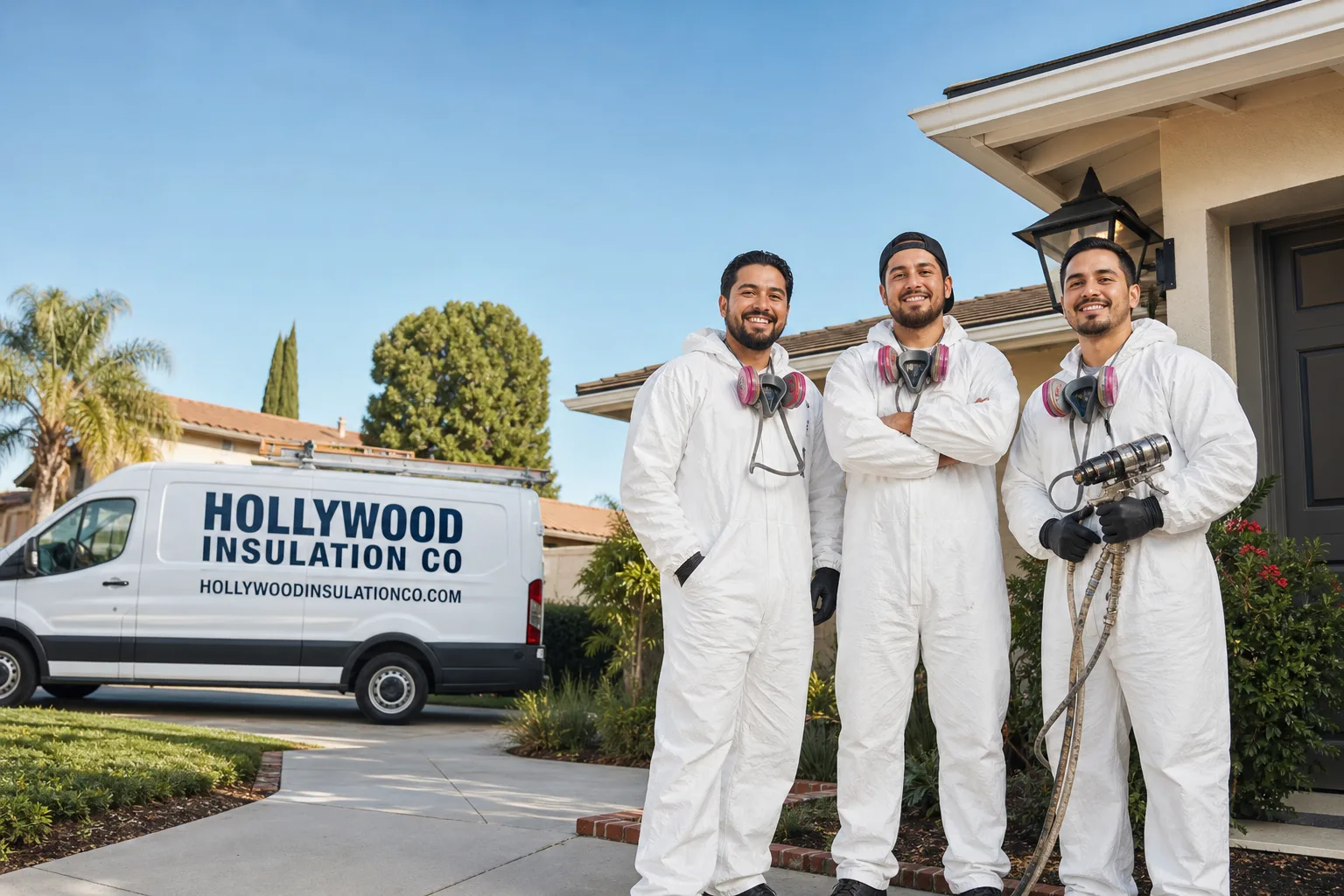
Fast, Reliable Spray Foam Insulation Across Downey
Spray foam insulation in Downey typically costs between $1,800 and $5,400 for a complete attic air seal and foam application, with rim joist work alone running $900 to $2,200. Most Downey jobs we quote start with a layer of removal work before any foam goes down, and we’ll get into why that matters in a minute. If you’re calling from 90240, 90241, or 90242, our crews can usually be at your door within 48 hours for an inspection. Reach us at (866) 605-6949 and we’ll walk your attic with you, tape measure and thermal camera in hand.
Why Hollywood Insulation Co Is Downey’s Preferred Spray Foam Insulation Company
We’re an insulation specialist, which means every tech on a Downey job lives in this trade full-time. We diagnose thermal bypasses, air leaks, and R-value deficiencies as the core skill, not a side service squeezed between remodeling jobs. When a Downey homeowner calls about a 140°F attic in August, we know what we’re walking into before we climb the ladder.
Our team works with eight manufacturer brands, but for Downey’s specific housing stock, we lean on Icynene and Demilec spray foam systems. Both open-cell and closed-cell applications are in our regular rotation. That matters here because Downey’s postwar ranches and bungalows rarely need the same foam spec as a new build in Orange County. We match the foam type to the attic conditions, not to whatever’s loaded on the truck that morning.
Noel Camacho leads our crews with a simple standard: every Downey job gets a full attic inspection and a clear scope of work before a single pass of foam goes down. We’re not a general contractor dabbling in insulation. We’re the crew other contractors in Downey call when they need the insulation done right.
Spray Foam Wall Insulation in Downey
Spray foam wall insulation in Downey is the fix for hot, uninsulated exterior walls in the city’s 1940s and 1950s bungalows, where original wall cavities are often empty or stuffed with a single layer of settled fiberglass. It involves drilling access into stud bays, injecting open-cell foam to fill the cavity, and sealing the holes. Downey homeowners who feel radiant heat bleeding through west-facing walls in the afternoon, especially on streets like Rives Avenue or parts of 90241, are the ones who call us about this. A typical wall insulation job in Downey runs $2,400 to $6,800 depending on the wall area and whether we’re working from the exterior or through interior drywall.
Open-Cell Cavity Fill for Existing Walls
Most Downey wall jobs we handle use open-cell foam. It expands fully into old, irregular stud bays, which matters in houses built before consistent framing standards. Open-cell air-seals the cavity and cuts the radiant heat transfer that turns bedrooms into ovens by late afternoon.
Closed-Cell for Moisture-Prone Walls
In Downey homes where stucco has aged or irrigation sits close to the foundation, we sometimes recommend closed-cell foam at the lower wall plates. It adds structural rigidity and blocks moisture wicking. The decision comes down to what we find in the cavity, and we’ll show you photos from the inspection before we recommend anything.
Rim Joist Spray Foam in Downey
Rim joist spray foam in Downey seals the band board where your floor framing meets the foundation, which is one of the biggest air leaks in the city’s ranch-style homes built across 90240 and 90242. A surprising amount of the dust and soot we vacuum out of Downey attics originally entered through unsealed rim joists. Sealing them cuts drafts, keeps the attic cleaner, and stops conditioned air from escaping through the floor-to-wall connection. Rim joist work on a typical Downey ranch runs $900 to $2,200, and we can usually get it done in half a day if the space is accessible.
Air Sealing the Band Board
The band board is the rim of wood that caps the floor joists. In Downey’s older homes, it’s rarely caulked or sealed, so air moves freely between the crawl or basement and the living space. Closed-cell foam squirted into each joist bay locks that air movement down.
Dust and Soot Infiltration from the Montebello Oil Field
Downey sits close to the Montebello oil field and an industrial belt that ran hard for decades. We regularly see rim joists caked with black, oily dust that’s been drawn in through gaps in the band board. Foam seals those gaps permanently, which means the next decade of dust stays outside where it belongs.
Trusted Brands We Service in Downey
We install Icynene and Demilec spray foam systems because they’re two of the most specified spray polyurethane foam brands in North America, and because they cover both the open-cell and closed-cell applications Downey homes actually need. For Downey homeowners who want recycled-content or fire-resistant alternatives, we also carry GreenFiber cellulose and Owens Corning batt products. Carrying eight brands across fiberglass, mineral wool, spray foam, and cellulose means we recommend the right material for your attic’s actual conditions, not the one we happen to stock. Spray Foam Insulation is what we do every day, so the material choice always comes from the inspection, not from inventory.
Common Spray Foam Insulation Problems We See in Downey Homes
- Foam sprayed directly over original Zonolite vermiculite. This is the most common mistake we undo in Downey. Vermiculite from the Zonolite mine commonly contains asbestos, and spraying foam over it traps the material against the attic deck permanently. It has to come out first, and that removal needs a licensed contractor.
- Foam encasing buried knob-and-tube or early romex wiring. Downey’s postwar homes often have original wiring still crossing the attic. If foam goes over it before an electrician clears it, those conductors are encased and unserviceable. We flag and map every wire run before we spray.
- Thin foam passes under-spec’d for Downey’s attic heat. Low-pitch roofs and long summer sun push Downey attic decks past 140°F. A thin open-cell pass that works in a cooler climate still lets radiant heat soak through the ceiling here. We spec the foam thickness and type for that actual heat load.
- Skipping the vacuum-out entirely. Decades of Montebello oil-field soot settles into Downey joist bays. Foam applied over that dust bonds poorly and traps the grime. A full attic vacuum-out before foam isn’t optional in Downey; it’s what separates a 15-year foam job from one that delaminates in five.
Pricing for Spray Foam Insulation in Downey, CA
Here’s what spray foam insulation actually costs in Downey, based on the homes and attics we work in every week. A full attic air seal with open-cell foam runs $1,800 to $4,200 on a typical 1,000 to 1,500-square-foot ranch. Closed-cell attic applications run higher, usually $3,200 to $5,400, because the material costs more and the application is slower. Wall cavity injection runs $2,400 to $6,800. Rim joist sealing runs $900 to $2,200. The two big variables in Downey are removal work, which most jobs here need, and wiring clearance, which adds time but not much material cost. Call (866) 605-6949 for a free estimate and we’ll give you a line-item scope based on your attic, not a generic square-foot price.
We Also Serve Cities Near Downey
Our crews run daily routes from Downey into Bell Gardens, Santa Fe Springs, Paramount, and Pico Rivera. If you’re in one of those ZIPs and your attic is cooking, call (866) 605-6949 and ask for a next-available inspection. We’ll bring the thermal camera and a straight answer.
Serving Downey, CA — Our Local Coverage Area
We’re based in the Downey area and know this community well. Use the map below to see our service coverage — if you’re nearby, we can almost certainly help.
FAQs About Spray Foam Insulation in Downey
No. We will not spray foam over Zonolite vermiculite in Downey. That material came from the Zonolite mine in Montana, and the vast majority of it contains asbestos. Foam applied over it seals it permanently against the attic deck and makes future removal far more expensive and hazardous. The vermiculite has to be vacuumed out by a licensed abatement contractor first, then we inspect the deck, clear any wiring issues, and proceed with foam. Call (866) 605-6949 and we’ll help you figure out if your attic has vermiculite and what removal will cost.
Downey attics carry decades of settled dust and soot from the Montebello oil field and surrounding industry, plus degraded fiberglass and often crumbled vermiculite. Foam doesn’t adhere to dust. It peels, gaps, and leaves air channels that defeat the entire air-seal. A full vacuum-out to bare deck and joists gives the foam a clean surface to bond to. We include this in every Downey attic quote because skipping it is the fastest way to waste a foam job.
It means we spec the foam thickness and type for that heat load, not for a generic climate chart. Downey’s low-pitch roofs and long summer sun push attic decks well past 140°F. Closed-cell foam handles that heat and adds structural rigidity to older decking. Open-cell can work, but it needs to be applied at the right depth and paired with proper ventilation. The heat load also means we don’t recommend thin passes that look good on paper but let radiant heat soak the ceiling by August. Call (866) 605-6949 and we’ll assess your specific roof pitch and sun exposure.
Yes, and we recommend it on nearly every Downey ranch we inspect. The band board in 1950s and 1960s ranches across 90240, 90241, and 90242 is almost never sealed. Air moves freely between the crawl space and the living areas, carrying dust and drafts. Closed-cell foam in each joist bay stops that. It’s one of the highest-value air-sealing jobs we do in Downey, usually done in half a day.
Most Downey jobs with layered insulation take two to three days total. Day one is the vacuum-out, which clears the old fiberglass blanket and the original vermiculite down to bare deck. Day two is wiring inspection and any clearance work your electrician needs to do. Day three is the foam application itself, which on a typical ranch is done in a single morning. The removal work is what stretches the timeline here, not the foam. Call (866) 605-6949 for a schedule based on your attic’s actual layers.
On a 1950s ranch off Rives Avenue in 90241, our crew opened the attic to find the original vermiculite buried under a collapsed R-11 kraft-faced fiberglass blanket, plus decades of oil-field soot settled into the joist bays and a run of undersized early romex crossing the rim. We vacuumed the whole deck out, cleared and flagged the wiring for the homeowner’s electrician, then sealed the rim joists and sprayed closed-cell along the top plates and knee walls to lock the attic down in one trip. That’s the job Downey attics actually need, and it’s the one we do.
Written by Noel Camacho, Owner at Hollywood Insulation Co, serving Downey and surrounding communities.