
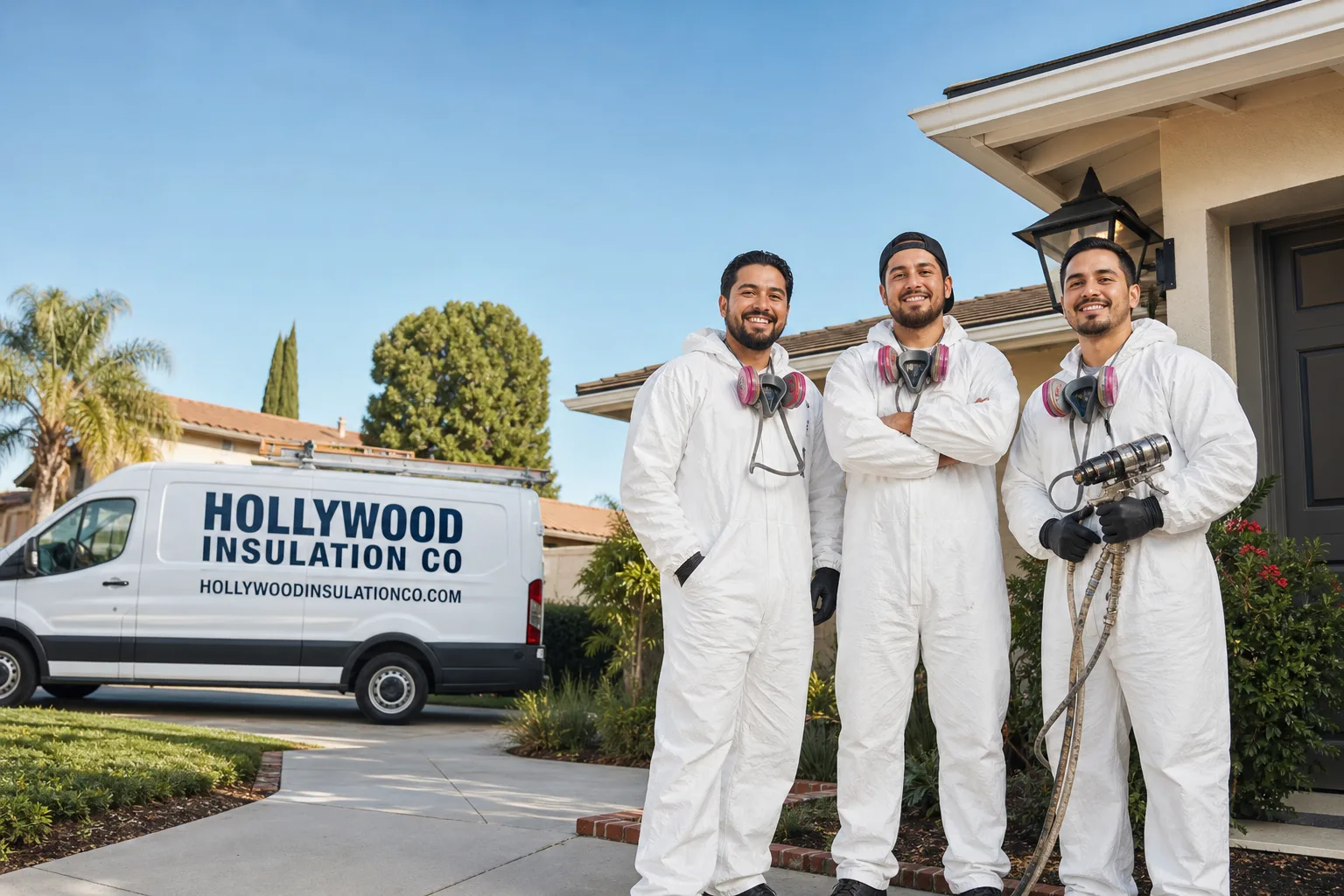
Fast, Reliable Spray Foam Insulation Across Good Hope
Spray foam insulation in Good Hope runs $2.80 to $6.90 per board foot installed, with most attic projects landing between $3,200 and $7,400 depending on foam type and square footage. We work throughout the 92572 ZIP code weekly, and our crews know exactly what Good Hope homes are up against: 100-degree summer attics, near-freezing winter nights, and Santa Ana dust that settles into every gap. That year-round thermal swing is why so many Good Hope homeowners call us after trying batt insulation that just couldn’t hold up. If you’re tired of hot and cold spots in the same house, call (866) 605-6949 for a free estimate.
Why Hollywood Insulation Co Is Good Hope’s Preferred Spray Foam Insulation Company
Good Hope homeowners recognize that we’re insulation specialists, not a general contractor squeezing in insulation between remodels. Every call we take in 92572 is handled by a team that works exclusively with insulation systems, and that focus shows up in the details: we diagnose thermal bypasses, air leakage points, and R-value deficiencies before recommending anything. We carry both Icynene and Demilec spray foam systems, which means a Good Hope home gets the right open-cell or closed-cell foam for its specific envelope problems, not whatever happens to be stacked in the truck.
Our reputation in this part of Riverside County is built on honest material matching. We’re the crew that tells a mobile home owner when closed-cell foam on the belly board makes sense versus when a different approach will outlast the rodents. That kind of straight answer matters in a small community like Good Hope, where word travels fast between neighbors on Gilman Springs Road and the side streets off Highway 74. Noel Camacho, who leads Hollywood Insulation Co, built the company on the principle that the right insulation is the one that fits the home’s actual conditions, not the cheapest square footage.
Response time to Good Hope is a priority for us. We schedule around your availability and show up when we say we will. For urgent issues like a roof deck with foam pulling away after a thermal cycle, we can typically get eyes on it within 48 hours. Estimates are always free, and we walk every attic before we quote.
Spray Foam Attic Insulation in Good Hope
Spray Foam Attic Insulation in Good Hope is the single most effective upgrade we install in this community because the attic is where Good Hope’s temperature swings hit hardest. In summer, an uninsulated attic here can reach 140°F, and in winter it can drop to near freezing on the same day the living room is heated. Closed-cell foam applied directly to the roof deck creates an air barrier and an insulation layer in one pass. It stops the stack effect that pulls conditioned air out of the house, and it holds up to the thermal expansion and contraction that inland Riverside County throws at it.
Most Good Hope attic foam jobs run $3,800 to $7,400 for a typical 1,200 to 1,800 square foot single-story home. That range covers full roof deck application of closed-cell foam at two inches, which delivers roughly R-14 plus a complete air seal. Open-cell foam is less expensive per board foot but doesn’t provide the same moisture control, so we tend to recommend closed-cell for Good Hope’s unvented attic conversions. It seals the envelope tighter, and in a climate this dry, that matters for keeping dust out along with the heat.
Why We Air-Seal Before the Foam Goes In
Foam is only as good as the prep work. We spend as much time sealing recessed light housings, top plates, and plumbing penetrations as we do spraying, because every unsealed path is a leak that foam alone won’t fix. On a 1970s single-family home off Gilman Springs Road, we found the original fiberglass batts collapsed and the attic hatch leaking summer heat. After air-sealing and applying two inches of closed-cell Icynene foam to the roof deck, the homeowners reported a 15-degree cooler attic and no more winter drafts.
Mobile Home Attic Foam
A surprising number of Good Hope residents live in manufactured homes, and the attic assemblies in those units are shallow and poorly sealed from the factory. Spray foam works well here because it conforms to shallow cavities and seals roof penetrations that fiberglass batts simply can’t reach. We’ve done dozens of these jobs in 92572, and the comfort difference is immediate, especially in the summer when the metal roof radiates heat downward into the living space.
Spray Foam Wall Insulation in Good Hope
Spray Foam Wall Insulation in Good Hope is the right call for older single-family homes where the original wall cavities are either empty or filled with settled fiberglass that’s lost most of its R-value. The dry climate here preserves wood framing remarkably well, but it also means wall cavities stay hot in summer and cold in winter, because there’s no moisture to slow the heat transfer. Closed-cell foam injected into wall cavities or sprayed on open framing during a remodel creates a thermal break that no fiberglass batt can match.
Wall foam projects in Good Hope generally run $2,900 to $5,800 for a retrofit on a typical three-bedroom home, depending on how accessible the cavities are and whether we’re working from the interior or exterior. Open-cell foam is sometimes the better wall choice because it’s less expensive and still air-seals effectively, but it absorbs moisture if water intrudes, so we evaluate each wall system before recommending a foam type. For remodels with open studs, we almost always recommend closed-cell because the added structural rigidity is worth it on older Good Hope framing.
Garage Walls and Rim Joists
Attached garages are a major source of heat gain in Good Hope, especially when the garage door faces west into the afternoon sun. We regularly spray garage wall cavities that separate the garage from the living space, along with rim joist areas where the floor framing meets the foundation. We also sprayed the garage walls on that Gilman Springs Road project, where salt air from the nearby Santa Ana River bed had corroded the original fasteners. We replaced them with stainless steel before foaming, because spraying over corroded hardware just buries a problem that will keep degrading behind the foam.
Trusted Brands We Service in Good Hope
Good Hope homeowners deserve to know exactly what product is going into their walls and attic. We install Icynene open-cell and closed-cell foam, plus Demilec closed-cell systems, both recognized as two of the most specified spray polyurethane foam brands in North America. For homes where spray foam isn’t the right fit, we also carry Rockwool mineral wool and GreenFiber cellulose. Eight manufacturer brands total means we’re never forcing one material on a Good Hope job. We stock enough Icynene and Demilec product to handle most Good Hope projects without delay, so a scheduled install doesn’t get pushed while we wait on a shipment from a warehouse in Riverside.
Common Spray Foam Insulation Problems We See in Good Hope Homes
- Foam pulling away from the roof sheathing. The expansion and contraction from 100°F summer days followed by near-freezing winter nights stresses adhesion. We see this in attics where foam was applied too thin or over a dusty surface, and it’s a leading reason Good Hope homeowners call us for remediation.
- Santa Ana dust fouling open-cell foam. Fine dust blows into attic vents during wind events and settles into the open-cell texture, reducing its insulating value over time. Closed-cell foam’s smooth surface doesn’t hold dust the same way, which is one more reason we lean closed-cell for Good Hope attics.
- Rodent damage to mobile home belly foam. Good Hope’s rural setting means packs of rats, feral cats, and ground squirrels consistently tear out vulnerable underbelly insulation in manufactured homes. When we spray foam on a mobile home belly, we always recommend skirting repair and rodent exclusion first, otherwise the new foam becomes a nesting material target within months.
- Air leakage around the attic hatch. The attic access point is often the worst-sealed spot in a Good Hope home, leaking heat in summer and cold air in winter. We seal and insulate the hatch as part of every attic foam installation, because skipping it undercuts the entire job.
Pricing for Spray Foam Insulation in Good Hope, CA
Here’s what Good Hope homeowners can expect to pay for spray foam work in the 92572 area:
- Open-cell spray foam: $2.80 to $4.40 per board foot installed
- Closed-cell spray foam: $4.20 to $6.90 per board foot installed
- Attic roof deck (typical single-story home): $3,800 to $7,400
- Wall retrofit (typical 3-bedroom home): $2,900 to $5,800
- Rim joist sealing: $900 to $1,800 depending on accessibility
The biggest cost driver in Good Hope is the home’s age and whether old insulation has to be removed first. Mobile home projects run on the lower end because the spaces are smaller, but rodent damage and skirting repairs can add to the total. We quote every job in writing before any work starts, and the price you approve is the price you pay. Call (866) 605-6949 for a free estimate and we’ll walk your attic or wall cavities with you.
We Also Serve Cities Near Good Hope
Hollywood Insulation Co handles Spray Foam Insulation projects throughout the Perris Valley and surrounding Riverside County communities. In addition to Good Hope, our crews regularly work in Perris, Romoland, Sun City, and Mead Valley. If you live in one of those communities and need spray foam expertise, the same team and the same honest material matching applies.
Serving Good Hope, CA — Our Local Coverage Area
We’re based in the Good Hope area and know this community well. Use the map below to see our service coverage — if you’re nearby, we can almost certainly help.
FAQs About Spray Foam Insulation in Good Hope
Yes. Spray foam is the most effective insulation method for Good Hope’s year-round temperature swings because it creates both an air barrier and an insulation layer, stopping heat gain in summer and heat loss in winter simultaneously. Closed-cell foam on the roof deck keeps attics from becoming ovens in July while also preventing warm interior air from escaping during freezing winter nights. Homeowners who switch from fiberglass batts to spray foam typically notice the difference within the first week. Call (866) 605-6949 for a free attic assessment and we’ll show you exactly where your home is leaking.
Yes, spray foam works in mobile homes, but the belly board application requires careful prep work in Good Hope because rodents constantly tear at underbelly insulation. We recommend repairing skirting and doing rodent exclusion first, then applying closed-cell foam to the belly area, which holds up better than fiberglass batt or factory belly board. The foam seals gaps that let heat in during summer and cold air in during winter, but it won’t fix a rodent problem on its own. Call (866) 605-6949 and we’ll inspect your mobile home’s underbelly before recommending a plan.
Good Hope’s dry climate and Santa Ana winds affect spray foam in two ways: the winds force fine dust into attic spaces, which can foul open-cell foam over time, and the extreme dryness combined with thermal cycling stresses adhesion on roof deck applications. We address this by recommending closed-cell foam for most Good Hope attics, since its dense surface resists dust accumulation and its adhesive properties handle expansion and contraction better than open-cell. Proper surface prep before spraying is also critical, which is something we never shortcut. For a specific recommendation on your home, call (866) 605-6949.
Closed-cell spray foam is the best choice for Good Hope attics because it handles thermal cycling without pulling away from the roof sheathing, and it creates a vapor barrier that protects the framing from condensation during cold winter nights. Open-cell foam is less expensive but doesn’t provide the same adhesion or moisture control under Good Hope’s conditions. We install both Icynene and Demilec closed-cell systems, and we’ll recommend the specific product based on your roof assembly and budget. Call (866) 605-6949 for an honest recommendation grounded in what we’ve seen work in 92572.
Sometimes yes, sometimes no. If the old insulation is clean, dry fiberglass batt, we can often spray foam right over it, though we’ll remove batt around lights and vents for proper air sealing. If the old insulation is rodent damaged, water stained, or full of Santa Ana dust, removal is the better call before new foam goes in. The goal is a clean substrate so the foam adheres properly and doesn’t trap moisture or contaminants. We’ll tell you during the free estimate whether removal is necessary, and we’ll include that cost in your written quote. Call (866) 605-6949 to schedule an inspection.
Written by Noel Camacho, Owner at Hollywood Insulation Co, serving Good Hope and the Perris Valley with spray foam, attic, and blown-in insulation.