
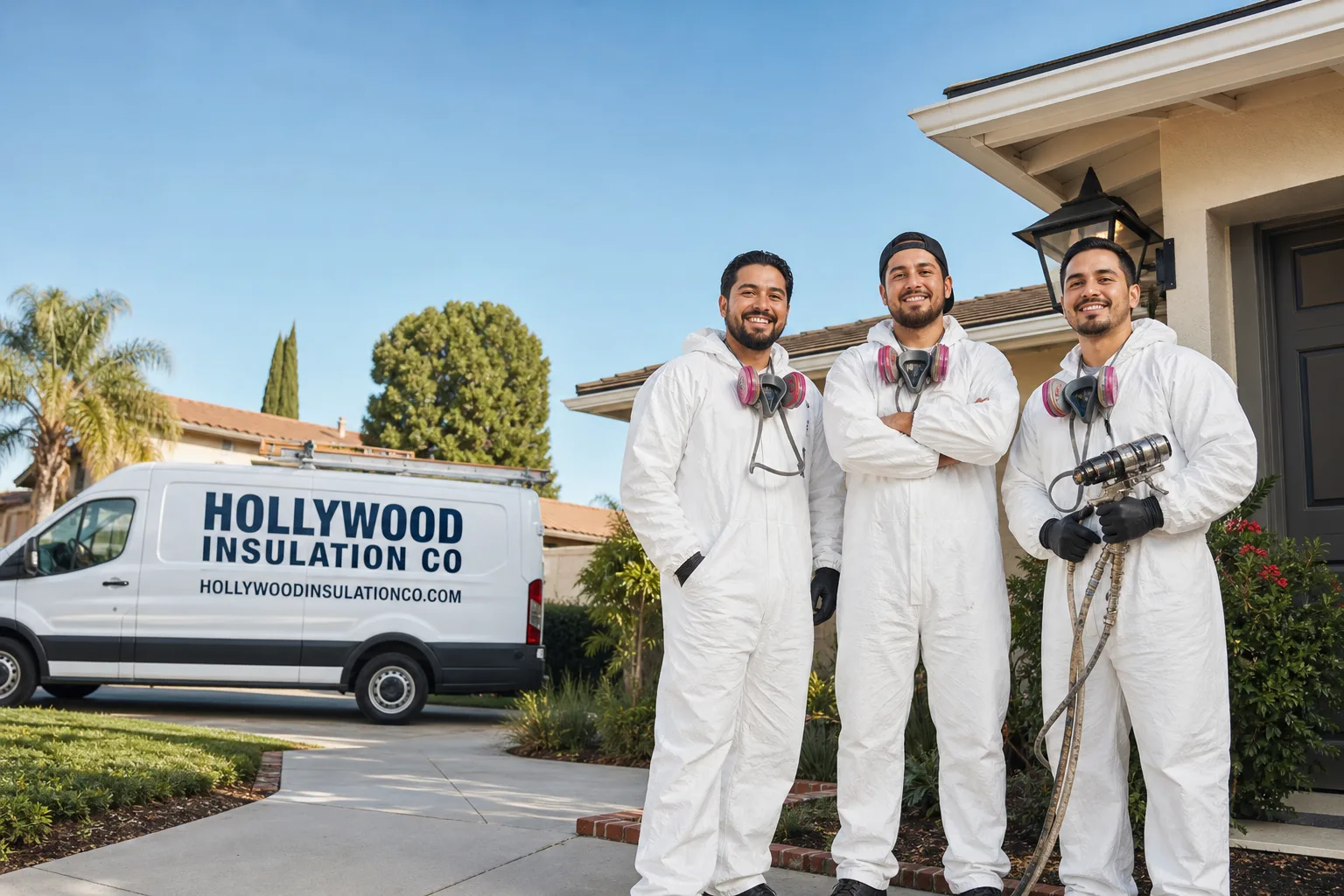
Fast, Reliable Spray Foam Insulation Across Grand Terrace
Spray foam insulation in Grand Terrace typically runs $2.25 to $4.75 per board foot installed, and most whole-attic projects land between $3,800 and $9,200 depending on foam type and roofline complexity. But here’s what matters more than the number: Grand Terrace attics are not like attics ten miles west. The homes along the slopes off Barton Road and the 215 corridor take heat and dust in ways a coastal house never will. If you’re in the 92313 ZIP and your west-facing rooms won’t hold temperature after 2 p.m., that’s a roof-deck and air-sealing problem, not just a “needs more insulation” problem. Call us at (866) 605-6949 and we’ll diagnose it properly.
Why Hollywood Insulation Co Is Grand Terrace’s Preferred Spray Foam Insulation Company
We’re a dedicated Spray Foam Insulation specialist, not a general contractor who happens to carry a foam rig. That focus matters in a city like Grand Terrace, where the housing stock is specific: small-lot 1950s to 1970s tract homes built on terraces climbing toward Blue Mountain. Our technicians walk these streets weekly. They know the difference between a 1962 original attic off La Cadena Drive and a 1980s addition off Barton Road, and they know which one has settled batts hiding under blown-in cover.
Noel Camacho leads our team, and the standard he sets is simple: diagnose the thermal bypass before recommending a material. We carry eight manufacturer brands because no single foam or batt system is right for every roofline. For Grand Terrace specifically, that means Icynene open-cell on shaded front slopes and Demilec closed-cell on sun-blasted rear slopes. It’s the same house, two different strategies. That’s the kind of detail a valley-floor crew from Colton or Highgrove often misses.
Closed Cell Spray Foam Insulation in Grand Terrace
Closed Cell Spray Foam Insulation in Grand Terrace is the material we spec most often on west-facing roof decks that back up to the Blue Mountain slope, because it adds structural rigidity, blocks moisture, and carries an R-value near 7 per inch even in high-heat conditions. When the afternoon sun hits those rear rooflines, the sheathing can climb past 150°F, and open-cell foam alone won’t manage that thermal load the same way. A typical closed-cell roof deck job in Grand Terrace runs $2.75 to $4.75 per board foot, with full attic applications usually landing between $5,500 and $10,500 on older tract homes where the existing insulation has settled to almost nothing.
Roof Deck Applications on Sun-Exposed Slopes
On the rear slopes that face Blue Mountain, we install closed-cell directly against the underside of the roof sheathing. This creates an unvented, conditioned attic that stops radiant heat before it ever reaches the living space. For Grand Terrace homes built in the 1950s and 60s, this is often the single highest-impact upgrade available.
Moisture Control and Air Sealing in One Step
Closed-cell’s density also gives it a built-in vapor barrier, which matters in Grand Terrace when winter rains follow months of dry heat. It seals top plates, penetrations, and rim joist gaps while insulating, so the wind-driven dust from Santa Ana events stops pulling through the wall cavities.
Open Cell Spray Foam in Grand Terrace
Open Cell Spray Foam in Grand Terrace is the right choice for shaded front slopes, interior walls, and garage ceilings where you want serious air sealing at a lower material cost. It expands to fill irregular cavities in older framing, which is exactly what 1960s tract homes off La Cadena and Barton Road need. Open-cell runs $2.25 to $3.75 per board foot, so a standard 1,200-square-foot attic on the front slope typically falls between $2,800 and $5,600. It’s the workhorse product when the sun exposure is moderate and the priority is stopping air movement, not adding maximum R-value per inch.
Air Sealing Older Wall Cavities
Most Grand Terrace homes built before 1980 have wall cavities that were never sealed at the top plates, so dusty air from the 215 corridor pulls through outlets and baseboards even after new insulation goes in. Open-cell foam fills those gaps and settles into the framing, cutting the drafts that make rooms feel five degrees warmer in August.
Garage Ceiling and Rim Joist Applications
The garage ceiling is a thermal boundary most Grand Terrace homeowners forget about, especially when it sits below a west-facing roofline. We apply open-cell foam to the garage ceiling and rim joist area to stop heat transfer into adjacent bedrooms. If the garage door itself is an original one-piece with failing hardware, that gets addressed separately before insulation goes in, otherwise the foam is just slowing down a leak that never closed.
Trusted Brands We Service in Grand Terrace
We install both Icynene and Demilec spray foam systems in Grand Terrace, which gives us genuine flexibility on every job. CertainTeed products round out our batt and roll inventory when a hybrid approach makes more sense than full foam. Because we work these streets regularly, we keep common material stock on the truck for Grand Terrace projects, meaning fewer return trips and faster completion. You’ll get a straight answer about whether Icynene open-cell or Demilec closed-cell fits your roofline and budget, not whichever can is already open on the trailer.
Common Spray Foam Insulation Problems We See in Grand Terrace Homes
- Settled original batt insulation on west-facing slopes. Homes built in the 1950s through the 70s along the terraces off Barton Road and the 215 corridor often have original fiberglass batts that have compressed to half their rated thickness, leaving the rear roofline with almost no effective R-value while the front stays comparatively cool.
- Unsealed top plates pulling dust and heat into living spaces. The small-lot tract construction common in 92313 rarely included air sealing at the framing level, so Santa Ana wind and corridor dust move through outlets, light fixtures, and baseboards year-round, even after insulation is added on top.
- Legacy garage doors creating thermal bridges at the ceiling. Original one-piece or early sectional doors with tired springs and worn openers leak air continuously, and spray foam on the garage ceiling only helps if the door hardware is addressed first, otherwise the thermal bridge remains open.
- High attic temperatures on rooflines that back to Blue Mountain. Attic temperatures in Grand Terrace regularly exceed 150°F on the rear slope in summer, which degrades older batt insulation faster and makes a roof-deck foam application far more effective than adding more fiberglass on the attic floor.
Pricing for Spray Foam Insulation in Grand Terrace, CA
Closed-cell spray foam in Grand Terrace runs $2.75 to $4.75 per board foot, while open-cell runs $2.25 to $3.75. A full attic on a typical 1,100 to 1,600 square foot 1960s tract home lands between $3,800 and $9,600 depending on foam type, roof complexity, and whether we’re doing the front slope, rear slope, or both. Garage ceiling applications usually run $1,200 to $2,600. Rim joist work on a single-story home typically falls between $900 and $2,100. These are honest ranges for the Grand Terrace market, not bait numbers from a national chain site. Call (866) 605-6949 for a free estimate and we’ll give you a fixed quote based on your actual roofline, not a square-footage guess.
We Also Serve Cities Near Grand Terrace
Hollywood Insulation Co handles spray foam projects throughout the Inland Empire. Beyond Spray Foam Insulation in Grand Terrace, our crews regularly work in Highgrove, Colton, Loma Linda, and Rubidoux. If you’re in one of those neighboring cities and dealing with the same west-facing heat load, call the same number: (866) 605-6949.
Serving Grand Terrace, CA — Our Local Coverage Area
We’re based in the Grand Terrace area and know this community well. Use the map below to see our service coverage — if you’re nearby, we can almost certainly help.
FAQs About Spray Foam Insulation in Grand Terrace
Because the rear slope that faces Blue Mountain takes direct afternoon sun for hours while the front slope stays shaded, so a single foam type across the whole roof wastes money on one side or under-protects the other. We typically spec closed-cell on the rear slope for maximum R-value and moisture resistance, and open-cell on the front for cost-effective air sealing. Call (866) 605-6949 and we’ll walk your roofline and tell you exactly what each slope needs.
In most cases, upgrade before insulating. A one-piece door with original springs and a worn drive gear will keep leaking air at the ceiling and jambs no matter how much foam you put above it. We work with Grand Terrace homeowners to remove the failing opener hardware, seal the top plates with spray foam, and re-hang a modern sectional door so the garage stops fighting the insulation. We don’t install garage doors ourselves, but we do coordinate the sequence so you’re not paying for insulation twice.
Grand Terrace sits at the eastern edge of the Inland Empire’s smog belt, and when Santa Ana winds blow, fine dust from the 215 corridor gets driven into wall cavities and attics that were never air-sealed. Spray foam, especially open-cell on interior walls and top plates, stops that dust infiltration at the source. Batts alone won’t do it because air moves around them.
Yes, and it’s the most direct fix we know of. When sheathing on a west-facing rear slope hits 150°F in summer, closed-cell foam applied to the roof deck stops heat before it enters the attic space. That keeps the attic closer to conditioned temperature and reduces the load on your HVAC. The same approach on a shaded front slope is usually overkill, which is why we split the strategy.
We install Icynene and Demilec spray foam systems, selected based on the application. For older tract homes with settled batts and unsealed cavities, Icynene open-cell is often the right first step on interior and shaded areas, while Demilec closed-cell handles the sun-exposed rear slopes. Both are recognized brands with a long track record, and we’ll tell you which one fits your specific house, not which one is easier for us to spray that day. For an exact recommendation, call (866) 605-6949.
Written by Noel Camacho, Owner at Hollywood Insulation Co, serving Grand Terrace and the Inland Empire.