
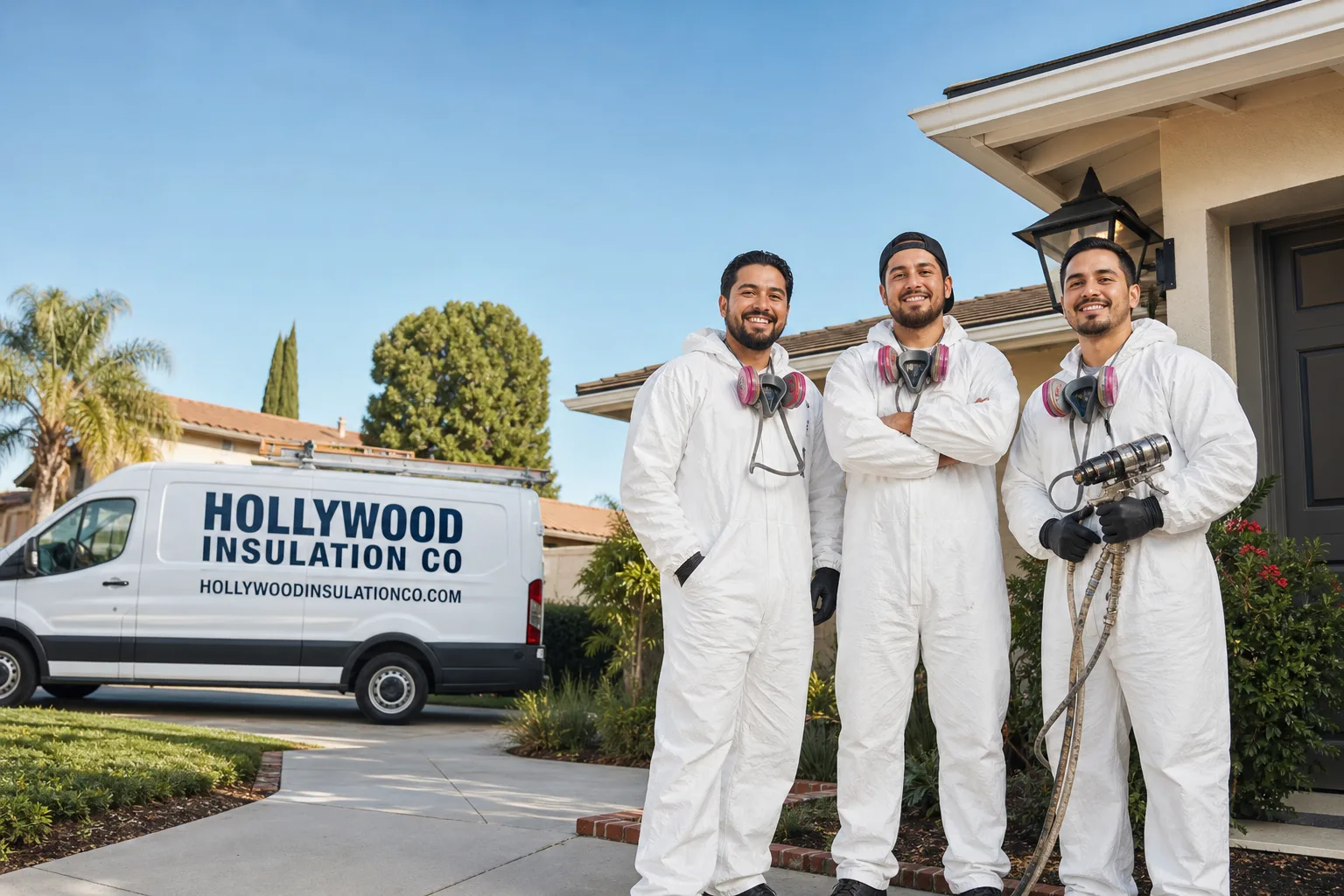
Fast, Reliable Spray Foam Insulation Across Koreatown
Spray foam insulation in Koreatown solves two problems most homeowners don’t expect: brutal summer heat gain through uninsulated attic spaces, and the constant transfer of noise through shared walls in converted multi-unit buildings. A typical closed-cell spray foam job in a Koreatown bungalow or apartment runs $2,400 – $5,800 depending on square footage and wall cavity access. Hollywood Insulation Co works throughout the 90005 ZIP code, from Wilshire corridor mid-rises to the converted Craftsman courts east of Western. Call (866) 605-6949 and we’ll have someone on your block within 48 hours to look at the actual wall or attic assembly, not just quote over the phone.
Why Hollywood Insulation Co Is Koreatown’s Preferred Spray Foam Insulation Company
We’re a dedicated insulation specialist, not a general contractor who occasionally installs foam. Every technician on our crew works in this one trade daily, which matters when you’re foaming a 1920s lath-and-plaster wall that still has knob-and-tube wiring inside the stud bays. We know how foam expands against old plaster keys, how to prep a 60-year-old attic for spray application, and when open-cell makes more sense than closed-cell for a Koreatown apartment’s interior partition.
Koreatown homeowners and building managers call us because we carry both Icynene and Demilec spray foam systems, so the conversation starts with your wall assembly, not with whatever product happens to be on the truck. That method-agnostic approach matters in 90005, where one building might need sound-dampening in party walls while the unit upstairs needs thermal protection in the roof deck. We specify the right foam for each surface.
Our Spray Foam Insulation team knows the converted bungalow stock around South Normandie, the stucco apartment blocks along Olympic, and the newer condo towers stacked near Wilshire and Western. We’ve foamed party walls in three-unit conversions, sealed rim joists in mid-century walkups, and insulated roof decks on recent construction. The building type dictates the approach, and we’ve seen most of them in Koreatown.
Noel Camacho leads every estimate and walk-through for Hollywood Insulation Co. If you’re a landlord with tenant noise complaints in a 1926 conversion, or an owner-occupant tired of cooling a unit that leaks air through uninsulated ceiling cavities, call (866) 605-6949 and we’ll schedule a site visit before you commit to anything.
Closed Cell Spray Foam Insulation in Koreatown
Closed Cell Spray Foam Insulation in Koreatown is the go-to spec for party walls, rim joists, and any surface where you need both an air seal and serious sound blocking in a 2×4 cavity. At roughly 6.5 R per inch and with a density that stops vibration, closed-cell foam performs in Koreatown’s converted bungalows where a shared wall is the only thing between one tenant’s TV and another’s bedroom. Count on $3.50 – $6.50 per board foot installed for typical 90005 retrofit work.
Party Wall Sound Isolation
In the tightly packed conversions around South Normandie and Westmoreland, closed-cell foam applied to the stud cavities of a shared wall closes the air gaps that carry sound. We also get the moisture-control benefit, which matters in a climate where the building dries out unevenly after the coastal marine layer burns off.
Rim Joist And Band Board Sealing
Older Koreatown apartment blocks and bungalows lose serious air through the rim joist where the floor framing meets the foundation. Foaming that perimeter band with closed-cell stops the stack effect that pulls hot air up through the wall cavities during summer and cuts the drafts tenants feel in winter.
Open Cell Spray Foam in Koreatown
Open Cell Spray Foam in Koreatown works best for interior partitions where you want sound absorption without the cost or density of closed-cell, and for attic applications where ventilation is already addressed. At about 3.5 R per inch and roughly $1.50 – $3.00 per board foot installed, open-cell Icynene foam is a practical choice for filling the ceiling cavities of a 1920s bungalow conversion in 90005 where the roof framing is too tight for batt.
Interior Partition Noise Reduction
When a Koreatown landlord needs to quiet footstep noise between upstairs and downstairs units, open-cell foam in the floor-joist cavities absorbs the sound instead of transmitting it through the structure. The foam expands to fill odd-shaped joist bays in older framing, something batts can’t do well.
Attic Ceiling Air Sealing
Applying open-cell to the underside of a Koreatown roof deck creates an air seal that stops radiant heat from baking the top-floor unit. We always confirm the attic has adequate venting first; foam against a sealed unventilated attic in a mid-century stucco block will trap heat and make summer cooling worse, not better.
Trusted Brands We Service in Koreatown
We carry two premium spray foam systems for Koreatown work: Icynene and Demilec. Both are spec-grade products that building managers and owners associations in 90005 recognize, and we install them in open-cell and closed-cell configurations depending on the wall or roof assembly. For jobs where spray foam isn’t the right call, we also handle Owens Corning fiberglass and GreenFiber cellulose, so the recommendation matches what your Koreatown building actually needs. Having all of these materials in our standard lineup means we don’t show up trying to sell you the one product we happen to stock. We stock local inventory for Koreatown jobs, which keeps turnaround on a typical party-wall retrofit under three days from start to finish.
Common Spray Foam Insulation Problems We See in Koreatown Homes
- Foam applied too thick on original plaster keys. In Koreatown’s 1910s – 1930s bungalow conversions, the plaster is often keyed directly to the lath with no modern adhesive. Closed-cell foam expanding too aggressively in a 2×4 stud bay can blow those keys and crack the wall, which is why we watch lift thickness on original-plaster jobs.
- Poor adhesion in knob-and-tube-era walls. When the stud cavities haven’t been properly cleaned of dust and old debris before spraying, the foam can’t bond and leaves voids. That’s a noise path that stays open between units, and it defeats the purpose of the job.
- Foam in unventilated attic spaces trapping heat. In the 1950s – 1970s stucco apartment blocks around Olympic and 8th Street, attics are often sealed up from decades of re-roofing. Spraying foam under the deck without adding ventilation can push second-floor temperatures higher in July and August.
- West-facing wall failures from intense afternoon sun. Units along Western Avenue and the numbered cross streets take full afternoon sun. Closed-cell foam on those west walls works well, but the substrate needs to be clean and dry; we see failures on walls where rain has wicked through cracked stucco and left the sheathing damp before install.
Pricing for Spray Foam Insulation in Koreatown, CA
A party-wall closed-cell retrofit in a Koreatown bungalow conversion typically runs $2,800 – $4,600 for a 30 – 40 linear foot shared wall, including plaster removal where needed. An open-cell attic ceiling seal in a 90005 apartment unit runs $1,800 – $3,200. Rim joist work on a standard Koreatown lot with 120 – 160 linear feet of perimeter framing runs $1,400 – $2,600. Factors that change the number: whether we’re removing original plaster or spraying directly onto exposed studs, access to the wall cavity from inside the unit versus the exterior, and the condition of the substrate. Call (866) 605-6949 and Noel Camacho will give you a site-specific quote, free, with the material and method you actually need.
We Also Serve Cities Near Koreatown
Hollywood Insulation Co runs full spray foam crews to Los Angeles, Echo Park, Silver Lake, and Hollywood on a weekly schedule. If your building sits just outside the 90005 boundary, or you manage properties across multiple neighborhoods, our Koreatown team coordinates site visits that keep the drive time from eating your afternoon. We know the housing stock in the adjacent areas well enough to quote accurately over the phone.
Serving Koreatown, CA — Our Local Coverage Area
We’re based in the Koreatown area and know this community well. Use the map below to see our service coverage — if you’re nearby, we can almost certainly help.
FAQs About Spray Foam Insulation in Koreatown
Yes. Closed-cell spray foam in a shared wall cavity physically blocks the air path that carries TV bass and footstep sound between units, and its density damps vibration through the framing. We recently foamed the party wall of a 1926 bungalow conversion on South Normandie Avenue where tenants had complained about TV bass for months. After removing the original plaster and applying closed-cell foam to the stud cavities, the noise complaints stopped and the landlord reported fewer turnover calls. Call (866) 605-6949 for a party-wall assessment.
Closed-cell gives you more R-value per inch (about 6.5 vs. 3.5) plus a structural stiffening effect and strong sound blocking, which fits the shared-wall and rim-joist problems in a Koreatown Craftsman conversion. Open-cell is cheaper per board foot and absorbs sound well, but it doesn’t block moisture or structure-borne vibration the same way. Most 90005 party-wall jobs we quote go closed-cell, while interior partitions and tight attic cavities often get open-cell.
It can if applied wrong. The original plaster in many Koreatown buildings is keyed directly to the lath, and closed-cell foam expanding too thick will crack those keys and cause the ceiling or wall to detach. We control lift thickness, clean the substrate first, and often recommend removing failing plaster before we spray. That’s the difference between a 15-minute quote and a site visit from someone who knows how old lath and plaster behaves. Call (866) 605-6949 to schedule a wall inspection.
West-facing walls on Western Avenue and the numbered side streets bake in the afternoon from about 2 PM to sunset, and that heat radiates inward through uninsulated cavities. Closed-cell foam on those west walls stops the radiant transfer and seals the air leaks at the same time, which drops the indoor temperature in the late afternoon. We have seen units drop 8 – 10 degrees in the afternoon after a west-wall retrofit, just from cutting that direct load.
We install both Icynene and Demilec systems, and we pick based on the wall assembly, not the brand name. For original-plaster K-town bungalows, we often lean Demilec closed-cell for the density and controlled expansion characteristics. For attic ceiling work in mid-century walkups, Icynene open-cell is a solid fit because it fills irregular framing without over-stressing the structure. Either way, you get a spray foam system designed for the building, not one picked from a single-brand catalog.
Written by Noel Camacho, Owner at Hollywood Insulation Co, serving Koreatown and greater Los Angeles.