
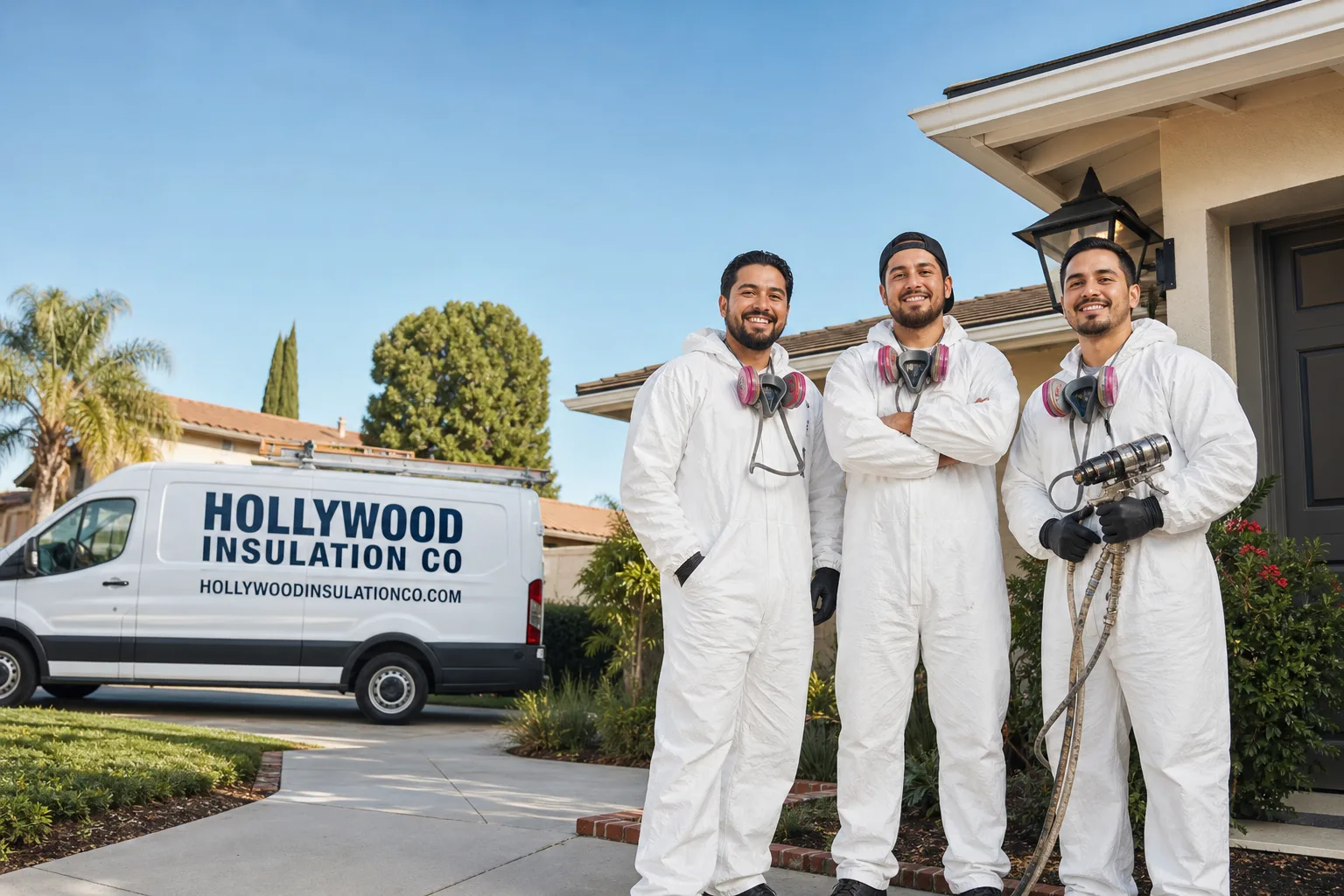
Fast, Reliable Spray Foam Insulation Across Portola Hills
Spray foam insulation in Portola Hills typically costs $2.85 – $6.40 per board foot installed, with most full attic projects in the 92610 zip code landing between $4,800 and $11,500 depending on cavity depth and roof-deck access. That’s the honest range for this foothill market, where clay tile roofs and vaulted ceilings make every job different. We run crews into Portola Hills weekly from our Hollywood base, and we know the tract layouts, the tile-roof access problems, and the Santa Ana heat patterns that drive most insulation failures here. Call (866) 605-6949 for a free estimate, and we’ll give you a straight number, not a sales pitch.
Key Takeaways
- Portola Hills attics under clay tile routinely hit 140°F-plus during Santa Ana events, which is why closed-cell spray foam against the roof deck outperforms blown-in fills here.
- Original R-11 and R-19 batts in 1980s – 2000s vaulted ceilings sag and fail. Spray foam is the fix for the bays, not the lid.
- We install both open-cell and closed-cell systems, including Icynene and Demilec, matched to your home’s actual cavity geometry.
- Free estimates, same-week scheduling for most Portola Hills projects, and pricing that reflects local conditions, not generic Southern California averages.
Why Hollywood Insulation Co Is Portola Hills’s Preferred Spray Foam Insulation Company
We’re a dedicated insulation specialist, not a general contractor who happens to carry a foam rig. Every technician on our crew works in this one trade every day, which means we diagnose thermal bypasses, air leakage, and R-value deficiencies the way a specialist should. When a Portola Hills homeowner calls about an upstairs bedroom that bakes by 2 p.m., we know to look at the knee-wall cavities and sloped ceiling bays before we even pull up to the house. That’s not guesswork. That’s repetition across hundreds of foothill homes with the same construction DNA.
Our method-agnostic approach matters here because Portola Hills homes don’t all need the same thing. Some need closed-cell foam against a tile-roof deck. Some need open-cell in wall cavities. Some need blown-in cellulose in a conventional attic with proper baffles. We carry eight manufacturer brands across every major insulation category, including Icynene and Demilec spray foam systems, Owens Corning and Johns Manville fiberglass, Rockwool mineral wool, and GreenFiber recycled cellulose. That breadth means the recommendation is based on your home’s actual needs, not on whatever product happens to be on our truck that week.
Spray Foam Insulation is one of three installation methods we perform, alongside attic insulation and blown-in. Having all three under one roof lets us be honest about when spray foam is the right call and when it isn’t. That honesty is why Portola Hills homeowners keep referring us to their neighbors off Glenn Ranch Road and along Saddleback Ranch Road.
Spray Foam Attic Insulation in Portola Hills
Spray Foam Attic Insulation in Portola Hills addresses a specific failure that regular blown-in insulation can’t fully solve: clay tile roof decks that absorb and radiate heat downward into living space. When Santa Ana winds push late-summer temperatures up and the tile has been baking all day, attic air temperatures in this area routinely exceed 140°F. Closed-cell foam sprayed directly against the underside of the roof deck creates an air seal and a thermal barrier in one pass, which keeps that heat from ever entering the attic cavity in the first place. That’s the difference between a hot attic and a conditioned attic, and it shows up immediately in upstairs bedroom temperatures.
Closed-Cell Roof Deck Applications
In Portola Hills homes with vaulted or cathedral ceilings, the roof deck is often the only viable insulation plane. Blowing cellulose into the lid doesn’t work when there’s no accessible attic floor, and batt insulation in sloped bays sags over time. Closed-cell foam, typically Icynene or Demilec, adheres to the deck, adds structural rigidity, and delivers R-6.5 to R-7 per inch. On a 2×8 rafter bay, that’s a real R-40-plus assembly.
Air Sealing Before Spray
We never spray foam in a Portola Hills attic without addressing the chase leaks first. The dry Santa Ana heat and steep diurnal swings here widen seams at baffles and top plates, so any gap left unsealed becomes a chimney for hot attic air in summer and cold foothill air in winter. Our crews foam the top plates, seal around electrical penetrations, and verify baffles are intact before the main spray pass. Skipping this step is the most common reason foam underperforms in this climate.
Spray Foam Wall Insulation in Portola Hills
Spray Foam Wall Insulation in Portola Hills often means working inside open stud bays during a remodel, because the stucco-over-wood-frame construction of these 1980s – 2000s Mediterranean and Spanish-style homes makes exterior injection impractical. What we find behind that stucco is usually original fiberglass batts that have compressed, sagged, or never fit the cavity well in the first place. Open-cell Icynene foam fills the entire cavity, air-seals it, and delivers about R-3.7 per inch, which is plenty for a wall assembly when combined with the home’s mass and the dry inland climate.
Knee Walls and Sloped Ceilings
Two-story Portola Hills tract homes have a specific problem: knee-wall and sloped-ceiling cavities that were framed fast and insulated minimally. These spaces are hard to reach, hard to air-seal, and often left uninsulated entirely. On a tile-roofed two-story off the Santiago Canyon corridor, our crew found original R-11 batts in a cathedral-ceiling cavity collapsed and a knee wall open to the vault, letting 140°F-plus Santa Ana attic heat pour into an upstairs bedroom. We sprayed closed-cell foam against the roof deck in the sloped bays and sealed the knee-wall top plates and baffles with Icynene, then foamed the wall cavities rather than blowing into a lid the dense clay tile made hard to access. The room stopped baking by mid-afternoon. That’s the kind of fix spray foam does that no other method can.
Garage Ceiling and Rim Joist Details
Garage ceiling spray foam and rim joist spray foam both matter in Portola Hills because garages here are unconditioned, south-facing, and built under the same tile roofs. Foaming the rim joist stops cold foothill winter air from entering the floor system, and foaming a garage ceiling keeps the room above it from becoming a pizza oven in August. These are smaller jobs, typically $1,200 to $3,400, but they’re the highest-comfort-per-dollar work we do in this zip code.
Trusted Brands We Service in Portola Hills
We install and service spray foam systems from Icynene and Demilec, the two most specified spray polyurethane foam brands in North America. For Portola Hills homeowners who want an eco-forward option, we also carry GreenFiber recycled cellulose and Rockwool mineral wool, and we stock Owens Corning batt products for hybrid assemblies where foam and fiberglass work together. Having eight manufacturer brands across four material categories means we’re not married to one product, and neither are you. When a Portola Hills project calls for a specific system, whether it’s closed-cell against a tile deck or open-cell in a wall cavity, we have it on hand, not on backorder.
Common Spray Foam Insulation Problems We See in Portola Hills Homes
- Sagging R-11 and R-19 batts in vaulted bays. The original batt insulation in sloped and cathedral ceiling cavities compresses over 20-plus years of direct sun on clay tile roofs, and once it sags, R-value collapses. During a Santa Ana event, those bays become radiant panels aimed at your upstairs rooms.
- Open knee walls and sloped-ceiling cavities. Two-story tract homes in the 92610 zip code frequently have minimal or missing insulation in knee-wall framing, and the top plates are rarely air-sealed. Hot attic air moves into living space in summer; cold foothill air moves in during winter mornings.
- Skipped air sealing before foam installation. In this dry, high-swing climate, seams at baffles and top plates expand and contract aggressively. If air sealing is skipped before spraying, the foam can’t do its job because conditioned air leaks around it through chases and framing gaps.
- Radiant-heat underestimation. Homeowners and even some contractors treat Portola Hills like the beach cities and assume a standard attic fill is fine. But the beach cities 20 miles west don’t see 140°F attic temperatures under dense tile. Here, radiant barriers and upgraded roof-deck insulation are not luxuries. They’re the point.
Pricing for Spray Foam Insulation in Portola Hills, CA
A typical open-cell spray foam attic in Portola Hills runs $4,200 – $7,800, while a closed-cell roof-deck application on a vaulted or cathedral ceiling runs $7,500 – $12,500 depending on square footage and access difficulty. Wall cavity spray foam during a remodel is usually $2,850 – $5,400 for a single-story home. Rim joist work runs $1,200 – $2,200. Garage ceilings run $1,400 – $3,400. What moves the price is mostly access: dense clay tile roofs that require working through the interior, second-story scaffolding, and cathedral bays with no attic access all add labor. We give free estimates in Portola Hills, and the number we quote is the number on the invoice. Call (866) 605-6949 to schedule a walkthrough.
We Also Serve Cities Near Portola Hills
Our crews work throughout the Santiago Canyon foothills and the surrounding South Orange County area. In addition to Portola Hills, we regularly insulate homes in Foothill Ranch, Lake Forest, Mission Viejo, and Trabuco Canyon. Each of these communities has its own microclimate quirks, but the foam-first, air-seal-always approach holds up in all of them.
Serving Portola Hills, CA — Our Local Coverage Area
We’re based in the Portola Hills area and know this community well. Use the map below to see our service coverage — if you’re nearby, we can almost certainly help.
FAQs About Spray Foam Insulation in Portola Hills
Clay tile absorbs and holds heat, and in Portola Hills that means attic temperatures routinely pass 140°F during Santa Ana events. You can’t simply blow insulation into the lid the way you would in a beach city, because the tile roof makes attic access tighter and the radiant heat load is far higher. We spray foam directly against the underside of the roof deck to stop the heat before it enters the attic. Call (866) 605-6949 and we’ll tell you whether your roofline is a candidate for a conditioned-attic conversion.
Yes. The diurnal swing here is steep, and winter mornings in the foothill thermal belt routinely drop into the 40s. Open-cell foam in wall cavities and closed-cell foam on roof decks both slow heat loss dramatically, especially in two-story homes where unsealed knee walls and sloped ceilings leak warmth all night. The air-sealing component of spray foam matters as much for winter comfort as the R-value does. Most Portola Hills homeowners notice the difference within the first week after installation.
Almost always yes, if the original batts are R-11 or R-19 and they’ve been up there since the Reagan administration. Those batts sag, compress, and leave thermal channels that let 140°F attic heat pour through. The investment range in Portola Hills is $4,800 to $11,500 for a full attic, and the payback comes in lower cooling bills, fewer hot spots, and a tighter building envelope that makes the whole HVAC system work less. For an exact number on your home, call (866) 605-6949 for a free estimate.
No. Closed-cell spray foam applied to the roof deck does what a radiant barrier tries to do, but better, because it blocks both radiant and conductive heat transfer. A radiant barrier stapled to the rafters only reflects radiant heat and does nothing for the conductive heat that tile radiates into the attic air. In Portola Hills, where the heat load is mostly radiant from the tile and conductive through the deck, foam on the deck is the more complete solution. If you already have a radiant barrier and still have hot rooms, the air sealing and deck insulation are the missing pieces.
Yes, we do this regularly. Knee-wall and sloped-ceiling cavities are the most common insulation failure we see in Portola Hills two-story homes, and they’re also the most labor-intensive to fix properly. We access them from the interior, remove the failed batts, air-seal the top plates and baffles, and spray foam directly into the bays. The work is slower than a standard attic blow, which is why the pricing reflects real labor, but the comfort difference in upstairs rooms is immediate. Call (866) 605-6949 and we’ll walk your home and show you exactly where the heat is getting in.
Get Your Portola Hills Spray Foam Insulation Estimate
If your Portola Hills home bakes in summer, freezes on winter mornings, or just costs too much to keep comfortable, call (866) 605-6949 today. We’ll schedule a free walkthrough, measure your actual cavities, and give you a written estimate that matches your home’s construction, not a generic square-footage formula. Noel Camacho leads our team, and he’ll make sure you’re getting the right system for your house, whether that’s Icynene open-cell, Demilec closed-cell, or a hybrid approach with GreenFiber cellulose.
Written by Noel Camacho, Owner at Hollywood Insulation Co, serving Portola Hills and the Santiago Canyon foothills.