
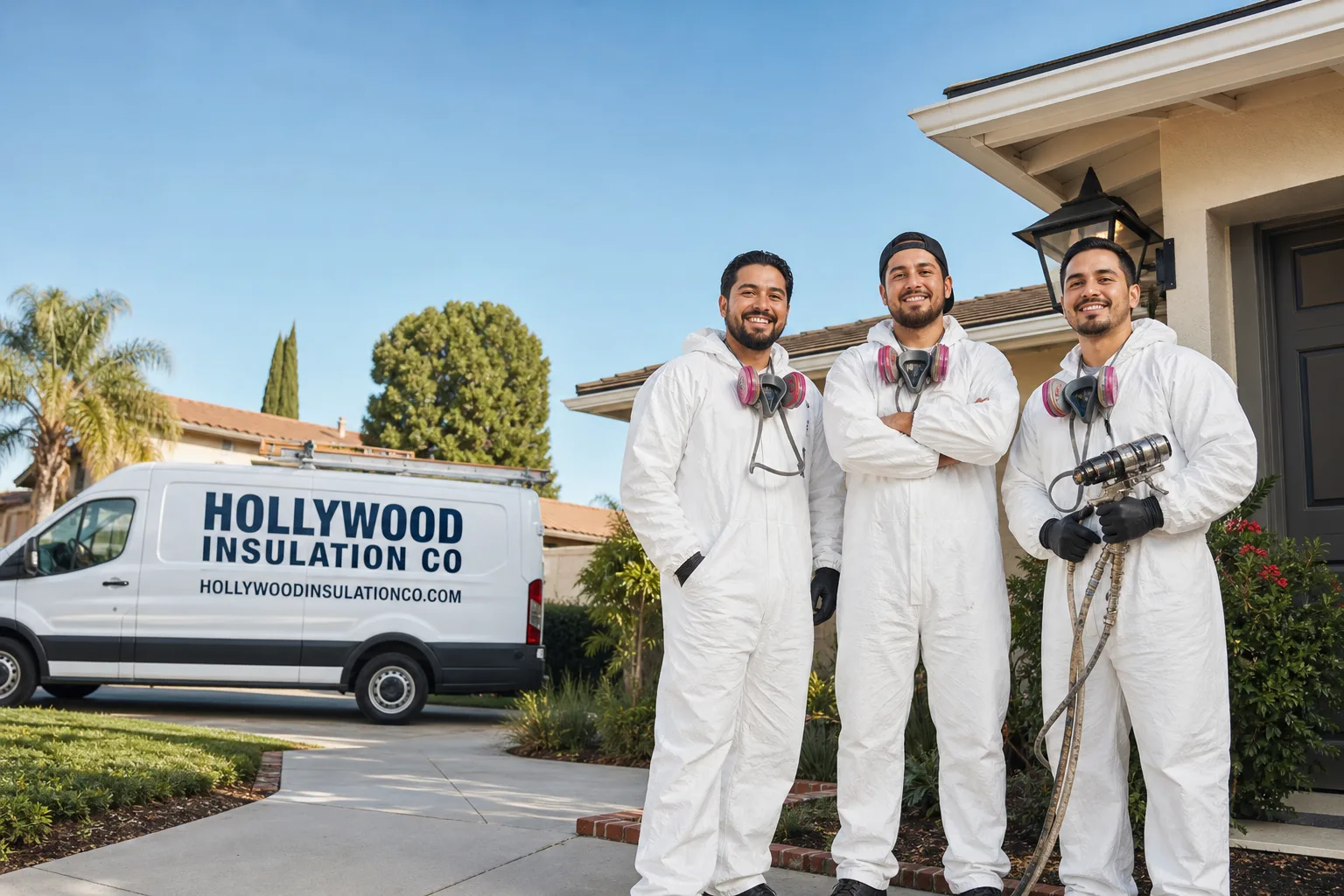
Fast, Reliable Spray Foam Insulation Across South San Jose Hills
Spray foam insulation in South San Jose Hills is how you stop the summer heat from cooking your attic and pushing into every room that faces the afternoon sun. We work throughout the 91792 ZIP, where most homes are post-war tract construction with original insulation that gave up years ago. Our crews know the hillside lots, the tight attics, and the heat loads these homes deal with from May through October. If you’re tired of rooms that never match the thermostat, call (866) 605-6949 and we’ll give you an honest read on what your home actually needs.
Why Hollywood Insulation Co Is South San Jose Hills’s Preferred Spray Foam Insulation Company
The homes here are different from what you find in Walnut or West Covina. South San Jose Hills is unincorporated, mostly 1950s to 1970s single-story tract construction, and a lot of that original fiberglass batt insulation is compressed, sagging, or gone entirely. We see it on nearly every hillside job we walk. That’s why we bring a corrective mindset to every project in the 91792 ZIP, not a sales pitch.
Our technicians work in this trade full time. We’re installing spray foam, blown-in, or batt insulation every single day across South San Jose Hills and the surrounding San Gabriel Valley. That repetition matters when you’re working in attics with irregular rooflines and tight clearance where a sloppy foam pass leaves unsealed corners at slope transitions. We flash those transitions carefully because that’s where the heat gets back in.
Noel Camacho leads our team with a simple approach: diagnose the thermal bypass first, then recommend the material that fits your home’s actual construction. Not whatever’s already on the truck. Call (866) 605-6949 and you’ll get that same straight read.
Closed Cell Spray Foam Insulation in South San Jose Hills
Closed Cell Spray Foam Insulation is the workhorse for the hillside attics we see throughout South San Jose Hills, because it brings structural rigidity and a vapor barrier along with its R-value. In the 91792 ZIP, where summer attic temperatures regularly push past 140°F and the rooflines slope and pinch in ways that standard batts can’t follow, closed cell foam seals the tight corners and sloped transitions that other materials simply can’t reach. A typical closed cell roof deck or wall retrofit in this area runs $2.10 to $3.40 per board foot installed, and for most South San Jose Hills attics that lands between $3,800 and $7,900 depending on square footage and how much prep the original framing demands.
When a Tract Home Needs It
Most of our closed cell work in South San Jose Hills happens when homeowners discover the original 1960s batt insulation has collapsed against the attic floor and done nothing for years. Closed cell foam applied to the roof deck turns the attic into a conditioned space and stops radiant heat before it ever presses down into the living areas.
Roof Deck Applications
On hillside homes with complex roof geometry, spraying the underside of the roof deck is often the cleanest solution. The Demilec closed cell system we carry holds tight against sloped plywood and irregular framing, filling the low-clearance corners where fiberglass never sat correctly in the first place.
Open Cell Spray Foam in South San Jose Hills
Open Cell Spray Foam works differently and costs less, which makes it the right call for certain South San Jose Hills attics where the roof deck is accessible and the home needs air sealing more than structural reinforcement. In the 91792 ZIP, open cell from Icynene typically runs $0.95 to $1.70 per board foot installed, so a full attic retrofit on a standard 1,200 to 1,600 square foot tract home usually falls between $2,600 and $5,100. It’s not the right choice for every hillside roof deck, but when it fits, it seals air movement far better than any batt ever will.
Attic Floors and Knee Walls
We use open cell on attic floors, knee walls, and band joists where the goal is stopping air leakage without the added moisture barrier of closed cell. In South San Jose Hills’s dry inland climate, that breathability is rarely a liability and often an advantage.
Interior Sound Control
Open cell also does real work for sound attenuation. For homeowners near the 60 freeway corridor or on busy collector streets through the hills, an open cell application on interior walls or garage ceilings cuts road noise noticeably while also tightening the thermal envelope.
Trusted Brands We Service in South San Jose Hills
We’re not tied to a single manufacturer, and that matters when your South San Jose Hills attic has a specific failure mode that one foam chemistry solves better than another. We carry Icynene and Demilec spray foam systems, which gives us genuine flexibility between open cell and closed cell applications. We also work with Rockwool mineral wool and CertainTeed fiberglass when a job calls for a hybrid approach, like pairing foam at the roof deck with mineral wool at sound-critical walls. Because our team installs these brands daily across the San Gabriel Valley, we can move fast on South San Jose Hills jobs without waiting on specialty parts or a truck from another region.
Common Spray Foam Insulation Problems We See in South San Jose Hills Homes
- Collapsed original batt insulation. Most 1950s to 1970s tract homes in the 91792 ZIP still have their original fiberglass, sagging and compressed to a fraction of its original R-value. You can’t foam effectively over failed substrate, so we clear it first and check the framing before any spray work starts.
- Slope-transition gaps. Hillside attics with irregular rooflines almost always show thin foam and unsealed corners at the transitions where the roof changes pitch. That’s where heat sneaks back in during August, and it’s exactly where we slow down and flash carefully.
- Foam without ventilation. Spray foam in a San Gabriel Valley attic that hits 140°F needs paired ventilation at the roof deck. Foam alone can trap heat and moisture, which undercuts the exact reason the homeowner paid for it.
- Band joist air leaks. On the hillside homes built over crawl spaces, the rim joist is a major leakage point. A clean rim joist foam job stops stack-effect air movement that pulls hot outside air into the conditioned space.
Pricing for Spray Foam Insulation in South San Jose Hills, CA
Closed cell spray foam in South San Jose Hills runs $2.10 to $3.40 per board foot, and open cell runs $0.95 to $1.70 per board foot. A full closed cell roof deck retrofit on a standard tract home typically lands between $3,800 and $7,900. An open cell attic floor job on the same footprint usually falls between $2,600 and $5,100. What moves the number is square footage, roof complexity, how much failed insulation has to come out first, and whether ventilation upgrades are part of the scope. We quote per square foot on a free site walk and we don’t pad the number for hillside addresses. Call (866) 605-6949 and Noel will give you a straight range before anyone steps on site.
We Also Serve Cities Near South San Jose Hills
Our Spray Foam Insulation crews run the same routes every week through Spray Foam Insulation in South San Jose Hills and the communities just next door. We’re routinely in Valinda, Walnut, West Covina, and Rowland Heights, so scheduling a walkthrough near you doesn’t mean waiting on a far-flung crew. Same team, same brands, same day response across the whole corridor.
Serving South San Jose Hills, CA — Our Local Coverage Area
We’re based in the South San Jose Hills area and know this community well. Use the map below to see our service coverage — if you’re nearby, we can almost certainly help.
FAQs About Spray Foam Insulation in South San Jose Hills
In a hillside attic with irregular rooflines and low clearance, batts never sit correctly at the slope transitions, leaving air gaps that spray foam fills completely. For most 91792 tract homes, spray foam is the only material that seals the corners and sloped framing where the original insulation failed and heat has been sneaking in. Call (866) 605-6949 and we’ll tell you which foam fits your roof.
No, not over it. The original insulation has to come out first because the foam needs a clean substrate to adhere to, and leaving failed fiberglass under foam traps a mess you’ll pay for later. We clear it, inspect the framing, and then spray.
Closed cell normally wins at the roof deck, because it brings a moisture barrier and higher R-value per inch to the hottest part of your attic. Open cell makes sense on attic floors, knee walls, and interior sound walls, but for the roof deck itself in this climate, closed cell from Demilec is our standard recommendation. Call (866) 605-6949 for an honest recommendation specific to your roof.
Spray foam alone is not enough in an attic that hits 140°F, because without paired ventilation the foam can trap heat at the roof deck. On every South San Jose Hills roof deck job we evaluate venting as part of the scope because the inland San Gabriel Valley heat load demands both.
The dry inland climate means we’re solving heat gain, not moisture problems, which changes the calculation. In South San Jose Hills’s low humidity, open cell’s breathability is rarely a concern, and closed cell’s vapor barrier is still valuable because it blocks summer humidity spikes and locks in its R-value. The right answer depends on whether we’re sealing a roof deck or an attic floor.
For a free, no-strings walkthrough of your South San Jose Hills home, call (866) 605-6949 today. We’ll tell you what you actually need, what it costs, and why.
Written by Noel Camacho, Owner at Hollywood Insulation Co, serving South San Jose Hills.